1D Motion
Projectiles
Forces
Circular Motion and Gravitation
Work, Energy, and Power
Momentum and Impulse
100
What is the difference between a vector and a scalar?
Vectors have a direction; scalars do not.
100
A projectile is launched at an angle. At point a the horizontal velocity (Vx) is 5 m/s and the vertical velocity (Vy) is +20 m/s. Determine the vertical and horizontal velocity at point C.
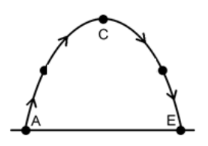
Vx=5 m/s
Vy = 0 m/s
100
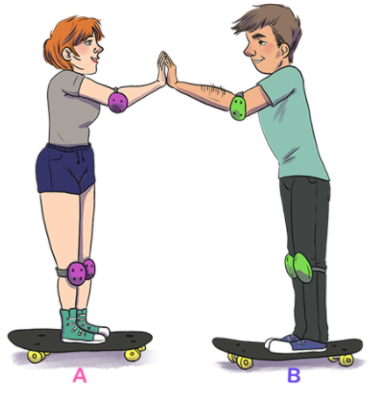
The two people on skateboards push off each other as shown. The man (B) has more mass than the woman (A). Who experiences more force? Who has a greater acceleration?
They experience equal forces. The woman experiences a greater acceleration.
100
Which type of relationship do gravitational force and distance have?
a) direct
b) Square
c) Inverse
d) Inverse Square
d) Inverse Square
100
A 9 N force is used to hold a box up while a person walks 3 m forward. How much work is done by that force on the box?
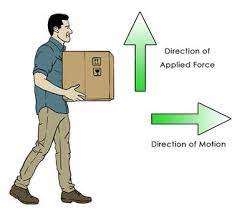
0 Joules. The force and displacement are perpendicular.
100
A 0.5 kg tennis ball moves at a velocity of 10 m/s. The ball is struck by a racket, causing it to rebound in the opposite (-) direction at a speed of 20 m/s. What is the change in the ball's momentum?
-15 kg*m/s
200
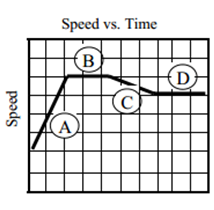
Which segment shows the fastest constant speed?
B
200
Select all of the variables you would need in order to calculate how long it would take a horizontally launched projectile to hit the ground.
Horizontal Velocity
Initial Height
Mass
Weight
Initial Height Only
200
A student is attempting to draw a free body diagram for a box being pushed across the floor at a constant speed. What is wrong with the diagram below?
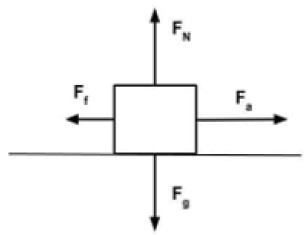
Ff must be equal to FA if the box is moving at a constant speed.
200
Two objects experience a gravitational force of 90 N. If the distance between them is tripled, how much force will they experience?
10 N
200
An engineering student is conducting an investigation on the motion of a model car and releases a car from the top of a U-shaped ramp. The car does not reach the same height when when it goes back up the other side of the ramp. This means the energy was (gained / lost) because of friction, which means this scenario is an (open / closed) system.
This means the energy was (lost) because of friction, which means this scenario is an (open) system.
200
What is an object's change in momentum equal to?
A) The impulse acting on it.
B) The force acting on it.
C) The force acting on the object multiplied by its velocity.
D) The change in velocity of an object.
A) The impulse acting on it
300
A freely falling object falls from rest. What will be the speed of the falling object after 6.0 s?
60 m/s
Vf=Vi+at
Vf=0+(-10)(6) = -60 m/s
Speed is a scalar, so 60 m/s.
300
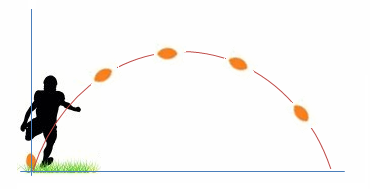
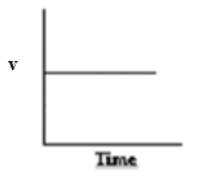
For any projectile such as a football kicked at an angle, draw a velocity-time graph to represent the object’s horizontal velocity while it is in motion.
300
Rank the following free-body diagrams from the largest net force to the smallest.
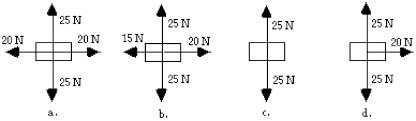
D>B>A=C
300
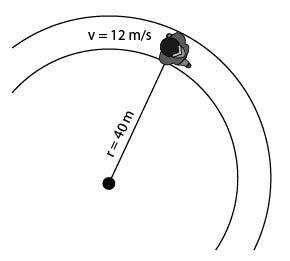
The diagram represents a speed skater traveling at a constant speed around a horizontal, circular curve. What direction would the skater travel if the rope snapped at the top of the circle?
Right
300
A 80-kg skater skates across a flat sheet of ice at a constant speed of 6.0 m/s. What is the kinetic energy of the skater?
1440 J
300
The diagram below shows a 4.0-kilogram cart moving to the right and a 6.0-kilogram cart moving to the left on a horizontal, frictionless surface.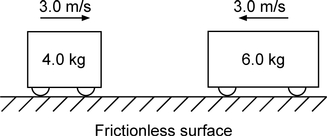
When the two carts collide they lock together. What is the magnitude of the total momentum of the two-cart system after the collision?
6.0 kg*m/s
400
A student is measuring and graphing the motion of a toy car. The car moves to the left with constant velocity along the number line as shown.
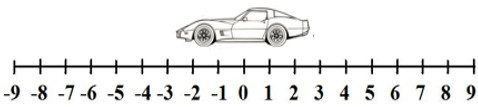
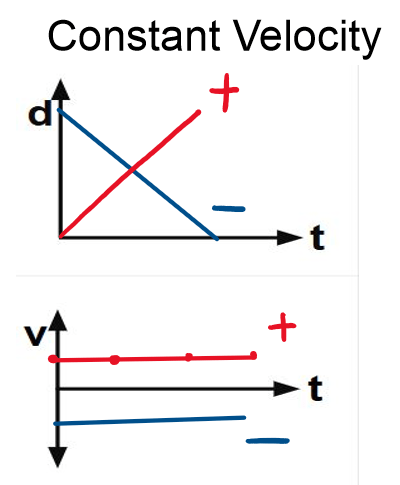
Draw a position-time graph and a velocity-time graph for the car.
400
A soccer ball was kicked toward the goal. The horizontal component of velocity was 22 m/s and the vertical component was 12 m/s. What is the magnitude of the resultant velocity of the soccer ball?
25.1 m/s
a^2+b^2=c^2
12^2+22^2=c^2
144+484=c^2
c=sqrt(542) = 25.1 m/s
400
Using the diagram below, how much friction exists if the 500 kg car's engine provides +15,000 N of force?
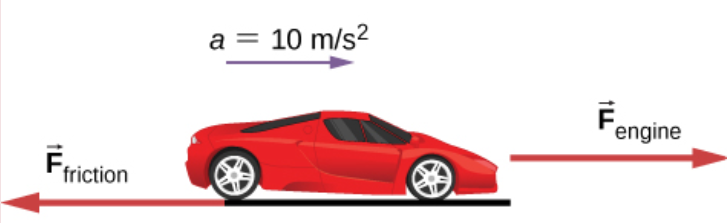
10000 N
400
The diagram represents a speed skater traveling at a constant speed of 12.0 meters per second around a horizontal, circular curve with a radius of 40 meters. The mass of the skater is 65 kilograms. Use this information and the diagram to answer the following questions. What is the magnitude of the centripetal force keeping the speed skater on the circular path?
234 N
Fc = m*v^2/r=65*12^2/40=234 N
400
What is the total mechanical energy of the 1 kg ball just as it rolls off the table top?
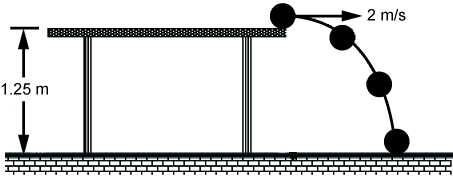
14.5 J
400
A net force of 10. newtons acts on an object of mass 6.0 kilograms for 8.0 seconds. What is the magnitude of the change in the object's momentum?
8 N*s