Cards
Pulm
Ophtho
ID
100
63 year old female with hx of CAD, HTN, HLD presents for SOB. She is diaphoretic and sitting upright, with nares flared. Her vital signs are T 37.2°C, HR 118 bpm, BP 190/122 mm Hg, RR 36/min, SpO2 88%, and BMI 36 kg/m2. Her chest X-ray from triage shows upper lobe pulmonary venous diversion, increased cardiac silhouette size, peribronchial cuffing, air bronchograms, and a moderate right-sided pleural effusion. You are concerned about scape, what medication is best as the next step in management of this patient?
Nitroglycerin
100
Which of the following previously healthy and fully immunized patients with an X-ray-confirmed case of community-acquired bacterial pneumonia can be treated at home with antibiotics?
A.) 1-month-old without hypoxia, dehydration, or difficulty breathing
B.) 2-year-old drinking well with oxygen saturation of 92% on room airCorrect Answer
C.) 3-year-old with a normal oxygen saturation and tachypnea to 60/min
D.) 4-year-old breathing normally with poor oral intake and urine output
B.) 2-year-old drinking well with oxygen saturation of 92% on room airCorrect Answer
100
A healthy 18-year-old man presents with 2 days of progressive right eyelid swelling and fever. He has had no trauma or diplopia. The exam is significant for a temperature of 100.8°F (38.2ºC), erythema, and swelling of the right upper eyelid and periorbital soft tissue without proptosis, chemosis, or limitation or pain on extraocular movement. What is the diagnosis?
Preseptal Cellulitis
100
A 45-year-old woman presents to the emergency department with a fever, productive cough, and diarrhea. Vital signs are a T of 102.8°F (39.3°C), HR of 120 bpm, BP of 130/85 mm Hg, and SpO2 of 94% on room air. Pulmonary auscultation reveals crackles in the lower lung fields. Her chest X-ray is shown above. Laboratory results are within normal range except for a sodium value of 127 mmol/L. Which of the following organisms is most likely to be responsible for these symptoms?
Legionella PNA
200
A 6-month-old infant presents with his parents for evaluation of respiratory distress. The parents describe episodes where the infant’s lips and fingers turn blue, coinciding with bouts of crying, and periods of rapid breathing. You suspect Tetralogy of Fallot. What are the key features of ToF?
VSD, Overriding aorta, Right Ventricular Hypertrophy, Right Outflow tract obstruction
200
A 59-year-old woman with a history of hypertension, end-stage kidney disease, and COPD as well as recent treatment for UTI presents to the emergency department with cough, subjective fever, and shortness of breath over 2 days. Chest radiograph shows a left lower lobe infiltrate concerning for pneumonia. Which diagnosis in this patient's PMHx warrants MRSA coverage?
ESRD
200
A 45-year-old woman presents to the emergency department with a severe headache. She was at the local cinema when her symptoms started, causing her to promptly report to the emergency department. The patient has a medical history of hypertension and anxiety. Her blood pressure is 157/108 mm Hg, heart rate is 100 bpm, and respiratory rate is 24/min. You note a diffusely red eye with proptosis on exam. The pupil is fixed and dilated and there is a loss of vision in the peripheral field of the affected eye. Which of the following is the best next step in management?
Latanoprost, timolol, apraclonidine
200
A 49-year-old previously healthy woman presents to the emergency department for confusion and tremor and is accompanied by her family. They returned from summer vacation to the beach in Florida 2 days ago, and yesterday she became confused and started acting strange, according to her family. She had reported a mild headache but no other symptoms. Today, her family noticed she seemed restless and more confused. Her family reports no sick contacts or anyone with similar symptoms. Her vital signs are HR 99 bpm, RR 18/min, BP 183/101 mm Hg, T 101.9°F (38.8°C), and SpO2 97%. Her physical exam is notable for a coarse tremor in her upper extremities. She also seems to stick her tongue out involuntarily and repeatedly. With brisk dorsiflexion of her ankle, there is a rhythmic, involuntary plantarflexion in response. A lumbar puncture is performed. What is the likely diagnosis?
West Nile Encephalitis
300
A 4-day-old infant presents with signs of sepsis. She appears ill, is lethargic, and has subcostal retractions. She has a poor femoral pulse and a capillary refill of 6 seconds, and her extremities are cool. An intraosseous line is placed, and she is intubated. Blood and urine cultures are obtained, she is given a 10 mL/kg saline bolus, and she is started on broad-spectrum antibiotics but does not have clinical improvement. Which of the following is the best next step for this patient?
Start Alprostadil Infusion
obtain CTH
Obtain US of abdomen
Start dextrose infusion
300
1-year-old boy is brought to the ED for fever, cough, and difficulty breathing. His parent reports that he had an upper respiratory tract infection 3 days ago. Vital signs include a T of 40.0°C (104.0°F), HR of 155 bpm, RR of 50/minute, SpO2 of 91% on room air, and BP of 90/52 mm Hg. Physical examination reveals suprasternal and subcostal retractions with expiratory wheezing and crackles bilaterally on auscultation. A chest X-ray shows hyperinflation of the lungs and peribronchial thickening. What is the most likely diagnosis?
Acute bronchiolitis
300
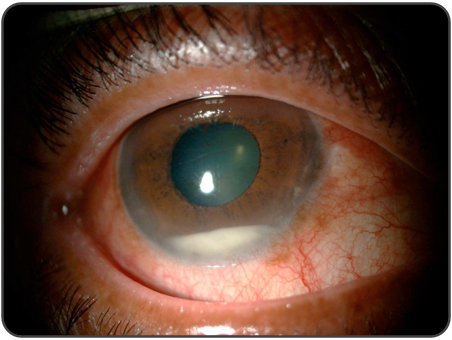
A 64-year-old man presents to the emergency department with eye pain, photophobia, and blurry vision. His medical history includes cataracts, which were removed 3 days ago. His physical examination is shown above. Which of the following is the most likely diagnosis?
Endophthalmitis
300
A 21-year-old man presents to the ED with right upper quadrant abdominal pain, fevers, chills, and nausea. He went camping in Mexico 1 month prior. On physical exam, his vital signs include a T of 38.1°C (100.6°F), HR of 67 bpm, BP of 120/60 mm Hg, RR of 14/min, and SpO2 of 99% on room air. The patient appears well overall, with minimal right upper quadrant abdominal tenderness. Abdominal ultrasound reveals a liver mass with well-circumscribed borders and a hypoechoic center.What is the most likely infectious agent?
Entamoeba histolytica
400
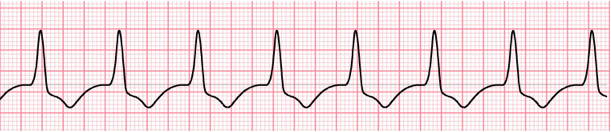
A 60-year-old woman presents to the ED with epigastric discomfort and shortness of breath. She is diagnosed with an inferior ST elevation myocardial infarction. There is no cardiac catheterization unit within 120 minutes, and she is treated with intravenous tissue plasminogen activator. At 30 minutes after administration of the thrombolytic, an ECG is performed and shows the above tracing. The patient has a palpable pulse, is mentating well, and has no chest pain. Which of the following ventricular dysrhythmias does this patient currently have?
Accelerated Idioventricular Rhythm
400
A 58-year-old man with a history of hypertension presents to the ED with a left shoulder dislocation. During procedural sedation for reduction, he vomits and is noted to aspirate gastric contents. He quickly develops respiratory distress, becomes hypoxic to 80%, and requires rapid sequence intubation. After intubation, pink frothy sputum is suctioned from the endotracheal tube. Chest radiograph shows bilateral lower lobe infiltrates. Vital signs are within normal limits, and he is resting comfortably under sedation. What is the most appropriate treatment for this patient while awaiting transfer to the intensive care unit?
IVF, suctioning, supportive care
400
Which of the following signs or symptoms is most consistent with a diagnosis of optic neuritis?
Decreased color perception
400
Which monoclonal antibody used for respiratory syncytial virus immunoprophylaxis is administered as a single dose?
Nirsevimab
500
A 69-year-old man with a left ventricular assist device secondary to severe heart failure presents with altered mental status, cool extremities, and a capillary refill of 4 seconds. His Glasgow Coma Scale score is 13. The patient does not have a pulse, and his jugular venous pressure is 2 cm H2O. You auscultate a continuous hum from the patient’s device. The device controller shows a low-flow alarm. What is the most likely cause of this patient’s presentation?
Hemorrhage
500
A 25-year-old woman presents to the ED with fever, fatigue, myalgias, headache, diarrhea, and dry cough. She works on a poultry farm. Vital signs are a T of 38.6°C (101.5°F), HR of 62 bpm, BP of 128/78 mm Hg, RR of 22/min, and SpO2of 94%. Lab results show leukocytosis and elevated aspartate aminotransferase. Chest X-ray shows bilateral lower lobe infiltrates. She has no recent travel. Farm labor puts the patient at an increased risk for which zoonotic infection?
Psittacosis
500
A 45-year-old woman with a history of hypertension and atrial fibrillation presents with sudden onset vision loss in her right eye that occurred 10 minutes prior to arrival in the emergency department. She reports no associated pain or trauma to the eye. Visual acuity is 20/20 at baseline. However, she can now only count fingers while utilizing the right eye only. CT Head without contrast is negative. Knowing there are not a lot of good treatment options for this disease, what management strategy is the most reasonable, according to the American Heart Association, in restoring this patient's eyesight?
Administer TnK
500
A 42-year-old woman with a history of hypertension, rheumatic heart disease, and mitral valve replacement 3 weeks ago presents to the emergency department with chest pain and fevers to 39°C over the last 24 hours. Her vital signs include an HR of 128 bpm, BP of 82/41 mm Hg, and T of 39.6°C. Examination reveals a midline sternotomy scar that is intact, with purulent drainage noted. Upon palpation, tenderness and crepitus are elicited. In addition to intravenous fluids and hemodynamic support as needed, what is the best treatment regimen for this patient?
Vancomycin and Ceftazidime