Cellular Respiration
Photosynthesis
Macromolecules and Functions
Transcription/Translation
Viruses
100
True or false: Glycolysis requires oxygen to be present in order to function
False
100
What are the two different pathways in Photosynthesis called?
Light-dependent reactions and light-independent reactions.
100
Proteins are made up of what molecule?
Amino acids
100
What is the central dogma of gene expression?
DNA ---> RNA ---> Protein
100
What is a Prion?
An infectious protein that was once normal but is now in a different shape.
200
During fermentation, what is the key molecule that is being reproduced for glycolysis to run?
NAD+
200
Correctly label which molecules have been oxidized and which have been reduced.
C6H12O6 + 6 O2 → 6 CO2 + 6H2O + Energy
Bold = oxidized
Italized = reduced
C6H12O6 + 6 O2 → 6 CO2 + 6H2O + Energy
200
Name three functions of carbohydrates
Energy source/storage
Structural
Cell communication
200
Explain RNA splicing is used as gene regulation in eukaryotes
During RNA splicing, the cell can decide to cut out certain exons from being incorporated into the final mRNA molecule. This allows for multiple different types of genes to come from the same strand of DNA.
200
Explain how prions are infectious
If ingested, they can turn other normal proteins into prions and form aggregates of these prions. This will eventually lead to cell death.
300
If 5 glucose molecules enter glycolysis, how many acetyl-coA’s would enter the citric acid cycle? What would be your total end products of the citric acid cycle?
10 Acetyl-Coa
End products of CAC:
30 NADH,10 FADH2,10 ATP, 20 CO2
300
Where is ATP and NADPH produced in photosynthesis? Where do the light-dependent reactions and light-independent reactions occur?
ATP/NADPH: stroma
light-dependent rxn: along the thylakoid membrane
light-independent rxn: stroma
300
Draw the basic structures of a purine and a pyrimidine
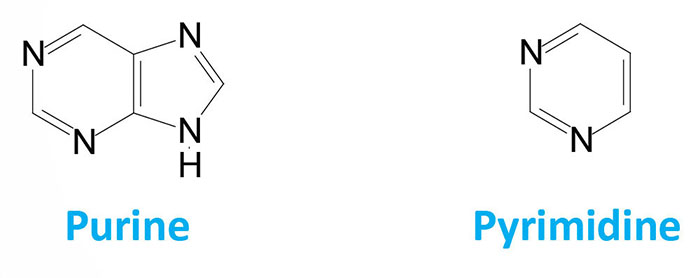
300
Explain how a ribosome is used in translation.
The ribosome has three sites: E, P, and A.
The ribosome will read each codon on the RNA strand and assist in binding the corresponding tRNA to the A site. This allows for the already growing change of amino acids in the P site to bind to the one in the A site. The tRNA without the amino acid will exit the ribosome via the E site.
300
How do eukaryotic viruses enter the host cell?
Typically, the virus will have a viral envelope with glycoproteins. Those glycoproteins will bind to specific receptors on the host cell, which allows for it to enter the cell.
400
Why is there an energy investment phase and an energy payoff phase in glycolysis?
You have to use 2 ATP at the beginning of the cycle to break down glucose. You then are able to make 4 ATP during the energy payoff phase.
400
Draw the Calvin cycle. Should include key products produced per one cycle, the key enzyme that is used at the start of the cycle, and the key 5 carbon molecule that is reproduced at the end of the cycle.
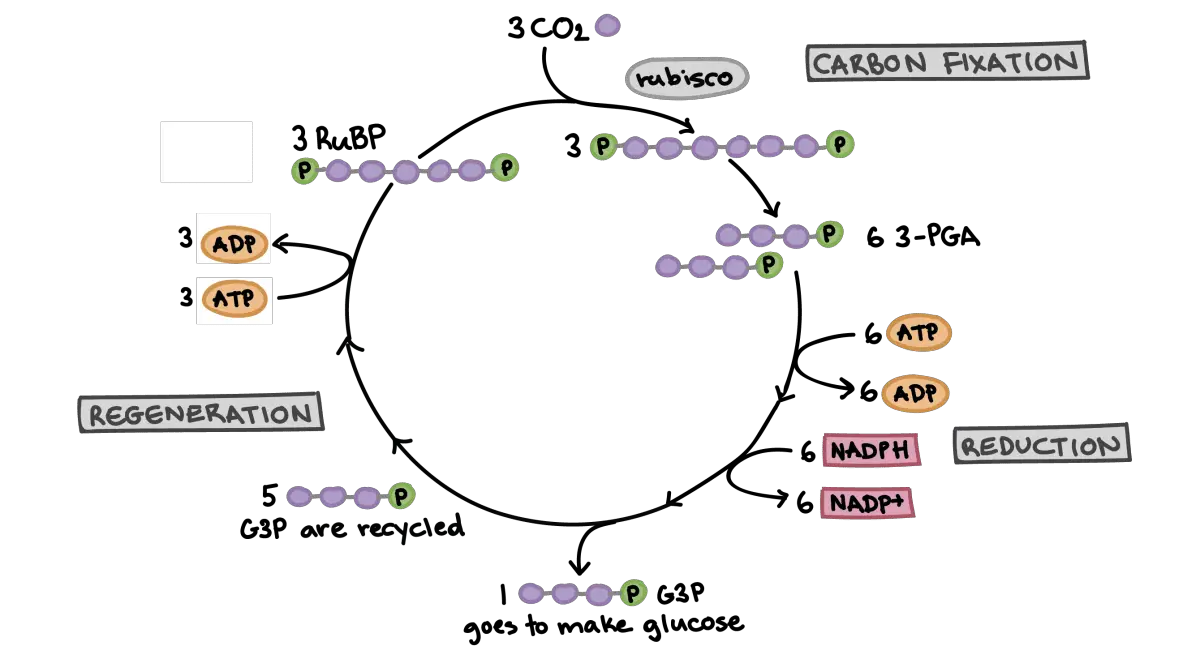
400
Name the three major types of transport. Describe the key characteristics of them.
Passive: no energy required, molecules will diffuse across the membrane. Concentration: high to low
Active: energy required. move molecules from low to high concentration gradient.
Vesicle: has endocytosis and exocytosis to more large molecules into or out of the cell.
400
Explain the process of transcription
RNA polymerase binds to the promoter, breaks H-bonds of the DNA to open it, and synthesizes RNA. RNA polymerase will continue to read the template strand of DNA until it reaches a terminator sequence, which will cause it to fall off and DNA to fully rewind.
400
Why does a virus using RNA instead of DNA make it more difficult to treat/cure?
Viruses that use RNA typically will use RNA-dependent RNA polymerase, which makes a lot of mistakes during replication. Those mistakes are not fixed, which allows for the virus to mutate quite often.
500
If 2 glucose molecules enter cellular respiration, what would be the total amount of NADH and FADH2 that will enter oxidative phosphorylation?
20 NADH
4 FADH2
500
Draw the basic diagram of photosystem II and I that shows how the light is used, e- flow, use of the electron transport chain. List the main products of this process and where they go to next.
See SI leader
Main products: NADPH and ATP to be used in the Calvin cycle.
500
Describe Osmosis. Your answer should include which molecule is being moved, explain what "responds to its own concentration" means, and define hypotonic, hypertonic, and isotonic.
movement of water across the membrane via diffusion. Molecules will only respond to their concentration gradient, which may result in two molecules moving in opposite directions.
Hypo: lower solute concentration
Hyper: higher solute concentration
Iso: equal solute concentration
500
Explain how the Lac operon works as a regulation of gene expression in prokaryotes.
It is an inducible operon. This means that initially, the repressor is active and bound to the operator, which doesn't allow for RNA polymerase to initiate transcription. When lactose is present, a molecule of lactose will bind to the repressor, causing a shape change which results in it unbinding from the operator. This allows for transcription of Lactase to occur until the lactose is all used up.
500
What is the difference between the Lytic cycle and the Lysogenic cycle of a prokaryotic virus?
Lytic cycle: the phage will inject its DNA into the host cell, which results in it using the host resources to create more phage DNA and assemble new phages. The cell will then lyse and release the phages.
Lysogenic: Phage DNA will integrate into the host's chromosome. The cell will reproduce normally, which results in it copying the phage's DNA into many more daughter cells. Those cells can continue to replicate, or go into the lytic cycle.