Week 6
Week 7
Week 8
Week 9/10
Application
100
Is Shah's fakeness good or bad? In the digital era, is fakeness good or bad?
Debate
100
What did Brecht invent?
Epic theatre
100
What is the metaphor of the dragonfly's eye? Also define and qualify it.
Machine Vision! technical systems that capture, process, and interpret data in an autonamted, distributed, and algorthmically governed process through which (today) we are always seen and being seen.
Bonus Points: How does machine vision affect the human subject?
100
Define Luhman's futures and openeness.
Present future: perspective from the present toward the horizon (depends on expectations and anticipation, not reality but always fiction). Future Present: the present as it will appear in the future, retrospective experience (What will future generations think), uncontrollable, but (as long as the future remains open!) a space of possibility.
Openess refers to opening up the present future through expanding the space of expectations, which in turn opens the future present by making alternative futures imaginable
100
1) What causes fakeness and realness according to Shah 2) why are users fake and 3) what are Shah's examples of the everyday media operations that facilitate fake/real in the digital realm?
"Fake” and “real” are outcomes of media operations, NOT morals, every new medium invents new ways of distinguishing truth from fiction.
Fakeness becomes a way of marginalized identities finding agency, a survival strategy that preforms authenticity.
“Fake” profiles, pseudonyms, or aesthetic exaggerations (AI filters)
200
What is the movie Her about? How can we apply gender, embodiment, labor, race, and technology to the understanding of cyborgs, as both liberating and binding?
Man who "falls in love" with an AI woman, who over time becomes less and less embodied until she choses to leave him. Representations of AI as women, encoded racialization, emotional labor, sexual labor, "possesion" of person-shaped labor, cultural memory of the "disembodied" labor to slavery,
200
What is the theme, or main question, of Galileo? How did this cause him to rewrite it twice?
1) How does power interfere with scientific truth? 2) How can the individual act ethically?
Nazis and science ("white physics"), the atom bomb, Stalinism200
What is subjundctivity? How is it related to embodiment? How can we "see" subjunctively? How can AI "see" subjunctively?
Subjunctivity is a way of perceiving the world in terms of what could be, possibility rather than "actuality." It humans, it arises from embodiment and our differing realities and experiences of the world. To “see” subjunctively is to perceive objects together with our hopes, fears, and understandings of eachother. AI can be subjunctive because it is trained on our biases and cultural productions of hopes and fears, buildling possibilities and predictions based on a subjunctivity reliant on bias without the grounding and empathy of human embodiment.
200
Define futurization, its problem, and its techniques
Definition: the process by which social systems orient action and decision-making toward the future. It creates a second, fictional reality that influences decisions. Problem: Futurization creates uncertainty for the individual because the future depends on actions and processes over which the individual has no control. Media Examples: Climate models, Insurance models, Risk assessments, Strategic planning in education and politics, Simulations, Fictional narratives (literature, film, TV, games)
200
How does the modern definition of science differ from the pre-modern and what cultural values does it reflect?
Since Galileo, the institution of modern science is positioned in the awkward space between sensory evidence and provisional, institutional truth(s). We no longer feel nature (Nietzche's primitive knowledge) or understand it embodied, we no longer narrativize mythologically. Instead nature must be deciphered, proven, and known fully from a universal standpoint. All becomes object to be studied, captured, and indexed. "With every new star he discovered, 'nature' turned more into a book."
Bonus question: How could this be a colonial tool?
300
What is the collective fake?
“Collective fake” refers to the way fakeness emerges from shared, networked circulation rather than from a single lie or deceiver. In Shah’s view, fakes spread because they move through social platforms, communities, and infrastructures that reward trust, resonance, and repetition; people amplify them not out of gullibility but because they fit existing beliefs or emotional climates. In a digital environment saturated with data, archives, and attention-driven circulation, “fake” becomes a structural feature of the information ecosystem itself, where multiple, shifting “truths” coexist and are retrieved differently depending on context, memory, and patterns of sharing.
300
How does the case study of the telescope work?
The telescope made visible that which was once invisible, proving that knowledge (we only know what we can see) depends on media operations (back to phenomenology again guys)
300
What is Kluge's concept of the virtual camera in our brains? How is this human gaze different from machine gaze, and similar to AI?
Human: Our camera reacts to the visible and invisible: (wishes, memories, ideas, possibilities). Machine: Meanwhile, the film camera and film montage are independent from the cameraman’s intentions. AI: AI works like a virtual camera & makes mistakes. We also work like a virtual camera & make mistakes. Both are form subjunctive images—images show possibilities, not realities.
300
Define defuturization, its problem, and its techniques.
Bonus Question: Is defuturization bad, and futurization good? How does fiction do both?
Definition: Defuturization shrinks the horizon of the present future.Systems reduce their temporal openness, suppress future possibilities, or restrict the horizon of potential futures. Systems defuturize when they close themselves to alternative futures; stabilize routines so strongly that the future is assumed. Problem: If taken too far, it makes the future feel “closed” or “already decided.” Media Examples: Cultural techniques of institutional routines (e.g., bureaucratic procedures, cultural techniques such as files, archives, etc.), Ideological narratives that claim inevitability (“there is no alternative”), Technological infrastructures that lock in a single path (think about Ed Tech, like Canvas or iClicker), Everything that decreases the contingency of a social system, that reduces its choices, etc.
300
What does Rettberg's case study about the selfie tell us about the algorithmic (and human!) gaze?
Human gaze is “anticipation of the other” — the desire to be seen and recognized by someone who sees us. Selfies perform this. Machine learning normalizes — the AI tells us what a face should look like. Based on the dataset the model was trained on, it will be biased toward the statistical normal distribution (race,
gender, abilities, stereotypes). Selfie filters and Face ID have familiarized us with biometrics and facial recognition = anesthetizing effect, makes us numb toward a powerful surveillance technology. Combined with emotion detection, facial recognition is
already used in classroom surveillance and during job
interviews.
400
What is the difference between memory and storage? How did exist pre-digital era? What does Shah say happen in the digital?
memory: embodied, temporal, ephemeral. storage: mechanical, spatial, indexical, permament. Digital life collapses the two, we lose the ability to forget
Bonus points: From pre-midterm, why is it important that we forget?
400
What are the literary characteristics of epic theatre? How does it reflect a modern experience?
: based on modern alienation (in oppostion to manipulative media today saturated and dependent on overblown indentification and catharsis, preying on our cultural loneliness), historical plot interupted by meta-narratives by a dialectical (discussion) voice between scenes, no heroes in "theater for the proletariat" because the audience is supposde to make the ethical decisions: "shows personal struggles amidst political and economic challenges: What is the ethical thing to do in a specific situation?"
400
DAILY DOUBLE
What was the Professor's critique on prior scholar's approaches to algorithmic gaze?
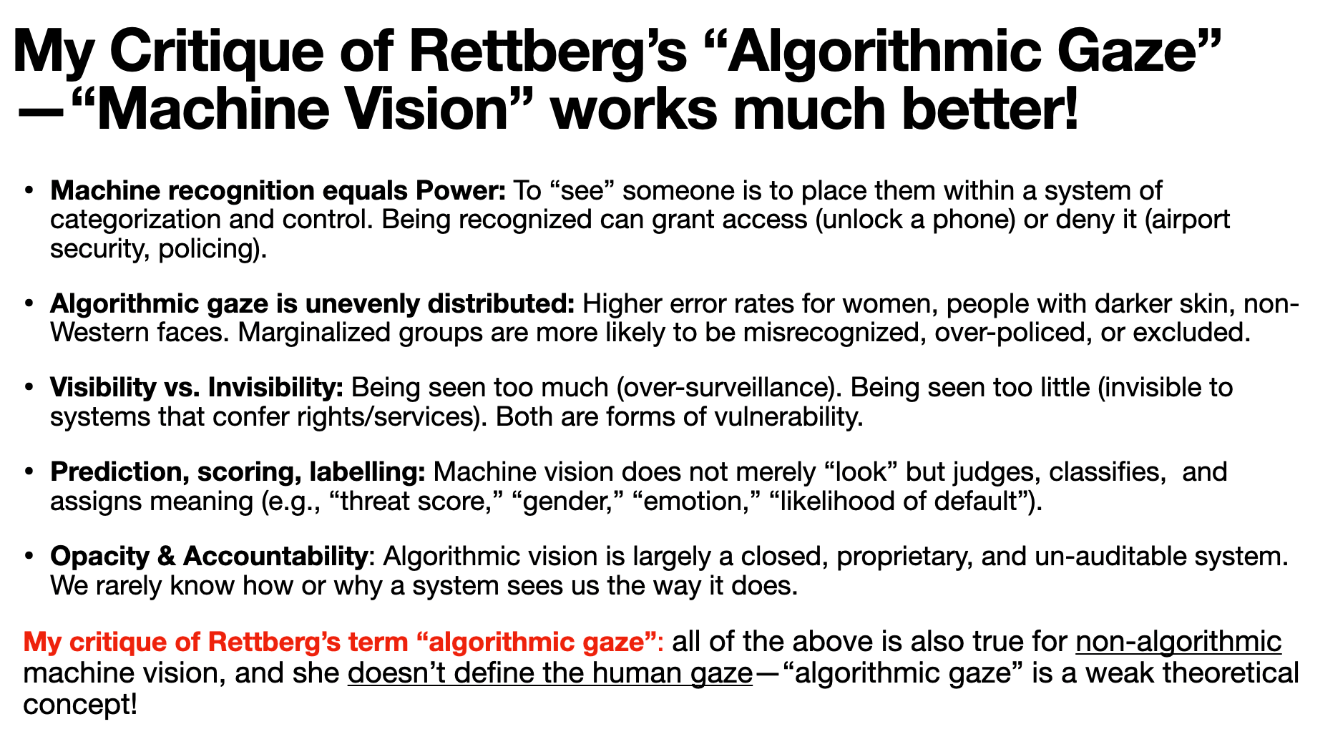
Bonus: Do you agree with the Professor? Why might you not?
400
What is social systems theory? How do we use it in media theory?
In individuals, families, and entire societies, behaviors are dependent on how they are coupled with their environment. There is no central reality, only differentiated ones in which the contexts of people's culture, technologies, and experiences shape how they act AND their imagination on how they could act
400
We've discussed cyborgs, prosthetics, and the entanglement of humans and technology before. What is the new threat posed to marginalized communities in increasingly digital worlds? From a media theory standpoint, what is the larger threat of digital performance?
The digital becomes threatening to the bodies that cannot bear the mark of digitalization. The human performs without having any knowledge of machine logic, logistics, impulses. AKA realness and fakeness is not preformed for each other, but for the technology; who neither feels empathy or hate but simply seeks programmed goals (goals which can endanger the user).
500
Shah performs two approaches, cultural technique (studying repeated behaviors that redefine cultural understandings of big, symbolic concepts) and a discourse approach (institutions and technology infrastructure). How does he fulfill both, or what are his two different approaches?
Cultural Technique: individuals use of real and fakeness, survival strategies, “fake” profiles, pseudonyms, or aesthetic exaggerations, collapse of memory/storage in the digital, uploading, tagging, archiving, filtering, syncing Discourse Network: Hello Kitty, “collective truth” on social media as depending more on corporations and media infrastructures than on individuals
Bonus: How does his understanding of collective truth work with Fleck? Do you agree with Shah?
500
DUELLING TEAMS
Team 1: Define and analyze Galileo's telescope as a cultural technique
Team 2: Define and analyze Galileo's telescope as part of a discourse network
Team 1: mediates and controls what is visible and invisible (it increases visibility, but proves itself fallible as it constantly dissproves itself (older hypotheses)), mediates and controls proof and truth (new understanding of truth as that which can be proven through science)
Team 2: Galileo and the Catholic Church (when tech threatened the heliocentric model, it ushered in a new era of technological authority: a new discouse network (old was Church + book, new is Scientists + instrument))
500
DAILY DOUBLE
Describe phenomenology and perception in relation to the human gaze
Phenomenology defines vision as an embodied, situated, and reversible relation in which seeing is always seeing from somewhere, yet never fully includes its own perception. Unlike science’s dream of objects without perspective—discrete things shown from all angles at once—phenomenology insists on an object-horizon structure: no single object can show itself without hiding others, because all objects form a system, a world in which each mirrors the rest. This horizon is spatial and temporal, and the gaze is reciprocal: the visible world returns my gaze, situates me, and reveals my limits. Perception is not data but an open-ended, forward-looking process shaped by memories, associations, desires, and movement. The human gaze is therefore not a classifier but a relational, unfinished engagement with a world given through horizons rather than discrete information.
500
Describe Forester's "Great Machine." How does it affect the character's understanding of the future? How does it create the future? How could we see it as allegorical to our modern life?
The “Great Machine” is an all-encompassing technological infrastructure that supplies every material need, mediates all communication, and regulates human life so completely that people no longer imagine a world beyond it. The Machine determines what the future is: it defines progress as ever-greater efficiency, comfort, and disembodied knowledge, so their understanding of the future becomes constrained by what the Machine can provide or permit. It also creates the future by shaping the very conditions of thought—producing a society that believes direct experience, physical travel, and unmediated encounter are unwanted. Allegorically, the Machine anticipates aspects of modern life: dependence on networked technologies, substitution of virtual interaction for embodied presence, algorithmic shaping of perception, and a cultural belief that technological systems are self-justifying and self-sustaining until they catastrophically fail.
500
What is at stake with today’s algorithmic machine vision?
Machine vision operates outside of the world, without a body. It is not relational: training sets are decontextualized, cameras have no horizon, the world is reduced to patterns, not phenomena in the sense of lived experience. Reduces people and bodies to data, we disembody vision from situated, real perception. Reduces images to objects of suspect, disempowered by AI's intervention of fakeness (not Shah's).
When we reduce vision to surface operations, we also lose the relation not only to our own bodies but also to those of others.Without a body, it is impossible to act like a subject—without a subject who acts, there is no responsibility, no ethics!