Properties of exponents
Polynomial Arithmetic
Polynomial Graphing
Rationals
Radicals
100
2^n*4^n
2^(3n)
100
5+2x-3x+x^2
Quartic polynomial, 4 terms
2x^4+x^2-3x+5
100
If f(x)= (x - 2)3(x + 4)2, what are the zeros and their multiplicities?
Zeros: x=2 (mult. 3), x=−4 (mult. 2).
100
(16x^2y^3)/(28xy^5)
(4x)/(7y^2)
100
Simplify:
root 3 (54y^3)
3y root 3 2
200
x^(-3)*x^7
x^4
200
(5a-2)+(3a+7)
8a+5
200
Describe the end behavior of
f(x)=-x^3 +4x^2 -x.
-/odd
As
x -> infty, f(x) ->-infty
x-> -infty, f(x)-> infty
200
Multiply:
(x^2+5x+6)/(x^2-9) * (6x-18)/(x^2-4)
6/(x-2)
200
Solve:
sqrt(x+5)=7
x+5=49
x=44
300
(6x^4)/(3a^(-2))
2a^6
300
(4x^3-x+6)-(2x^3+3x-4)
2x^3-4x+10
300
Find the leading term of
f(x)=-3(x-1)^2(x+4)
Leading term:
-3x^3
300
For
((x+3)(x-3))/((x-2)(x+1)) divide (x-4)/(x+5)^2
list all restrictions.
x ne -3, 3, 2, -1, 4, -5
300
(2sqrt9)(6sqrt3)
36sqrt3
400
(3y^2)^3
27y^6
400
(3x-2)(x+1)
3x^2+x-2
400
A graph bounces off the x-axis at x=−2 and crosses at x=3. Write one possible equation.
f(x)=(x+2)^2 (x−3).
400
Solve:
8/(x+4)=5/(x-2)
x=14
400
(2+sqrt5)/sqrt5
(2sqrt5+5)/5
500
Explain why zero and negative exponents work the way they do.
When dividing powers with the same base, we subtract exponents: But any nonzero number divided by itself equals 1
negative exponents mean the reciprocal
500
(x+5)(2x^2-3x+4)
2x^3+7x^2-11x+20
500
Write a polynomial in factored form with zeros at −1,2,4.
f(x)=(x+1)(x−2)(x−4).
500
Describe the transformation of
y=1/(x+5)-4
Left 5, Down 4
500
Sketch the graph
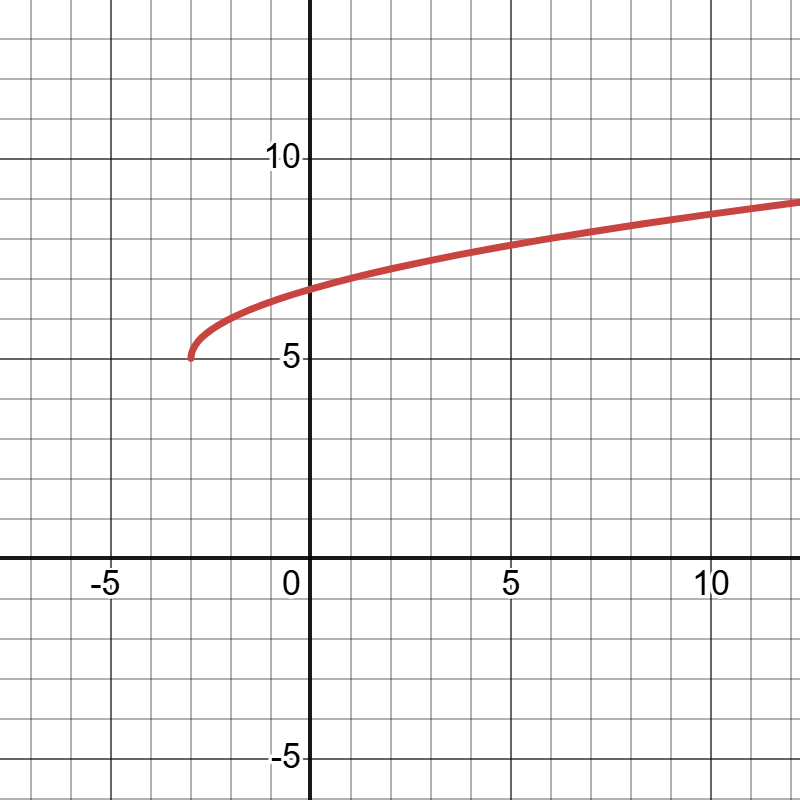
y=sqrt(x+3) +5