Mass vs Weight
Types of Forces
Types of Forces (continued)
Gravity
Unbalanced Forces
Distance Time Graphs
100
What is the primary difference between mass and weight?
Mass is the amount of matter in an object, while weight is the gravitational force acting on that object.
100
Give 1 example of a Contact Force, and give 1 example of a Non-Contact Force.
(several options)
Contact: friction, applied, air drag, normal...
Non-Contact: gravitational, magnetic, electrical...
100
What type of force is involved when you push a door to open it?
Applied force
100
Which of the following statements best describes the Law of Gravity?
- A)Gravity only affects objects on Earth.
- B)Every object exerts a gravitational force on every other object.
- C)Gravity is stronger on smaller objects.
- D)Gravity only acts between objects that are touching.
B) Every object exerts a gravitational force on every other object.
100
An object is moving in a straight line at a constant speed. If an unbalanced force is applied in the opposite direction of its motion, what will happen to the object?
It will slow down.
100
What is the formula for Speed?
Speed = Distance/Time
150
What happens to the weight of an object if it is moved from the Earth's surface to a higher altitude?
The weight decreases.
150
Which force is responsible for keeping the planets in orbit around the sun?
Gravitational force
150
List two examples of Applied force.
(various correct answers)
Ex: pushing a chair, pulling a wagon, punching a wall
150
What two factors affect the gravitational force between two objects?
Mass and Distance
150
Which of the following scenarios best illustrates an unbalanced force acting on an object?
- A)A book resting on a table.
- B)A car accelerating on a highway.
- C)A satellite orbiting Earth at a constant speed.
- D)A pendulum at the highest point of its swing.
B) A car accelerating on a highway.
150
Give an example of a correct unit for speed.
Examples: km/h, MPH, m/s (Several Correct Answers)
200
If an object has a mass of 30 kg on Earth, what would be its mass on the Moon?
30kg
200
Describe how gravitational force acts between two objects.
It acts at a distance and pulls objects toward each other.
200
Why does a compass needle point north?
It is attracted by magnetic force.
200
A scientist is studying two planets. Planet X has twice the mass of Planet Y, but they are the same distance from the Sun. Which planet exerts a greater gravitational force on the Sun?
Planet X exerts a greater gravitational force.
200
A force of 10 N is applied to a stationary object, and it starts moving. What can be inferred about the forces acting on the object before it started moving?
The forces were Balanced
200
If a car travels 150 kilometers in 3 hours, what is its average speed? (Explain/Show your work)
150km/3hrs = 50km/h
250
What happens to the weight of an object when it is moved from the Earth to empty space?
It's weight becomes 0.
250
How does the distance between two magnets affect the magnetic force between them?
The force decreases as the distance increases.
250
Explain why a charged balloon sticks to a wall.
The balloon is attracted to the wall by electrical force.
250
If the mass of the Earth were to suddenly double, what would happen to the gravitational force it exerts on the Moon?
Increase, x2 stronger.
250
A toy car is pushed with a force of 5 N to the right and experiences a frictional force of 3 N to the left. What is the net force acting on the car, and in which direction will it move?
2N to the right
250
A car travels at a constant speed of 60 km/h. How far will it travel in 2.5 hours? (Explain/Show your work)
60km/h x 2.5hrs = 150km
300
Explain why an astronaut weighs less on the Moon than on Earth, even though their mass remains the same.
The Moon has a weaker gravitational pull than Earth.
300
Plan an experiment to demonstrate the effect of magnetic force on a metal object.
(various correct answers)
Use of a magnet and a metal object. (metal object must have iron, cobalt, or nickel in it)
300
Explain how frictional force can be reduced between two surfaces.
Applying a lubricant between the surfaces.
Smoothing the surfaces.
300
A student observes that a feather and a rock fall at different rates on Earth. How would you explain this observation in terms of gravity?
Air resistance affects the feather more than the rock.
300
A ball is rolling on a flat surface and gradually comes to a stop. Explain the forces involved in this process.
Friction acts on the ball, opposing its motion and causing it to stop.
300
How would you determine the speed of an object using a distance versus time graph?
Determine the Slope using Rise/Run
350
Explain how your weight would change if the gravitational force on Earth were to suddenly double.
You would way twice as much.
350
Devise a method to test the strength of different magnets using paperclips.
Count how many paperclips each magnet can hold.
350
What is the net force of this object and what direction will it start moving?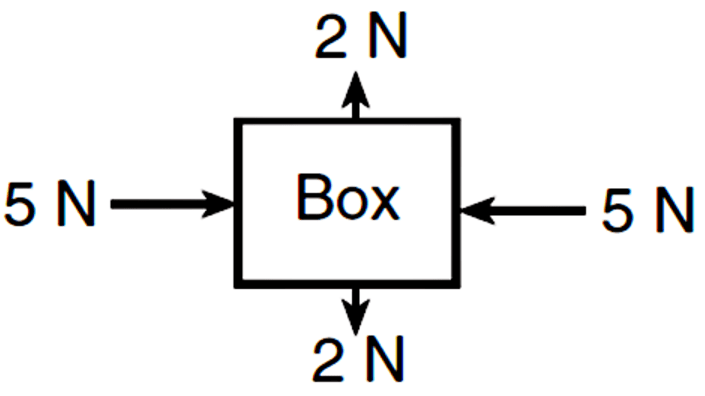
0N, no change in motion.
350
A student claims that the gravitational force between two objects is only dependent on their masses. Is this claim correct? Why or why not?
No, because distance between objects also affects gravitational force.
350
Explain how an unbalanced force can change the direction of an object's motion without changing its speed.
By applying a force perpendicular to the object's motion.
350
Explain what a steep slope on a distance versus time graph indicates about an object's speed.
The object is moving quickly.