Friction
Angled Forces
Systems
Newton's Laws
Symbols & Units
100
When the maximum static friction force = 1000 N, what happens when you push with a force of 1001 N?
The object begins to move
100
When a force is applied at some angle to the horizontal, you must calculate the _______________ of that force (Fx and Fy).
components
100
A system in physics is a collection of objects connected by _________.
strings
100
A resistance to a change in motion is called ____.
inertia
100
What is the only unitless quantity that we have worked with so far?
The coefficient of friction
200
When the maximum static friction force = 1000 N, what happens when you push with a force of 999 N?
The object doesn't move, and is resisted by 999 N of static friction.
200
In this drawing, which force or forces will contribute to a vertical net force?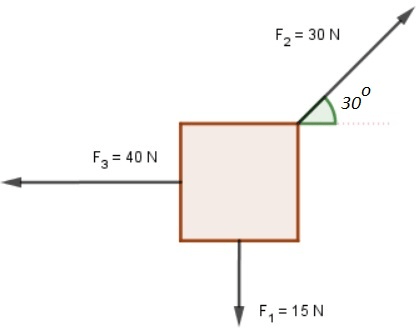
F1 and F2y
200
Which force makes a system move when one of the masses is hanging?
gravitational force
200
Which pulls with a stronger force on the other: a big massive star or a tiny little asteroid?
The same force is exerted by both
200
m/s2 are units of _____________.
acceleration
300
Friction depends on FN. In which situation can we rightfully say that FN and Fg are equal?
When there are no other vertical forces or vertical components such as FN. Alternatively, when there are no angles in the problem.
300
Which force or forces will contribute to the horizontal acceleration?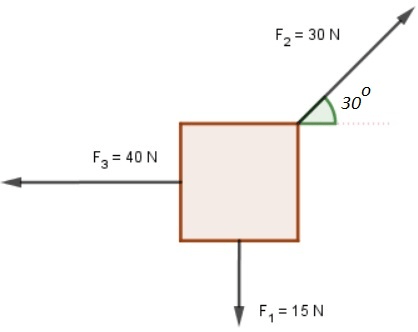
F3 and F2x
300
DAILY DOUBLE
To find the acceleration of three objects connected in a row together, you divide the force pulling on the system by __________________.
300
When a big massive star and a tiny little asteroid exert forces on each other, which is accelerated more?
The tiny little asteroid
300
DAILY DOUBLE
Name FOUR Greek letters that we have learned about this year
400
Friction depends on which two factors?
coefficient of friction (mu) and normal force (FN)
400
When a force is a applied upward and to the left on an object, what happens to the normal force FN?
it decreases
400
Assume mass M sits on a frictionless table, what is the net force acting on M?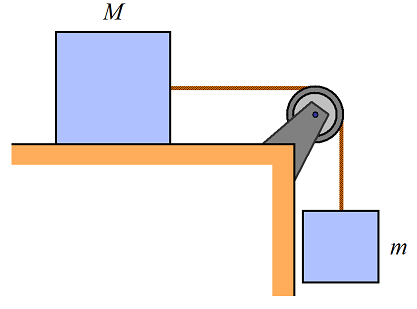
Just the tension force
400
If you push on two objects with the same mass, what would you have to do to cause one of the masses to accelerate more?
Provide a larger net force
400
Does Fy have units? If so, what are they?
newtons (N)
500
A student pushes a book across a table with a force F = 50 N at a constant speed. How does one figure out the friction force if they are not given the coefficient of friction?
It is equal to the applied force F
500
When a force is a applied downward and to the right on an object, what happens to the normal force FN?
It increases
500
What would need to happen for this system to accelerate to the left?
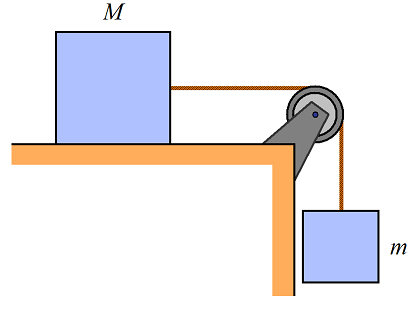
The force pulling to the left would need to be greater than the gravitational force pulling m downward.
500
What happens to the motion of an object when the net force is zero?
It remains at rest or at constant speed.
500
If I push on something and it doesn't move, besides FN, Fg, and F, which other symbol should I include on my free body diagram?
fs