History of Forensics
You are Making a Scene!
Stained Glass
Sticky Fingers
Hairy Kerry
100
This is an application of science to law and the study of evidence in order to solve crimes.
What is forensic science?
100
This is the location where a crime has been committed.
What is a crime scene?
100
This is any disintegrated surface material both natural and artificial that lies on or near the earth’s surface.
What is soil?
100
This is a reproduction of friction skin ridges found on the palm side of the fingers and thumbs.
What are fingerprints?
100
This is the study of the color and structure of hair.
What is morphology?
200
This is an application of science to criminal and civil laws that are enforced by police.
What is criminalistics?
200
This is the most important part of a crime scene and encompasses any and all objects used to link the crime and the victim or crime and the perpetrator.
What is physical evidence?
200
This is glass put through a process so as not to crack or shatter like untreated or normal glass?
What is tempered glass?
200
These are fingerprints which are invisible to the eye.
What are latent prints?
200
Hair is an appendage of the skin that grows out of a structure known as this.
What is a hair follicle?
300
n 1814, Mathieu Orfila published the first scientific producers for the detection of this and its effect on animals.
What is poison?
300
This is the responsibility of the first officer on the scene of a crime.
What is preserve and isolate the crime scene?
300
These are glass fractures lines which form on the surface opposite that of the penetrating force.
What are radial lines?
300
No two fingers have yet been found to possess these.
What are identical ridge characteristics?
300
Name the three parts of the hair that compose the shaft of the hair.
What are cuticle, cortex and medulla.
400
In 1892 this person was the first to study fingerprints.
Who is Francis Galton?
400
Name three methods utilized to record the crime scene.
What are photography, sketches and notes?
400
These are glass fractures lines which form not he same side as the penetrating force.
What are concentric cracks?
400
Name the three general patterns of all fingerprints.
What are loops, whorls, and arches?
400
Name the different types of medullae.
What are continuous, interrupted, fragmented?
500
This is the title of the book that contained the statistical proof supporting the uniqueness of and method to identifying finger prints.
What is Finger Prints?
500
Name four types of analysis that can be performed on physical evidence.
What are comparison, visual, microscopic, chemical?
500
These are white fracture lines which are observed microscopically on a cross section of glass.
What are stress marks?
500
Name the 4 kinds of Whorls.
What are plain, central pocket loop, double loop and accidental?
500
Identify these parts.
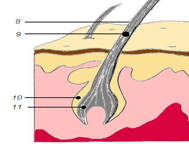
What are 8. cuticle, 9. cortex, 10. follicle and
11. root.