Linear Functions
Quadratic Functions
Rational Functions
Exponential Functions
Logarithmic Functions
100
The domain and range of all linear functions.
What is all real numbers?
100
The vertex is always on this line that cuts the parabola into identical havles.
The axis of symmetry.
100
All rational functions have this format.
What is a variable in the denominator of a fraction?
100
The _______ of exponential functions is always all real numbers.
What is the domain?
100
A log is an ________.
What is an exponent?
200
THE key feature of linear functions.
Constant rate of change
200
This formula is key to graphing a quadratic function in standard form.
Axis of symmetry:
200
The domain of rational functions depends upon these key features.
What is the vertical asymptotes?
200
The range of an exponential function depends a lot on this key feature of exponential functions.
What is the asymptote?
200
The domain of logs depends on this key feature....
What is the vertical asymptote?
300
This form is used when we have two rates and a total.
Standard form, ax+by=c
300
Factored form finds the _________ of a quadratic function.
The zeros, x intercepts, roots, solutions.
300
This method finds the horizontal asymptote.
What is dividing the coefficients on x? (IF x has the same power in both the numerator and the denominator!)
300
The standard form used for exponential functions.
What is y=ab^x ?
300
Logarithms are the ________ of exponential functions.
What is the inverse?
400
This form models the graph of a linear function perfectly.
Slope intercept form, y=mx+b
400
This form identifies the maximum or minimum as well as the range for us.
Vertex form:
y=a(x-h)^2+k
400
The range of rational functions depends upon this key feature.
What are the horizontal asymptotes?
400
The temperature of Ms. Griffin's tea as it cools in her classroom is an example that uses this key feature.
What is asymptote?
400
Given an exponential function whose domain is all real numbers and the range is y>5, the domain and range of its inverse (the log) is ____________.
What is a domain of x>5 and a range of all real numbers?
500
The exact equation of the line that passes through the points (-2, 5) and (1, 6).
y=1/3x+17/3
500
The graph of this quadratic function:
y=x^2+8x-20
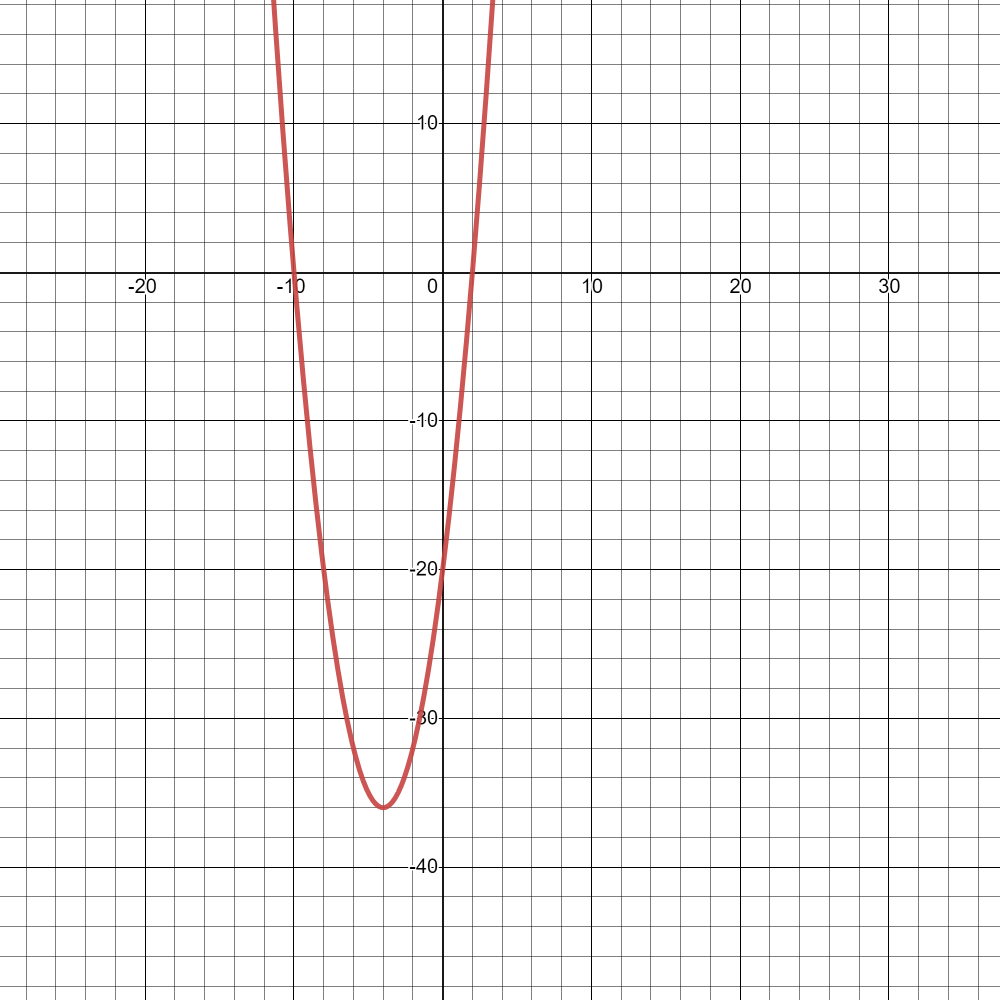
500
The asymptotes of this rational function:
y = (6x + 1) / (3x – 1)
What are y = 2 and x = 1/3
500
The range of THIS exponential function...
y=-2(1/2)^x-4
What is y<-4?
500
Find ONE point on this log function...
y=log_2(x-1)+3
What are....?
(2, 3), (3, 4), (5, 5), (1.5, 2), (1.25, 1),...