Are You Having Fun(ction)?
Am I a function?
What's my function?
Key Features of Graphs
Domain & Range
Sequences
100
This word is used to describe the set of all inputs for a function.
the domain
100
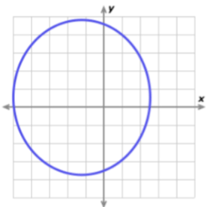
No, it does not pass the vertical line test.
100
f(-3) if f(x) = 2x +1
f(-3)= -5
100
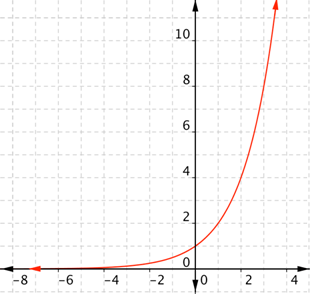
What is the equation for the asymptote of this exponential function?
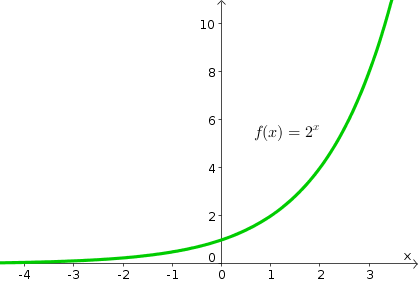
y=0
100
Find the DOMAIN:
{(-2, 4), (3, 2), (2, 10)}
{-2, 2, 3}
100
Find the next term in the arithmetic sequence.
-18, -10, -2, 6, . . .
14
200
This word is used to describe the set of all outputs of a function.
the range
200
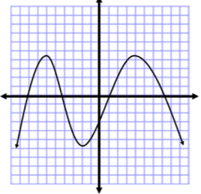
Yes, it passes the vertical line test.
200
g(x)=4(3^x)
Find g(-1).
g(-1)=4/3
200
The shaded region is increasing, decreasing, or constant.
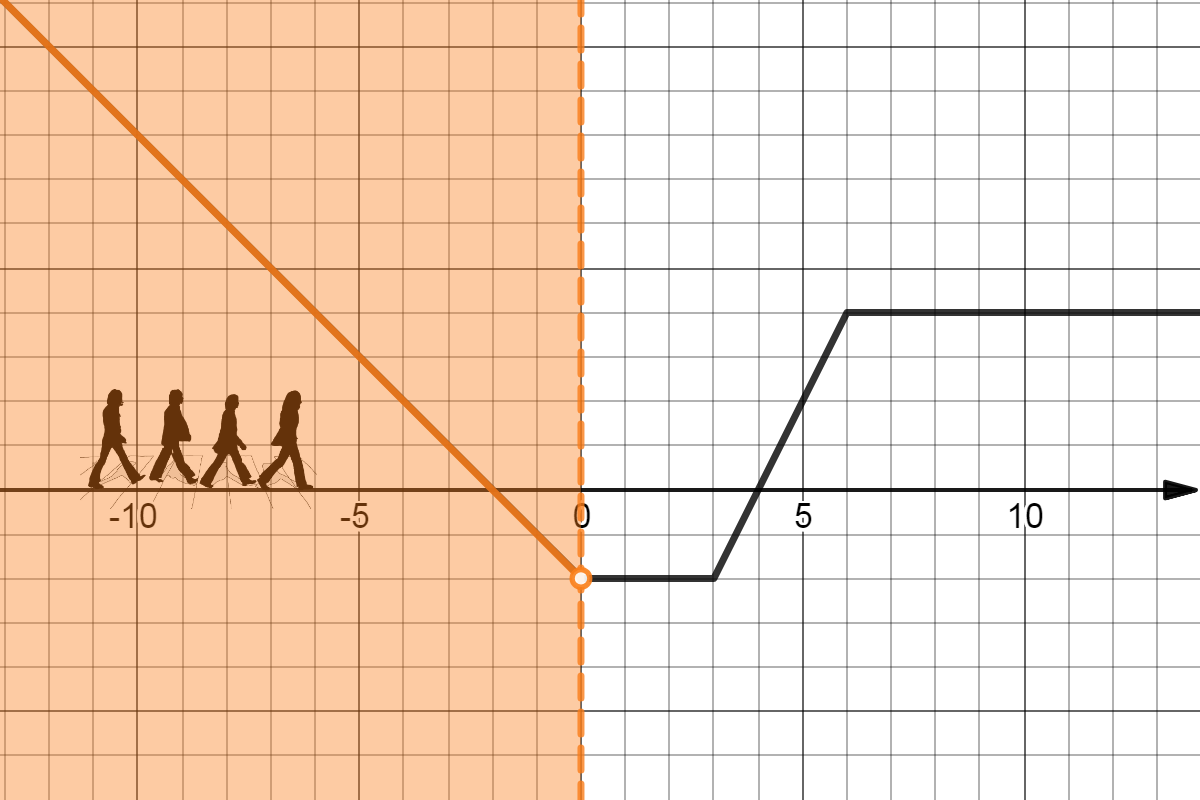
Decreasing Interval
200
Find RANGE:
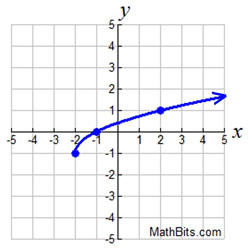
y\ge \-1 or [-1,∞)
200
What is the common difference based on the recursive formula?
a_1=31
a_n=a_(n-1)+9
9
300
What type of function is f(x)?
f(x)=x^2-4x+3
quadratic
300
The mapping diagram shows a function or not.
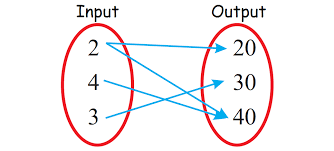
No, the input 2 has more than one output.
300
Based on the graph of the function, what is f(4)?
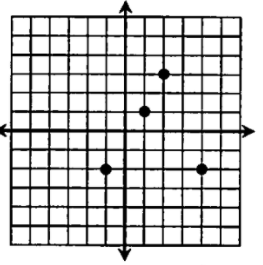
f(4) = -2
300
What is the first increasing interval for this graph?
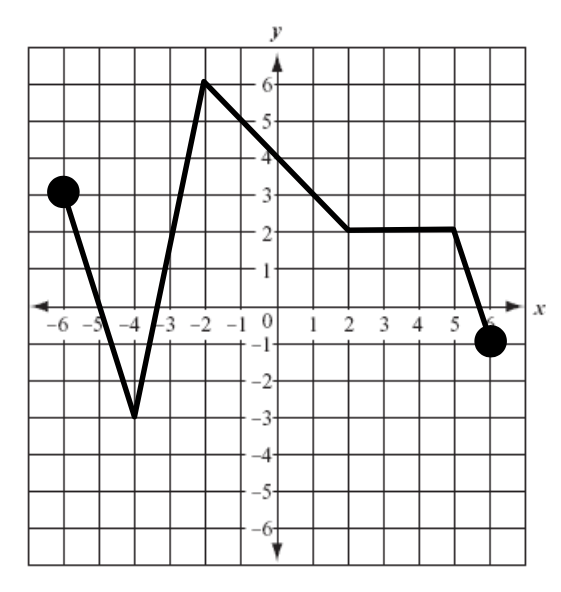
[-4,-2]
300
Find DOMAIN:
all real numbers
(neg infinity, pos infinity)
300
Write an explicit formula for the following sequence.
6, -18, 54, -162, . . .
g_n=6(-3)^(x-1)
400
How do you determine if a GRAPH is a function or not?
use the Vertical Line Test
400
Does the following table represent a function?
x y
1 2
2 5
6 2
2 9
5 1
No, because the input (x) of 2 has two different outputs (y).
400
Evaluate this function for P(2).
F(x)=-1/2x^2+5x+2
P(2)=10
400
The y-intercept of the graph.
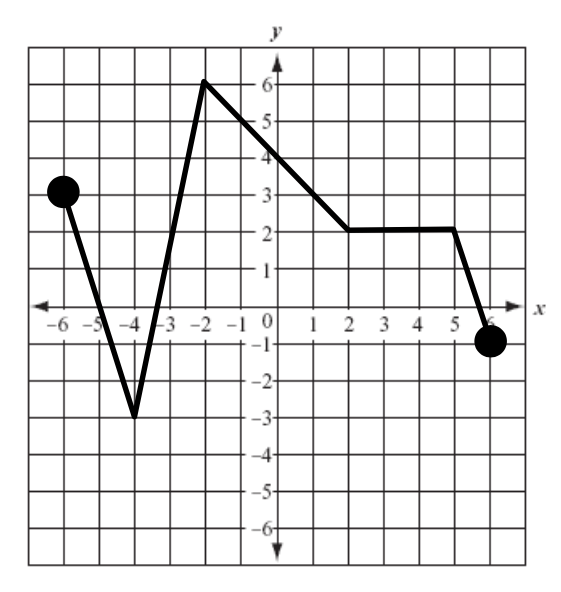
What is (0, 4)?
400
Find the RANGE:
x^2+6
y\ge 6
400
Write an explicit formula using the recursive formula given.
a_1=15
a_n=1/2a_(n-1)
a_n=15(1/2)^(x-1)
500
What type of function is represented by the graph?
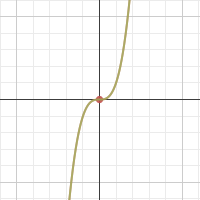
a cubic function
500
Is this a function and why?
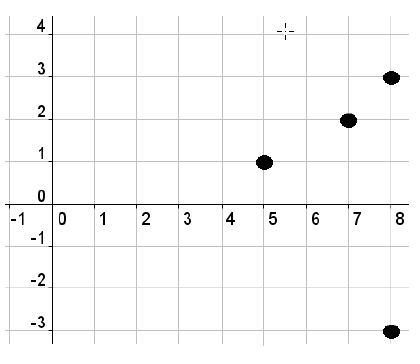
No, because x's repeat at 8. It also fails the vertical line test.
500
Find f(4) =
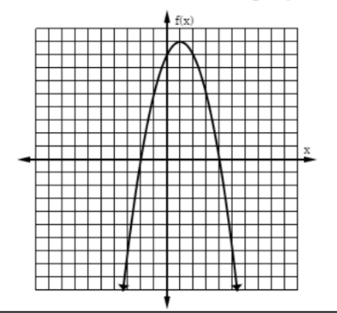
f(4)= 0
500
f(x) = 2x^2 + 12x + 16
What is the average rate of change of f(x) on the interval [-3, -2].
2
500
Find the DOMAIN:
f(x)=998(4.645^x)
All Real Numbers
500
Find the 30th term of the sequence below.
34, 29, 24, 19, . . .
-111