Fungi
Protists
Mixed
Plants
Photosynthesis
100
What are some key characteristics of fungi?
What is:
- Fungi are eukaryotic organisms.
- They are heterotrophs, obtaining nutrients through absorption.
- Fungi have cell walls made of chitin.
- They reproduce through spores.
- Fungi can exist as single-celled yeasts or multicellular organisms like mushrooms.
100
What is a protist?
What is:
- Protists are a large class of eukaryotic microorganisms that do not belong in the animal, plant, or fungal kingdoms.
- Can be multicellular, colonial, or unicellular.
100
Why do fungi employ both sexual and asexual reproductive strategies?
What is:
- Sexual reproduction encourages genetic variety and environment-adaptation.
- In ideal circumstances, asexual reproduction enables fungus to swiftly create progeny, guaranteeing their survival and the colonisation of new environments.
The proportion of sexual and asexual reproduction is influenced by the fungi's species and the surrounding environment.
100
What are some key characteristics of plants?
What is:
- Cell walls of plants multicellular eukaryotic creatures are formed of cellulose.
- They can manufacture their own food through photosynthesis because they are autotrophic.
For support (like stems), nutrition and water absorption (roots), and reproduction (flowers or cones), plants have specialised structures.
With a diploid sporophyte stage and a haploid gametophyte stage, they display alternation of generations.
100
What is the overall equation for photosynthesis?
What is:
- The equation for photosynthesis is: 6 CO2 + 6 H2O → C6H12O6 + 6 O2.
- In this process, carbon dioxide and water are converted into glucose (C6H12O6) and oxygen.
200
What are the main parts of a mushroom?
What is:
- Cap/Pileus: The mushroom's spherical cap.
- Gills/Lamellae: Small, radiating plates that are found on the underside of the cap and are where spores are produced.
- Stipe/Stem: The vertical structure supporting the cap.
- Annulus/Ring: A ring-like structure on the stem.
- Volva: A cup-like structure at the base of the mushroom.
200
How are protists classified?
What is:
- Based on their way of nutrition and other features.
- Protozoa, which are organisms with animal-like characteristics, algae, which are organisms with plant-like characteristics, and slime moulds and water moulds, which are organisms with fungus-like characteristics.
200
What were some benefits of plants moving onto land?
What is:
- More sunlight became available to plants, increasing photosynthesis and energy generation.
- The ozone layer offered defence against dangerous UV radiation.
- Plants found new ecological niches after settling on land, which decreased competition and predator activity.
200
How did plants evolve from water to land?
What is:
- Over millions of years, plants transitioned from aquatic to terrestrial life.
- Freshwater algae were probably the source of the first plants, which subsequently adapted to terrestrial environments.
- The creation of specialised pores for gas exchange (stomata), structures to prevent water loss (cuticle), and vascular tissues for water and nutrient delivery were among the most significant adaptations.
200
How do plants capture light energy during photosynthesis?
What is:
- To absorb solar energy, plants employ a range of pigments, including, chlorophyll a, and chlorophyll b.
300
How does the structure of a mushroom aid in its reproductive process?
What is:
- For the synthesis and release of spores, the gills on the underside of the cap offer a significant surface area.
- The annulus/ring aids in spore dissemination and serves to safeguard the growing gills.
The volva may aid in spore distribution as well as play a part in safeguarding the mushroom as it grows.
300
What are the characteristics of protists?
What is:
- Protists display a broad variety of traits.
They may move using flagella, cilia, pseudopodia, or they may not have any specialised structures for movement.
Protists have sexual or asexual reproduction options depending on the species.
They use a variety of feeding techniques, including as symbiotic partnerships, photosynthesis, ingestion, and absorption.
300
What does a plant need to keep constant to maintain homeostasis?
What is:
- Plants need to maintain a constant internal environment in terms of temperature, water balance, nutrient levels, pH, and gas exchange.
300
What were some challenges plants faced in surviving on land?
What is:
- The lack of water was a significant issue since terrestrial ecosystems are often drier than aquatic ones.
- To combat dryness, plants have to evolve defences like cuticles to stop water loss and specialised structures to absorb water quickly.
300
What is Englemann's experiment, and what did it demonstrate?
What is:
(Ee, 2018)
- In Englemann's experiment, light was divided into its spectrum using a prism and shone onto a slide containing the green alga Spirogyra and bacteria that love oxygen. It shown that chlorophyll most effectively reflects or transmits green light while efficiently absorbing blue and red light.
400
What role do fungi play in the ecosystem?
What is:
- Decomposing organic matter and redistributing nutrients into the environment are important functions of fungi.
- They establish cooperative interactions with plants that facilitate nutrient intake and promote plant development.
- Lichens, which are significant pioneers in the biological succession, are produced when some fungus create symbiotic partnerships with algae or cyanobacteria.
400
What is endosymbiosis?
What is:
- Understanding the evolution of eukaryotic cells requires knowledge of the notion of endosymbiosis.
- It implies that some eukaryotic cell organelles, such mitochondria and chloroplasts, descended from prokaryotes that were captured by ancestors of these cells.
- These endosymbiotic associations developed through time into advantageous partnerships where the host cell offered resources and protection while the endosymbiont provided vital services like energy generation (mitochondria) or photosynthesis (chloroplasts).
400
What is the purpose of the light-dependent reactions in photosynthesis?
What is:
- Adenosine triphosphate (ATP) and NADPH are utilised in the light dependent processes to turn light energy into chemical energy, which is subsequently used in the light independent reactions (Calvin cycle) to make glucose.
400
What are some plant adaptations that help maintain homeostasis?
What is:
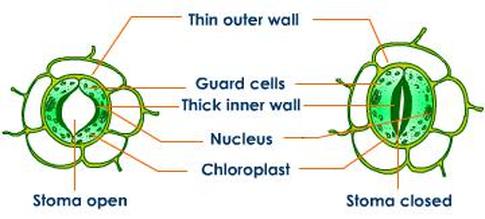
(″, n.d.)
- To control gas exchange and water loss, stomata, which are tiny holes on the surface of leaves, may open and close.
- To live in dry settings, plants like cactus have specialised parenchyma tissue for water storage.
- The cuticle, a waxy covering on leaves, prevents water from evaporating from the leaves.
- For effective gas exchange, plants acclimated to watery settings have more stomata.
- Pine needles' long, thin structure minimises water loss by lowering surface area.
400
What is the role of chloroplasts in photosynthesis?
What is:
- Plants' chloroplasts are the organelles used for photosynthesis. Chlorophyll and other pigments found in them absorb light energy and speed up the chemical processes involved in photosynthesis.
500
What is sexual reproduction in fungi, and what is the role of a zygospore?
What is:
- Hyphae from two separate fungus must fuse in order for fungi to reproduce sexually.
- A zygospore is created when the hyphae join together and includes genetic material from both parents.
By acting as a resting structure, the zygospore enables the fungus to endure unfavourable circumstances until they are suitable for development and spread.
500
How does endosymbiosis contribute to the diversity of protists?
What is:
- By giving protists specialised organelles, endosymbiosis was essential in the development of those organisms.
- Protist diversity grew as a result of the ability to explore new ecological niches and adopt different metabolic processes.
- As an illustration, endosymbiosis of photosynthetic algae (plant-like protists) produced a variety of algal lineages with distinct traits and ecological functions.
500
How does the splitting of water molecules contribute to photosynthesis?
What is:
- During the light-dependent processes of photosynthesis, the splitting of water molecules serves two crucial purposes. In order to maintain the steady flow of electrons through the photosystem, it first offers a supply of electrons to replace those lost from chlorophyll molecules. Second, as a byproduct, it produces oxygen gas (O2), which is discharged into the atmosphere and adds to the oxygen supply for living things.
500
What are some structures in plants that help collect and move water?
What is:
- Root systems and root hairs on roots enhance the surface area available for water absorption.
- Water and dissolved minerals are transported upward by xylem tissue found in stems and leaves.
500
What are the main steps of the light-dependent reactions of photosynthesis?
What is:

(″, n.d.)
- The following are the steps in the non-cyclic route of the light-dependent reactions:
- a) Photosystems in the thylakoid membrane absorb light energy.
- b) The photosystems' electrons are energised and released.
- c) Hydrogen ions (H+) are pumped into the thylakoid lumen by the energised electrons as they pass through an electron transport chain.
- d) A gradient is produced by the accumulation of H+ ions in the thylakoid, which causes ATP synthase to produce ATP.
- e) The electrons are employed to convert NADP+ to NADPH once they have lost energy.
- f) Water molecules break, producing oxygen gas as a byproduct and supplying electrons to replace those lost by chlorophyll.