Geological Timeline & IV/DV/Controls
The Rock Cycle
Geology 101
Fossils
Absolute vs Relative Dating
100
Q: What is the geological timeline used for?
(100 pts for solid answers; +100 points for best answer)
A: To show Earth’s history and major events over billions of years.
100
Q: Name the three main types of rocks.
A: Igneous, sedimentary, metamorphic.
100
Q: What does the Law of Superposition state?
(100 pts for solid answers, +100 points for best, most accurate answer)
A: In undisturbed rock layers, the oldest layer is on the bottom and the youngest is on top.
100
NON-Fossil Question - tricked you.
What does CER stand for?
Claim
Evidence
Reasoning
100
Q: What is relative dating?
Q: What is absolute dating?
(100 points for each good/correct answer. +200 bonus points for the best)
A: Determining if something is older or younger than something else.
A: Finding the actual age of a rock or fossil using numbers.
200
Identify the IV and DV:
A scientist tests how the color of a surface affects its temperature when exposed to sunlight.
IV: different colored surfaces
DV: temperature
200
Q: Which rock type forms from lava or magma?
A: Igneous rock.
200
Q: What geological event causes rock layers to bend?
A: Folding.
200
Q: What is permineralization?
(good answers get you 100 pts, the best gets you +200 bonus points)
A: Minerals fill in the spaces of an organism, turning it into stone.
200
Q: Which type of dating uses the Law of Superposition? Which type of dating uses radioactive decay?
Relative
Absolute
300
Q: Why is the geological timeline divided into eras and periods?
A: To organize Earth’s long history into smaller sections based on major changes in life and environment.
300
Q: List two processes in the rock cycle.
A: Weathering, erosion, deposition, melting, cooling, heat, pressure (any two).
300
Q: What is tilting, and what does it tell scientists?
A: Tilting is when rock layers are slanted; it shows the layers were disturbed after forming.
300
Q: What is an index fossil used for?
A: To determine the relative age of rock layers.
Must include "relative" in answer for points.
300
Explain how this photo could represent both absolute and relative dating?
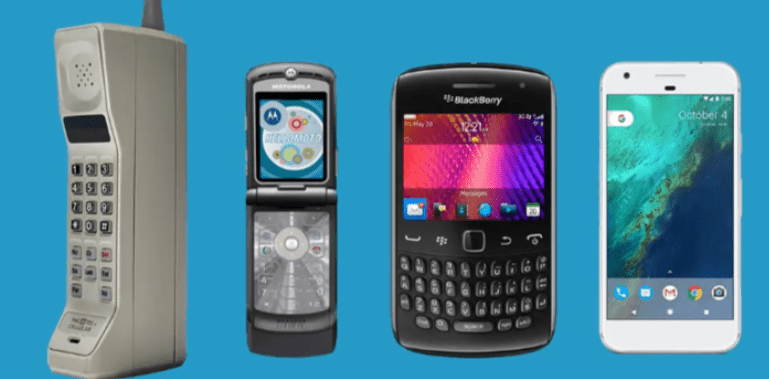
RD: comparing phones and putting them in order from oldest to youngest
AD: some of these weren't around very long, you'd know right away what era it's from
400
What are three pieces of evidence we use to support the Geological Timeline?
Relative Dating, Absolute Dating, Fossils, Plate Tectonics, Ice Core Samples, Tree Rings, Meteorites
400
Q: What type of rock forms from small, pieces of rock being compacted and cemented?
A: Sedimentary rock.
400
Q: Explain why an igneous intrusion is younger than the rock layers it cuts through
A: The surrounding rock had to exist first before magma could cut through it.
400
What is the difference between a cast fossil and a mold fossil?
Mold: objects outer shape is pressed into mud (or something soft) and an imprint is left
Cast: Objects soft parts are replaced by minerals
400
RANDOM NON-SCIENCE QUESTION:
What were the top five grossing (most money) films in the United States in 2025? Points for the team with the most correct guesses. You only only list 7 movies, no more.
- A Minecraft Movie (Warner Bros.): Leading the pack with over $423 million.
- Lilo & Stitch (Disney): Close behind with over $423 million.
- Superman (Warner Bros.): A strong performer with over $354 million.
- Jurassic World: Rebirth (Universal): Earned over $339 million.
- Wicked: For Good (Universal): A big hit with over $305 million
500
In the cast fossil experiment/lab, what was the IV, DV, and one control?
IV: different types of materials (sand, soil, mix)
DV: data and observations determining which cast fossil was best (detail, intact, etc.) ANSWER WILL VARY
Control: Answers will vary.
500
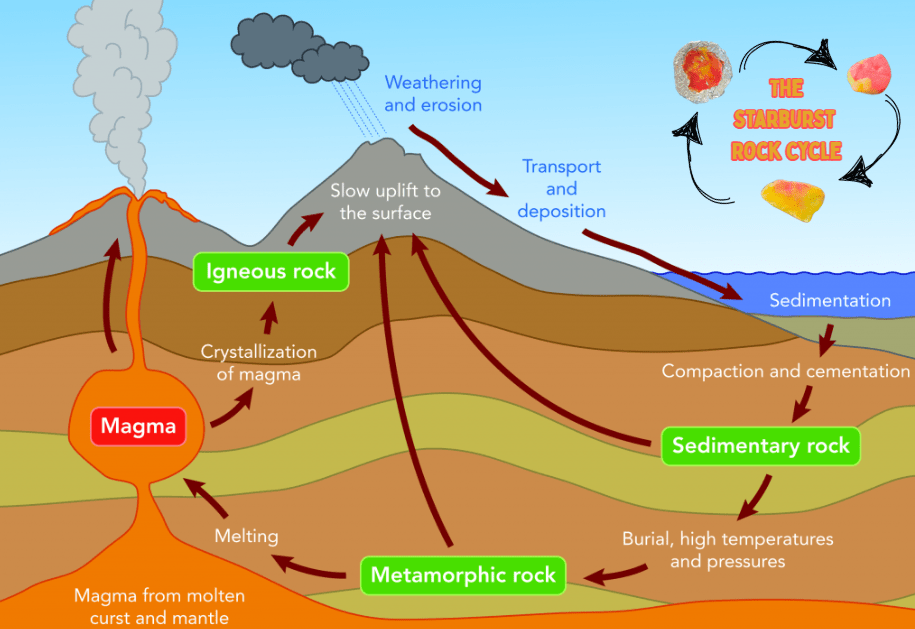
Q: Draw and label a simple rock cycle diagram showing at least 3 rock types and 2 processes.
A: Diagram should correctly connect igneous, sedimentary, and metamorphic rocks with processes like melting, cooling, heat, pressure, weathering, or erosion.
500
Put these in the correct order: oldest to youngest (ignore the circles, just focus on letters; the fault line doesn't have a letter, so just label it F.L.):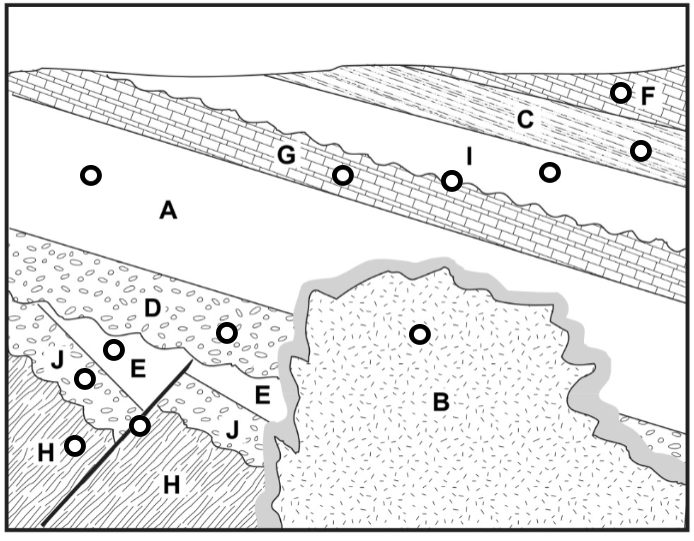
Oldest to Youngest:
H <- J <- E <- F.L. <- D <- A <- B < - G <- I <- C <- F
500
Q: List all four characteristics of a good index fossil.
A: Lived for a short time, widespread, abundant, easy to identify
500
RANDOM CHALLENGE (since I can't think of another absolute/relative dating question) - you choose.
- Whitney Houston Challenge
- Romantic Stare Off Challenge
- Best 10 second counter
- Don't spill
1st Place - 500 pts
2nd Place - 300 pts
3rd Place - 100 pts