Gamma Knife
Cyber Knife
Patient Safety
Radiation Sources
Choose Your Weapon
100
Level of precision for mechanical systems and accurate patient position that is one of the defining features of Gamma Stereotactic Radiosurgery devices
submillimeter
100
Number of degrees of freedom of the cyber knife robotic arm.
Six (Translation: A/P, R/L, Sup/Inf, Rotation: pitch, roll, yaw)
100
A state that agrees to uphold NRC regulations at a minimum, while governing the use of radiation and radioactive sources themselves
Agreement state
100
The half-life of Cobalt-60 (rounded to the nearest integer is fine)
5.27 years
100
Of the two systems, this one requires a radiation oncologist to be physically present during every treatment fraction per NRC regulations, due to its use of radioactive sealed sources.
Gamma Knife
200
What does this equation represent?
{{dD}/dt(4mm)}/{{dD}/dt(16mm)}
Output factor for a 4 mm collimator
200
DAILY DOUBLE (WAGER AMOUNT)
The gold standard detector for TPR, Off-center ratio, and output factor annual measurements on a Cyber Knife
Diodes - ion chambers, even microchambers, not recommended below 20 mm collimator
200
According to NRC regulations, a wipe test should be performed this often on a Gamma Knife
every 6 months
200
This Linac component is used to produce the RF waves used for acceleration in the Cyber Knife
Magnetron
200
This machine boasts a range of nominal collimators from 5-60 mm, as opposed to the 4-16 mm of its counterpart
Cyber Knife
300
Number of Cobalt sources found in a Gamma Knife (within +/- 10)
192 or 201 depending on model
300
Frequency with which a physicist should observe a Cyber Knife's Synchrony treatment, whether it be on a patient or phantom
Monthly
Synchrony is the motion tracking feature. Puts a lot of stress on robot joints, especially when interrupted and the brakes have to engage often. Check for unusual noises or vibrations
300
The M.D. Anderson Radiation Quality Assurance Laboratory offers end-to-end anatomical phantoms for dosimetry QA.
IROC
300
Energy produced by a Cobalt-60 decay
(average or specific decay energy)
Decay energies are 1.17, 1.33 MeV
Average Energy is 1.25 MeV
300
This machine utilizes the ABS phantom: a spherical, calibration phantom made of Acrylonitrile Butadiene Styrene
Gamma Knife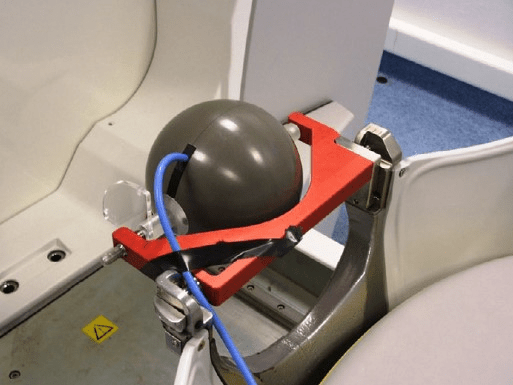
400
According to TG 178, the optimal chamber orientation for Gamma Knife
Along the Z-axis.
Placing the chamber along other axes could cause tangent effects, producing a lower measurement
400
Methods used for cyber knife tracking - there are 3, name 2
-bony structure tracking
-soft tissue tracking
-fiducial marker tracking
400
According to the task group, if there is a Cyber Knife collision, you want to hit this button
Emergency Motion Off (EMO)
Do not hit the Emergency Power Off (EPO)!
400
Maximum Cyber Knife Energy
6 MV
400
TG-135 is a report that specifically addresses quality assurance for this type of machine, including mechanical, dosimetric, and image guidance checks.
Cyber Knife
500
meaning of msr found in the following equation:
D_{W,Q_{msr}}^{f_{msr}}=M_{Q_{msr}}^{f_{msr}}\times N_{D,W,Q_0}\times K_{Q,Q_0}\times K_{Q_{msr},Q}^{f_{msr},f_{ref}}
Machine-Specific Reference
500
Collimator size that should be used for monthly outputs, beam shape, and beam symmetry measurements
60 mm (the largest available collimator)
500
Usage Factor of Cyber Knife
0.05
500
Starting activity of Cobalt-60 sources used in Gamma Knife
~30 Ci
500
This machine utilizes the AQA test: a test analogous to a Winston-Lutz to be performed daily
Cyber Knife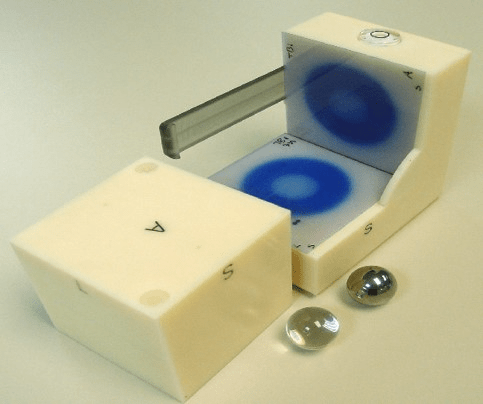
600
Name given to the dose error caused by the opening and closing of the source window for a gamma knife
Shutter Effect, where τ is the shutter lag time: the brief delay between when the source window is commanded to open/close and when it actually does, causing a small dose delivery error that must be corrected
D(t) = \dot(D)(t'-\tau)
600
This is the name of the CyberKnife's real-time tumor tracking system that correlates internal fiducial position with external optical markers on the patient's chest, allowing treatment without breath-hold
Synchrony
600
Per NRC regulations, this is the required action and timeframe when a patient receives a dose that differs from the prescribed dose by more than 20%
A medical event must be reported to the NRC within 24 hours by telephone, followed by a written report within 15 days
600
Frequency Cobalt-60 sources are replaced
every 5-10 years
600
FINAL JEOPARDY
This is the AAPM Task Group report that covers recommendations on the Practice of Calibration, Dosimetry, and Quality Assurance for Gamma Stereotactic Radiosurgery
TG-178