Does it even matter?
(Matter and transformations)
(Matter and transformations)
This law states energy cannot be created or destroyed, only transformed.
1st law of thermodynamics
These two variables define a biome
Temperature and precipitation
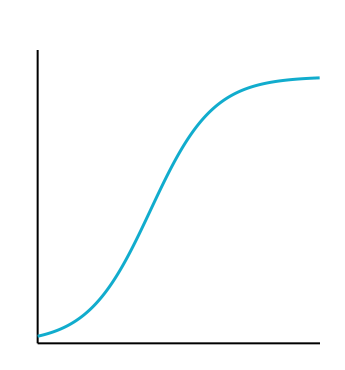 This chart shows this type of population growth
Logistic
This is the term for number of individuals per area
Population density
This is the term for humans receiving benefits from nature
Ecosystem services
This is measure of disorder that increases with energy transformations
Entropy
These types of organisms breakdown dead material and recycle nutrients
Decomposers
A golden jackal follows a tiger as it hunts and feeds on the leftovers of its kills - known as this kind of species relationship
Commensalism
When an individual leaves a population for another, it's called this
emigration
I could describe my __________ as 6.8 earths
Ecological footprint
This is a type of feedback loop where change is dampened and the system stabilizes
Some species have disproportionate effects on their ecosystems relative to their abundance - a beaver is an example of this
Keystone species
This is a density dependent factor that affects the carrying capacity of a system
Disease, competition, predation, population size
In this graph, we see a country in THIS population phase 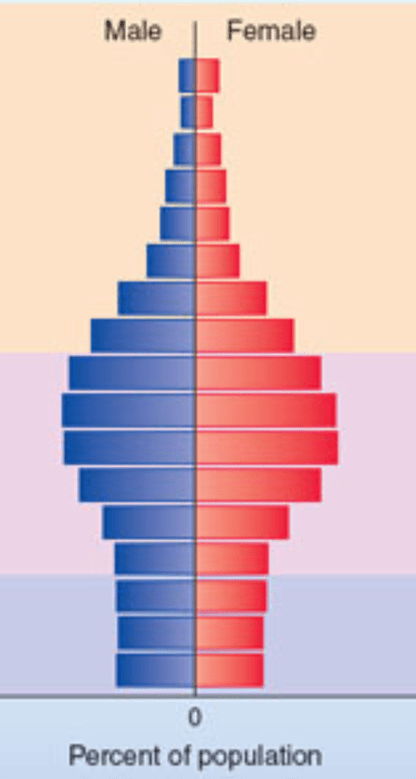
declining
Most of human-cased land use change is for this purpose
Agriculture/food
The levels of energy transfer through an ecosystem are called these
trophic levels
Fill in the blank in the equation for photosynthesis
CO2 + H20 = ___________ + O2
C6H12O6
Rapid changes in allele frequency in a population that occur via random genetic mutations are known as this
Genetic drift
Doing this in a developing society leads to reduced fertility rates and slowing population growth
Educating and empowering women and girls
Nearly 1,000 species have gone extinct since 1500 AD, an example of global decline of this metric
Biodiversity
This is an example of a positive feedback loop in the environment
Ice-albedo etc
Multiple spatially distinct populations of the same species in the same community that interact through dispersal and migration is known as this
Metapopulation
In this equation, pi is the relative abundance of a species in system. H` is known as this.

Shannon diversity index
These terms make up the acronym IPAT, which describes the human population-driven factors in environmental degradation (usually expressed in equation form as I = P x A x T
Impact = Population x Affluence x Technology
These are three agents of disturbance; how human populations impact the environment
•Clearing of natural vegetation for growing crops, pasture, transportation and housing
•Selective harvesting of desirable species and introduction of alien ones
•Mining for coal and other minerals
•Draining of wetlands for agriculture and human settlements
•Introduction of chemicals into the environment
•Introduction of greenhouse gases into the atmosphere and climate change.