Government
Standards of Living & Population
Political Organizations
Migration & Other
Vocabulary
100
What is government?
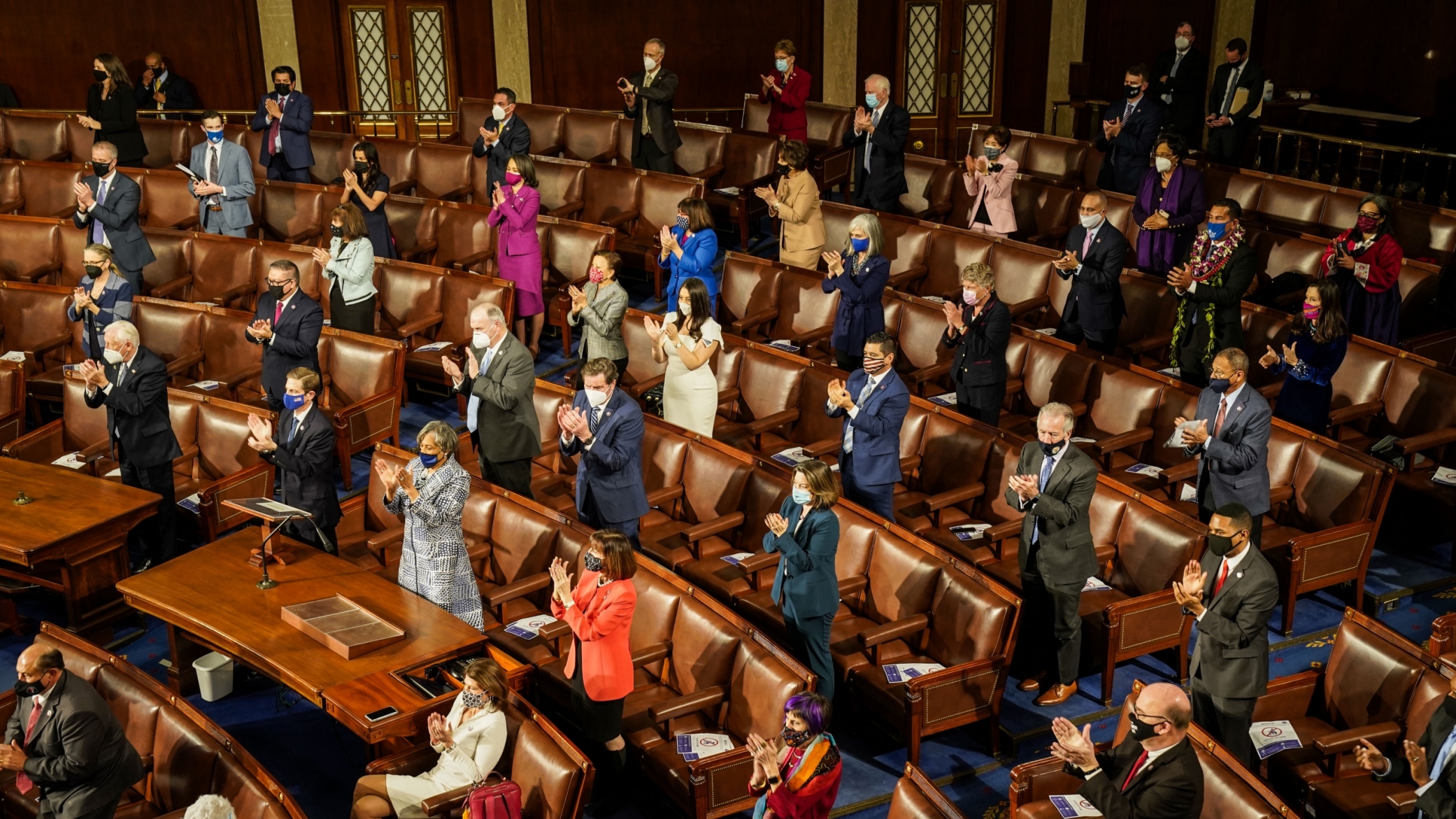
Government: the organized system of authority that creates and enforces laws, manages public resources, and provides collective services for a society
100
What does MDC and LDC stand for? Give me example of each
BONUS 100 POINTS IF YOU CAN TELL ME OLD NAMES FOR THESE
MDC - More developed country - France
LDC - Less developed country - Congo
100
Name at least 4 different political organizations:
BONUS 100 POINTS IF YOU CAN EXPLAIN ALL THE ACRONYMS.
NATO - North Atlantic Treaty Organization
EU - European Union
UN - United Nations
British Commonwealth
100
What are push and pull factors? Explain

Push factors - adverse circumstances at origin such as war, persecution, unemployment, natural disasters, or lack of services that compel people to move.
Pull factors - favorable conditions at destination such as job opportunities, political stability, higher wages, family ties, or better education and healthcare that attract migrants.
100
Explain the difference between the following words:
Migration, Immigration, and Emigration

Migration - Move
Immigration - In
Emigration - Exit
200
What is a difference between oligarchy and anarchy?
Anarchy - There are no laws and no leaders. Freedoms are unlimited, but also very unsafe.
Oligarchy - Rule by a few; small groups hold power over the state or organization.
200
Why do we measure HDI? What does it stand for?
Human Development Index - It allows us to analyze the quality of life within the country.
200
Where can we find the headquarters of UN? How many members are in UN?
NYC + 193
200
Net Migration
The total # of people leaving the country vs. the total # migrating to the country.
200
What is a brain drain?
Brain drain is the emigration of highly skilled, educated, or professional individuals from their home country (often developing) to another (usually developed) seeking better opportunities, higher salaries, or quality of life:
300
What is a theocracy? Give an example of one.
Religion is the ultimate authority. Leaders are believed to speak through God - lack of individual representation.
Example - Vatican (Absolute Elective Theocratic Monarchy)
300
What is difference between life expectancy and birth rate?
Life expectancy - The average age a person is expected to live to the year they are born.
Birth rate - the number of live births per 1,000 people in a population during one year; it quantifies current fertility and contributes directly to population growth.
300
What is EU? What was it created and how many members are there?
EXTRA 100 POINTS IF YOU CAN TELL ME IN WHICH YEAR DID CZECH REPUBLIC JOIN
European Union - 1993 - 27
CZECHIA - May 1, 2004
300
What are different types of migration? Give me at least 4 examples + explain them.
Internal Migration - Within country
International Migration - Outside country
Voluntary Migration - personal choice
Seasonal Migration - Temporary movement
Chain Migration - One person moves within family and then others follow.
300
Divide the following factors into two categories - HUMAN and PHYSICAL FACTORS:
Famine, Climate, Religion, Drought, Education, Resources, Transportation, War
HUMAN: Famine, Religion, Education, Transportation, War
PHYSICAL: Climate, Drought, Resources
400
There are two types of monarchy. What are they and what is the difference between them?
Give one example of monarchy.
Absolute monarchy - In an absolute monarchy, a king or queen has complete power. They are not elected, but rather, inherit the power from relative - Oman, Brunei, Saudi Arabia
Constitutional monarchy - Also known as limited monarchy, the rule is by king or queen, but they are limited by a constitution - UK, Japan, Spain, Canada, and Sweden
400
What does a low birth rate indicate about standard of living in the country? Why?
BONUS 100 IF YOU CAN TELL ME WHETHER IT'S GOOD OR BAD and WHY
A low birth rate generally indicates a higher standard of living—better healthcare, higher female education and labor participation, and greater economic security—though it also brings challenges like population ageing and workforce shortages;
Czechia is an example of a high‑income European country with low fertility consistent with these patterns
400
What is collective defense? Article 5?
A security arrangement where multiple countries agree to mutual defense, meaning an attack on one is considered an attack on all.
400
What is the difference between REFUGEE & ASYLUM SEEKER?
Asylum seeker: a person who says they are fleeing persecution or serious harm and has applied for protection in another country but has not yet been legally recognized as a refugee
Refugee: a person who has fled their country - has legal status
400
What is the difference between population distribution and population density?
- Population density: the number of people per unit area (commonly per square kilometer or mile); it quantifies how crowded a place is.
- Population distribution: the spatial pattern of where people live across a landscape — whether people are clustered, evenly spaced (uniform), or randomly scattered.
500
What are the two types of democracy? Explain the difference between them.

BONUS 100 POINTS IF YOU CAN TELL ME WHAT DOES CZECHIA HAVE.
Direct Democracy - Citizens vote on laws and policies themselves
Representative Democracy - Citizens elect representative officials to make decisions on their behalf -- CZECH REPUBLIC
500
Analyze the population pyramid. What does it say about Qatar? Anything abnormal?
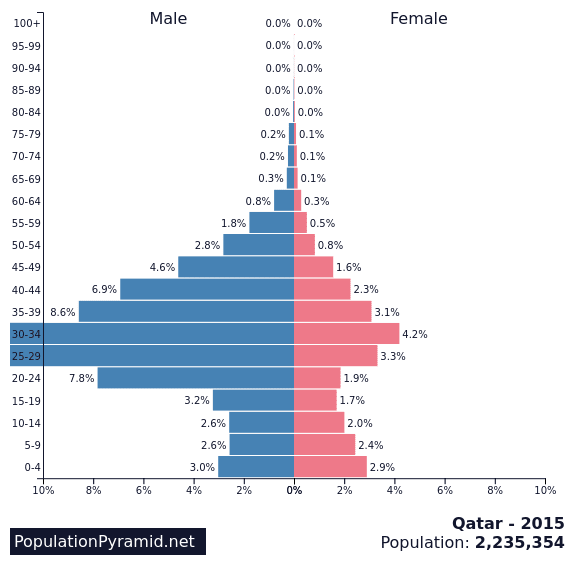
Qatar's population pyramid is highly unusual and unbalanced, resembling a sharp, distinct bulge for working-age males (20-59) due to massive numbers of male migrant workers in construction and oil, leading to a very skewed gender ratio (over 3 males for every female) and a small proportion of native Qatari citizens, creating a unique demographic structure dominated by foreign labor rather than a traditional pyramid shape.
500
What 3 factors does UN uses to set an HDI? Explain what each one tells us about a country.
- Life expectancy at birth - How long is an individual expected to live
- Education - Quality of education
- Gross National Income per Capita - Average yearly salary per person
500
Describe life in the city vs. village. Describe how it would affect population density and distribution?
- Population density: Cities have high density (many people per km²) because housing and services cluster; villages have low density with large open spaces and fewer people per km².
- Population distribution: Urban areas show clustered distribution (people concentrated in towns/cities), while rural areas show dispersed distribution (small settlements, farms spread across the landscape).
500
What is the difference between race, ethnicity, and nationality. Give example of each
Race refers to socially perceived physical traits (a social construct tied to appearance), ethnicity refers to shared culture, language, or ancestry, and nationality denotes legal membership of a state (citizenship)
Race: Black/African;
Ethnicity: Romani;
Nationality: Czech (citizen of Czechia).