Principles of Geology
Rock Layers
Fossils
Natural Selection
Geologic History
100
This principle states that in undisturbed rock sequences, the oldest rocks are at the bottom and the youngest at the top.
What is the Law of Superposition?
100
True or False: The youngest rock layers are located at the bottom of a rock formation.
What is false?
100
These are any trace of a living organism preserved in a rock.
What are fossils?
100
True or False: Having genetic diversity is helpful for survival of a species.
What is True?
100
The Earth's geologic history is thought to span this many years.
4.6 Billion Years
200
This type of dating is used when geologists determine which rock layer is older based on the order of the layers.
What is relative dating?
200
Why do unconformities (breaks in the rock layers) exist?
Due to erosion of layers
200
List an example of something that would make a good fossil.
Bones, teeth, shell
200
This scientist first introduced the idea of natural selection.
Who is Charles Darwin?
200
This event marks the end of a geologic era.
What is a mass extinction?
300
If geologist use radioactive decay to determine the age of rocks, this type of dating is being used.
What is absolute dating?
300
What do the lines labeled B and E represent?
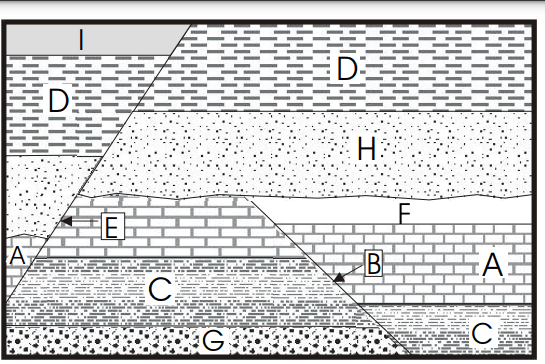
What are faults or fault lines?
300
These types of fossils are used by geologists to determine the geologic time period that other organisms are from.
What are index fossils?
300
As a result of a drought, the major source of forkbird foods is worms in small holes.
What do you think this will do to the population of each type of forkbird over time? Why?
The 4-tined forkbirds would die because they would not be able to get any food. The 1-tined forkbirds would now have the advantageous trait and would survive and reproduce. That population would grow.
300
This era is known as the Age of Reptiles.
What is the Mesozoic Era?
400
This law explains that if there are bits of rock found inside another rock layer, the bits of rock must be older than the layer they are found in.
What is the Law of Inclusions?
400
This rock layer depicted below is the oldest.
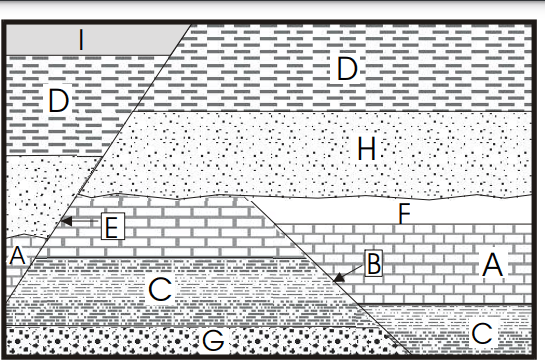
What is layer G?
400
If you find a trilobite fossil in one rock layer at the bottom and a dinosaur fossil in another layer on top, what can you conclude?
The trilobite layer is older than the dinosaur layer.
400
A random change in a gene from parent to offspring (that could be good or bad) is called this.
What is a mutation?
400
This era is the longest of all the eras.
What is the Pre-Cambrian Era?
500
This law states that rock structures that cut across existing rock structures (such as intrusions) are younger than the existing rocks.
What is the Law of Cross Cutting Relationships?
500
The rock layers in the picture below were formed in this order. List the oldest to youngest layers.
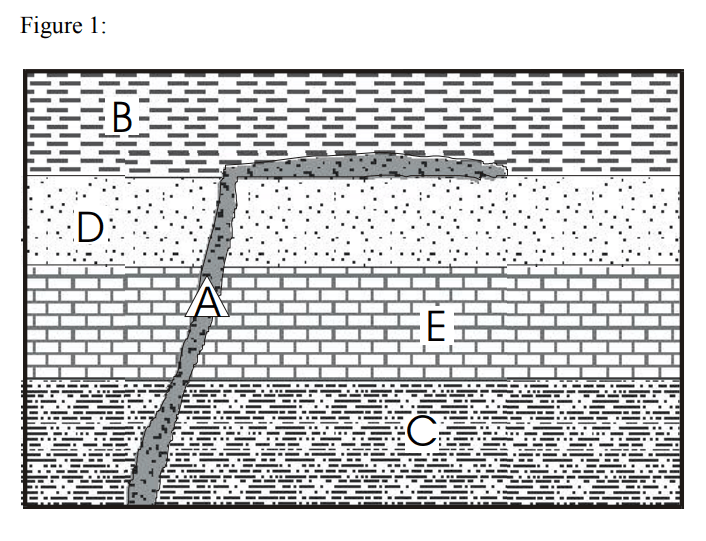
What is C, E, D, B, A?
500
List the two characteristics that must be true for a fossil to be considered an index fossil.
It must be widespread (found in many locations) and short-lived (found in only one rock layer).
500
A trait that is gained throughout a lifetime that cannot be passed down from parents to offspring is called this.
What is an acquired trait?
500
This principle states that the processes that happen today also happened in the past. (The present is the key to the past.)
What is Uniformitarianism?