Translations
Reflections
Rotations
Dilations
Symmetry
Linear Transformations
100
A translation is when you do this to a figure.
What is move it right, left, up, or down?
100
A reflection is when you do this to a figure.
What is flip it or make a mirror image of it?
100
A rotation is when you do this to a figure.
What is spin it?
100
A dilation is when you do this to a figure.
What is make it bigger or smaller? (expansion or contraction)
100
 Does the figure below have line symmetry, rotational symmetry or both?
Line symmetry only
100
Describe the transformation that has occurred between these two functions.
f(x)=4x + 5 and g(x) = -4x + 5
Reflection across the y-axis
200
Find the new coordinates of (10,12) if you translate the point three units left and 4 units up.
What is (7,16)?
200
Find the new coordinates of (3,-2) after you reflect the point over the y-axis.
What is (-3,-2)?
200
Find the new coordinates of (5,4) after you rotate the point with 180º.
What is (-5, -4)?
200
Find the new coordinates of (3,-2) if you dilate the point with a scale factor of 4.
What is (12,-8)?
200
This figure has rotational symmetry. Name the order and degree it is rotated.
Order = 4; Degree of rotation = 90 degrees
200
Describe the transformation that has occurred between these two functions.
f(x) = 3x - 10 and g(x) = -2x - 10
Rotation about the point (0, -10)
300
Write the notation (formula) of point (x,y) after it moves 3 spots to the left and 7 spots up.
What is (x-3,y+7) OR
<-3, 7>
300
Write the notation (formula) of point (x,y) after it is reflected over the y-axis.
What is (-x,y)?
300
Write the notation (formula) of point (x,y) after it rotates 90º?
What is (-y,x)?
300
Write the notation (formula) of point (x,y) after it is dilated with a scale factor of 6.
What is (6x,6y)?
300
Draw all lines of symmetry for the following image. (Describe them to your partner.)
Horizontal
Vertical
Diagonally with a positive slope
Diagonally with a negative slope
300
Describe the transformation that has occurred between these two functions.
f(x)=(2/3)x + 4 and g(x) = (2/3)x - 11
Translation down 15 units.
400
Describe in words the translation for this notation: (x,y) --> (x + 8, y + 4)
What is a translation of 8 units to the right and 4 units up?
400
A picture with one point (-3,4) was reflected over the line y=x. What should be the new coordinates of the point?
What is (4,-3)?
400
Figure QRST has vertices Q(2,-1), R (6,-1), S(6,-3) and T(2,-3). Which will be the coordinates of vertex R after the rectangle is rotated 90º counterclockwise about the origin?
What is (1,6)?
400
Line segment CD was dilated around the origin by a scale factor of 2. The endpoints of the image are C' (4,0) and D' (6,2). What are the coordinates of the endpoints of the original line segment?
What is C(2,0) and D(3,1)?
400
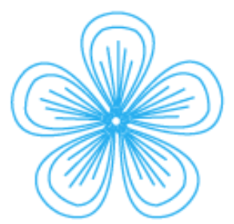 This figure has rotational symmetry. What is the order and angle of rotation?
Order = 5; Degree of rotation = 72 degrees
400
Describe the transformation that has occurred between these two functions.
f(x)=-x + 5 and g(x) = -4x + 8
Rotation and Translation up 3 units
500
Graph ∆LMN after a translation of 6 units to the right and 4 units down.
L(0,3)
M(6,4)
N(3,9)
What is L'(6,-1), M'(12,0), N'(9,5)?
500
Graph rectangle DEFG after a reflection over the line y=x. D(5,5) E(5,8) F(8,8) G(8,5)
What is D'(5,5), E'(8,5), F'(8,8), G'(5,8)?
500
Graph ∆JKL after a rotation of 180º about the origin. J(5,6) K(7,9) L (1,2)
What is J(-5,-6), L(-7,-9), L(-1,-2)?
500
Graph ∆DEF after a dilation with a scale factor of 0.5. D(2,8) E(2,2) F(6,2)
What is D'(1,4), E'(1,1), F'(3,1)?
500
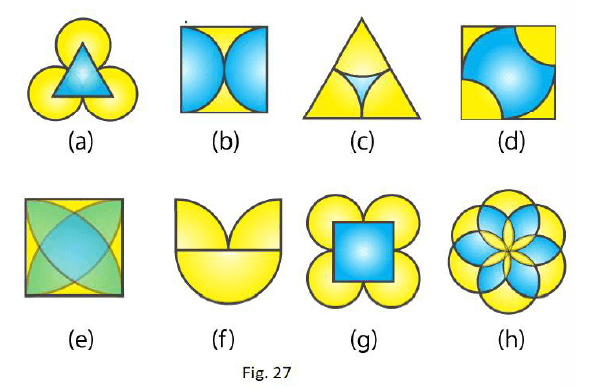 Which image(s) have BOTH reflection symmetry (line symmetry) AND rotational symmetry? (Assume all triangles you see are equilateral & quadrilaterals are squares.)
A, B, C, D, E, G & H
500
Describe the transformation that has occurred between these two functions.
f(x)=-4x + 5 and g(x) = (1/4)x + 5
Rotation 90 degrees about the point (0,5).
(Slopes are opposite & reciprocal so they are perpendicular.)