Reflections
Rotations
Translations
Dilations
Compositions
100
Which figure is a reflection of triangle x over the y-axis?
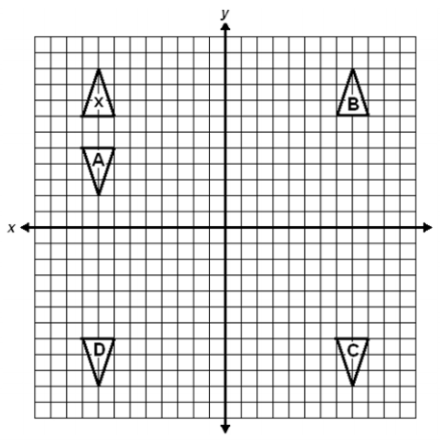
B
100
What are the coordinates of point H' after a 180o clockwise rotation around the origin?
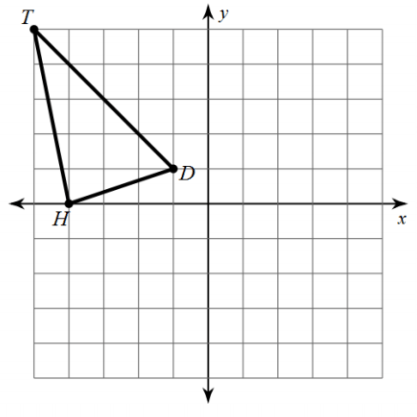
Rule: (x,y) -> (-x,-y)
H(-4,0) -> H'(4,0)
100
Describe the translation that will move point S to the location (-1,0).
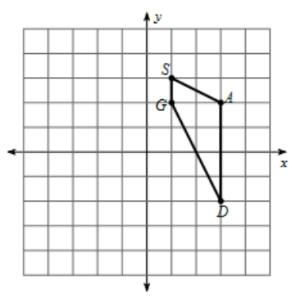
S(1,3) -> S' (-1,0)
Rule: (x,y) -> (x-2, y-3)
Left 2, Down 3
100
If the triangle undergoes a translation with a scale factor of 3, what would the coordinate of point D' be?
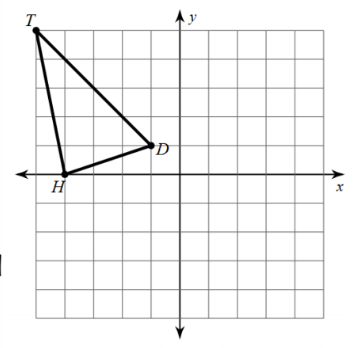
Rule (x,y) -> (3x, 3y)
D(-1,1) -> D'(-3,3)
100
What composition of transformations could map triangle x onto triangle C? (need two transformations)
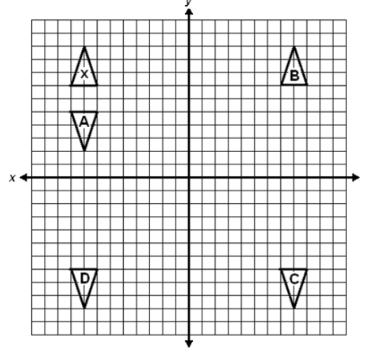
Reflection over x-axis, then reflection over y-axis.
-OR-
Reflection over y-axis, then reflection over x-axis.
-OR-
Reflection, Translation combo
200
If the triangle were reflected over the line y=x, what would the coordinate of point K' be?
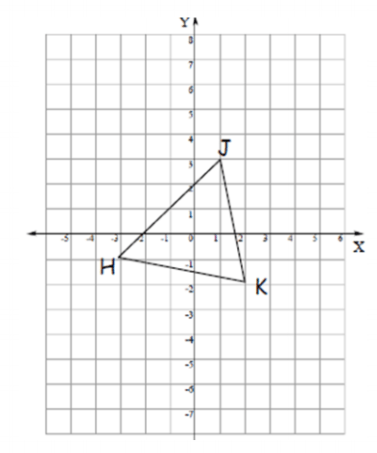
Rule: (x,y)->(y,x)
K(2,-2)->K'(-2,2)
200
If trapezoid EFGH is rotated 90o clockwise about the point F, what would the coordinate of F' be?
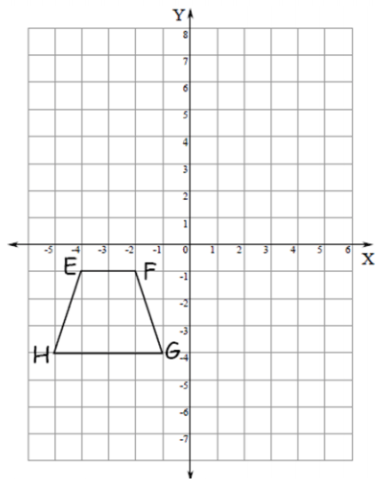
If F is the center of rotation it doesn't move.
F'(-2,-1)
200
Triangle ABC undergoes a translation of 5 units up and 1 unit to the right, resulting in Triangle A'B'C'. If the C(1,7), what is C'?
Rule (x,y) -> (x+1,y+5)
(1,7) -> (1+1,7+5) -> (2,12)
200
Triangle XYZ undergoes a transformation. Based on the new coordinates, which transformation occurred? (Be specific)
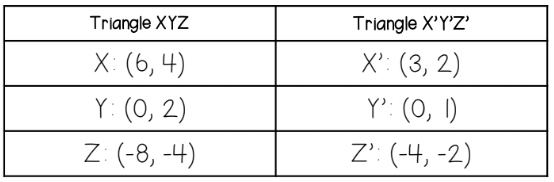
Dilation with a scale factor of 1/2.
200
An isometry is a transformation of an object in which the original object and its image are congruent. Which transformation is NOT always an isometry?
Dilation
300
How many lines of symmetry does this concave 16-gon polygon have?
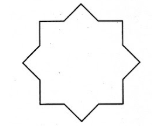
8
300
In the figure below, Triangle GCF has been rotated 90 degrees counterclockwise to create triangle XYZ. What angle is congruent to angle C?
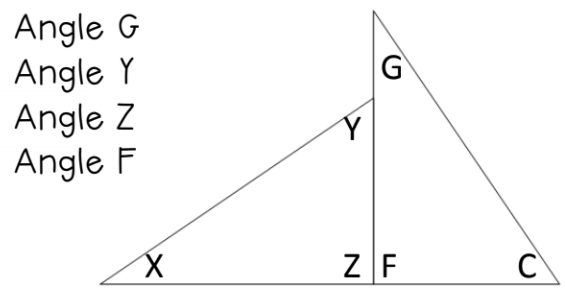
Angle Y
300
If figure LZJD is translated so that the image of Z is Z' at (1,2), then what will the coordinates of point D be after the translation?
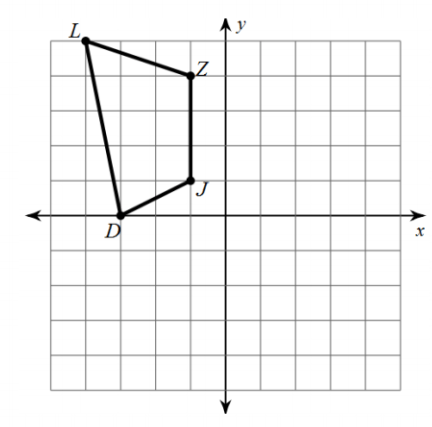
Z(-1, 4) -> Z'(1, 2)
(x, y) -> (x+2, y-2)
D(-3,0) -> (-1, -2)
300
What is the image of point (7,4) after a dilation of 2?
Rule (x,y) -> (2x,2y)
(7,4) -> (2*7,2*4) -> (14,8)
300
What two transformations were performed to obtain X"Y"Z" in the diagram?
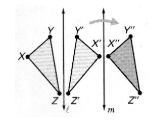
Reflection, Reflection
400
Give the coordinates of the vertices after a reflection in y=1.
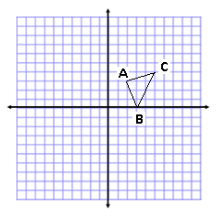
A'(2,-1)
B'(3,2)
C'(5,-2)
400
Give the coordinates of the vertices after a 90o clockwise rotation about the origin.
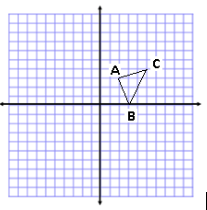
A'(3,-2)
B'(0,-3)
C'(4,-5)
400
Give the coordinates of the vertices after a translation (x,y)->(x+4,y-3)
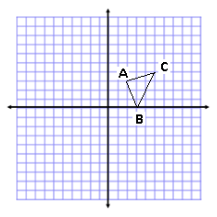
A'(6,0)
B'(7,-3)
C'(9,1)
400
The image of (3,10) after a dilation with respect to the origin is (12,40). What is the scale factor?
(3,10) -> (3k, 10k) -> (12, 40)
k = 4
400
Describe the composition of transformations with in depth descriptions.
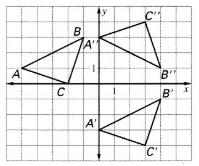
Translation <5,-4> or (x,y)->(x+5,y-4) or 5 right, down 4.
Reflection across the x-axis
500
The point P(-7,3) is reflected in the line y=x. What are the coordinates of P'?
(3,-7)
500
Describe angles of rotation that give this figure rotational symmetry.

360/8=45
45, 90, 135, 180, 225, 270, 315, 360
500
Quadrilateral QRST has vertices Q(3,5) R(1,-1) S(-4,5), and T(-2,-3). The quadrilateral is translated left 2 units and up 3 units. What is the ordered pair of S'?
(-6, 8)
500
You are making shadow puppets on a wall using a flashlight. You hold your hand 1 foot from the flashlight and 4 feet from the wall. Your hand is parallel to the wall. If the measure from your thumb to ring finger is 6 inches, what will the distance be between those same fingers in the shadow?
30 inches
500
Give the coordinates of the vertices after the composition of transformations in the order they appear.
*translation (x,y) -> (x-2,y+4)
*180o rotation about the origin
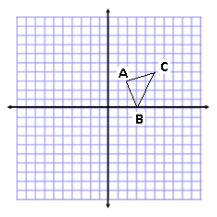
A(2,3)->A'(0,7)->A"(0,-7)
B(3,0)->B'(1,4)->B"(-1,-4)
C(5,4)->C'(3,8)->C"(-3,-8)