Ocean Movement
Coastal Environments
Marine Biology
Marine Communities
Big Picture
100
This is the highest point of a wave, while the trough is typically the lowest
What is the wave crest?
100
These continental margins are defined by their relationship with the neighboring oceanic plate. One is geologically active and one is stable.
What are passive and active margins?
100
This term describes the sum of all biological and physical parts of a marine environment interacting as a unit.
What is an ecosystem?
100
These two broad groups of organisms dominate the pelagic environment. One drifts and one swims.
What are plankton and nekton?
100
While matter is recycled through the marine ecosystem, this component only flows in one direction and is constantly replenished from an external source.
What is energy?
200
This process is likely to produce tsunamis like the one in Japan in 2011
What are deep sea earthquakes?
200
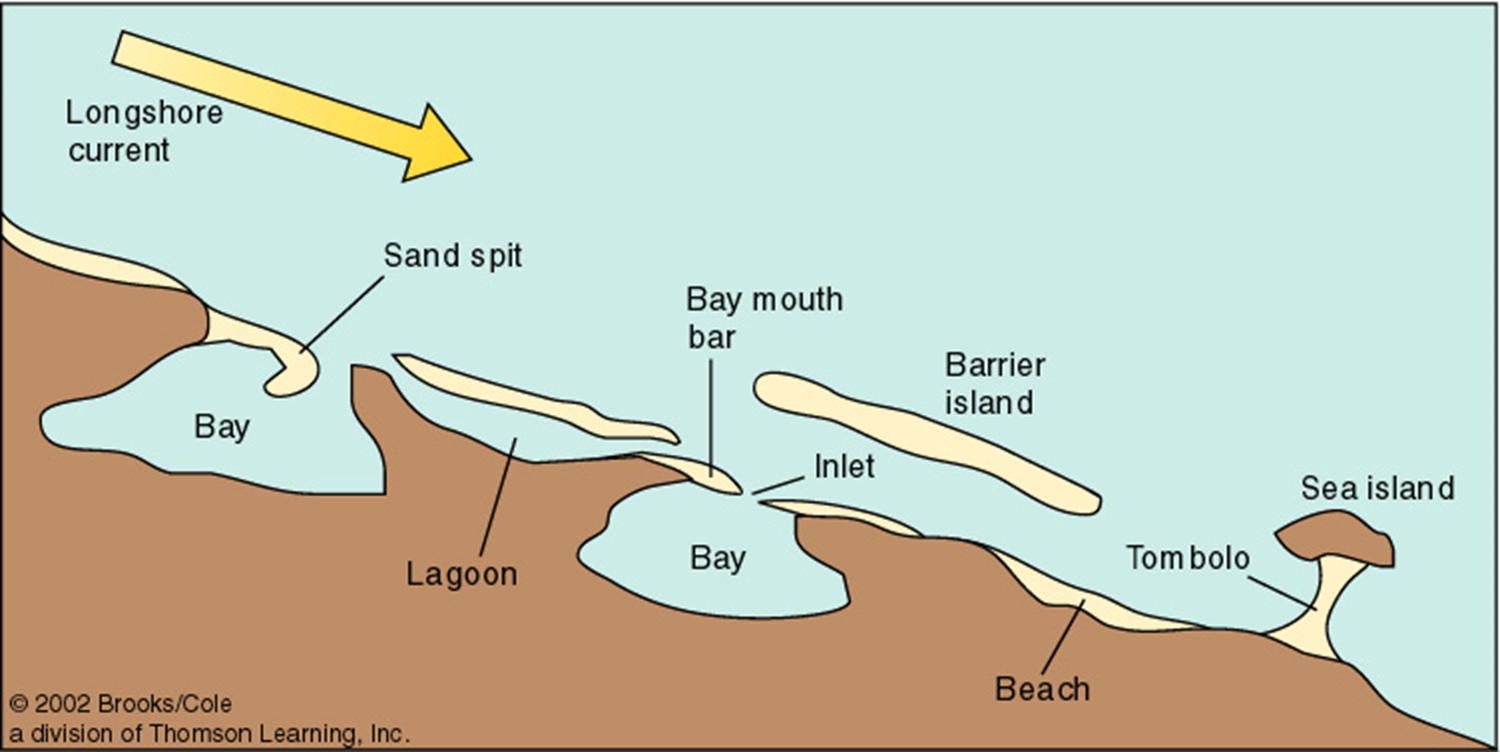 This is an example of a ________ coast.
What is a depositional coast?
200
Holoplankton differs from Meroplankton in this way
What is living their entire lifetime as plankton?
200
Producers in the deep ocean are not able to photosynthesize. What process allows them to produce food from inorganic materials?
What is chemosynthesis?
200
This marine life zone is located on the ocean floor, rather than the water column of the ocean.
What is the benthic zone?
300
 The following diagram is showing a _____ tide.
What is a neap tide?
300
This type of semi-enclosed coastal body of water is where fresh water from a river meets and mixes with salty ocean water.
What is an estuary?
300
Diatoms, dinoflagellates, coccolithophores, cyanobacteria make up what group of organisms?
What are phytoplankton?
300
These temporary communities in the deep ocean provide a pulse of nutrients that allow specialized organisms to migrate between isolated hydrothermal vent communities.
What are whale falls?
300
 The role that phytoplankton play in the marine food web is referred to as this.
What are primary producers?
400
These three tidal patterns are observed across the world, one having two cycles a day, another having one, and the final being a combination of both.
What are semidiurnal, diurnal, and mixed tides?
400
This 'zig-zag' movement of sediment along the shore is caused by waves hitting the beach at an angle and the resulting current that flows parallel to the coastline.
What are longshore drift and longshore currents?
400
These areas are considered to have the highest primary productivity in the oceans often due to the large input of nutrients, as opposed to areas of low productivity like the center of ocean gyres.
What are areas of upwelling (coastal waters)?
400
Community location is primarily determined by these two types of factors: physical (like salinity and temperature) and biological (like predation and competition).
What are limiting factors?
400
This term describes a species that has an exceptionally large impact on its community, such as Antarctic Krill or certain predators.
What is a keystone species?
500
In the dynamic theory of tides, this is the 'no-tide' node at the center of an ocean basin around which the tide crest rotates once each tidal cycle.
What is the amphidromic point?
500
To prevent erosion, humans build these structures to disrupt the transport of sediment from the ocean. They often starve the down-drift areas of sediment
What are groins (jetties)?
500
 This simplified diagram is showing what process that sequesters inorganic carbon in the ocean?
What is a biological pump?
500
In a marine community, these three terms describe A) a group of the same species, B) the physical place they live, and C) their specific "job" or role within that community.
What are population, habitat, and niche?
500
This 'loop' within the marine food web describes how bacteria recycle dissolved organic matter back into the ecosystem, making it available to larger plankton.
What is the microbial loop?