Charge it
Electric Force
Vocabulary
Sparks Fly
Currently
100
The matter around us is made of atoms. What are atoms made up of? (p.194)
Atoms are made of protons, neutrons, and electrons.
100
While the force of gravity always attracts objects, electric charges can be either attractive or repulsive.
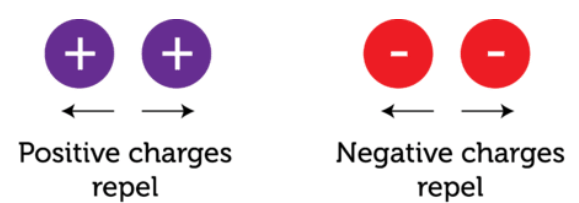
If two objects are both positively charged, will they attract or repel each other? (p.195)
Repel.
100
What do we call the transfer of electric charge between objects that are touching each other? (p.196)
Charging by contact.
100
What is the imbalance of electric charge on an object called? (p.198)
Static charge.
An object that loses electrons has more positive charge than negative charge. An object that gains electrons has more negative charge than positive charge.
100
What is the flow of electric charges called? (p.201)
Electric current.
200
What type of charge do electrons have? (p.194)
Electrons have a negative charge.
200
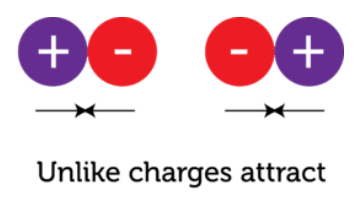
If one object is positively charged, and the other object is negatively charged, will they attract or repel each other? (p.195)
Attract. Remember opposites attract!
200
What do we call the rearrangement of electric charge due to the presence of an electric field? (p.197)
Charging by induction.
When an object has been charged by induction, one part of the object becomes positively charged, and another part becomes negatively charged. However, the object remains electrically neutral.
200
What is the movement of static charge from one place to another? (p.198)
Static discharge.
200
What is the SI unit for current? (p.201)
Ampere.
Amperes are represented by the symbol A.
300
What type of charge do protons have? (p.194)
Protons have a positive charge.
300
The electric force between two charged objects depends upon the distance between the objects.
If two electrons move farther apart, will the electric force between them increase or decrease? (p.195)
Decrease.
The electric force decreases as the distance between the objects increases.
300
What is a material in which electric charges can move easily? (p.197)
Conductors.
The best conductors are metals such as gold, silver, and copper. Because electrons move easily in copper, it is widely used in electric wires.300
True or false?
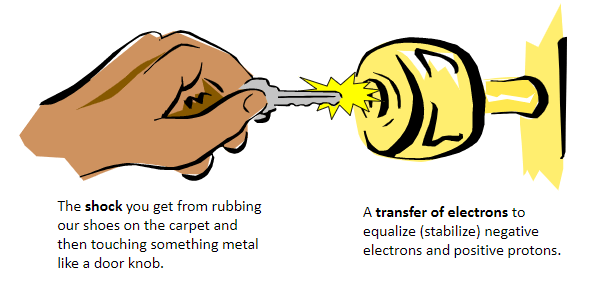
Charging by induction causes a spark to jump from your hand to the doorknob after you have walked on carpet. (p.198)
True.
300
True or false?
When a current flows in a wire, the same number of charges flow into and out of the wire. (p.201)
True.
The wire remains electrically neutral.
400
What is the name for an object that has an equal amounts of positive and negative charge? (p.194)
Electrically neutral.
Because an atom has equal numbers of protons and electrons, it contains equal amounts of positive and negative charge.
400
The electric force between two charged objects also depends on the amount of charge on each object.
If the amount of charge on one object increases, will the electric force between the objects increase or decrease? (p.195)
Increase.
As the amount of charge on either (or both!) objects increases, the electric force between them also increases.
400
What are materials in which electric charges do not move easily? (p.197)
Insulators.
Examples of insulators are plastics, glass, rubber, and wood.
400
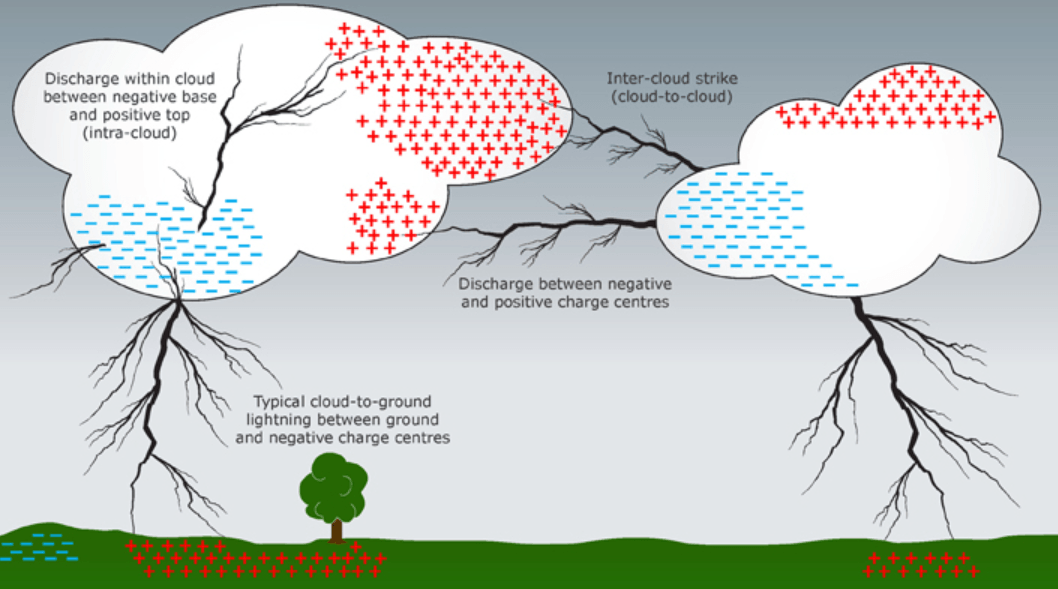
What is an example of electric discharge that occurs in nature? (p.199)
Lightning.
400
Electric current will flow continuously only if the charges flow in a closed path. What do we call a closed path in which electric charges can flow? (p.202)
Electric circuit.
500
What do we call an object that has an unequal number of positive and negative charge? (p.194)
Electrically charged.
If an atom gains or loses an electron, it is electrically charged.
500
How can electric charges exert forces on each other if they are not touching? (p.196)
An electric charge is surrounded by an electric field that exerts on other electric charges.
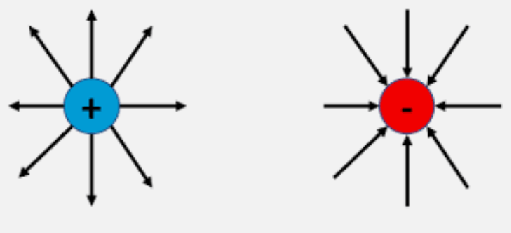
The electric field around a positive charge points away from the charge. The electric field around a negative charge points toward the charge.
500
What do we call the measure of how difficult it is for electrons to flow in an object? (p.203)
Electric resistance.
The resistance of insulators is usually much higher than the resistance of conductors.
500
What is one way to protect buildings from the effects of being struck by lightning? (p.200)
Grounding.
By attaching a metal lightning rod to the top of the building. When lightning strikes the lightning rod, the electric charges in the lightning flash flow through the connecting wire into the ground. Earth is able to absorb large quantities of excess electric charge.
500
What type of energy conversion occurs in a battery that is connected in a circuit? (p.202)
Chemical to Electric.