Slope
Y-intercept
Equations
Graphing
100
How do you calculate the slope of a straight line?
To calculate the slope of a straight line, you can use the formula: Slope= rise / run.
100
What does the Y-intercept represents in a linear equation?
The Y-intercept represents the point where the line crosses the Y-axis.
100
What is an equation?
An equation is written as two expressions, connected by an equal sign ''=''.
100
The point where the x-axis and y-axis intersect is called the?
Origin point.
200
What does a positive slope indicate in terms of the line's direction?
A positive slope indicates that the line is going upward from left to right.
200
How can you tell if the Y-intercept will be added or subtracted?
If the y-intercept is positive, it will be added.
If the y-intercept in negative, it will be subtracted.
200
Solve the linear equation below:
y = 8x - 17
x = 6
y = 51
200
In a coordinated pair (12,8), which variable is written first?
x-values are written first.
300
How do you calculate the rise of a line?
You find the difference along the y-axis between two data points.
300
What is the y-intercept of the graph below?
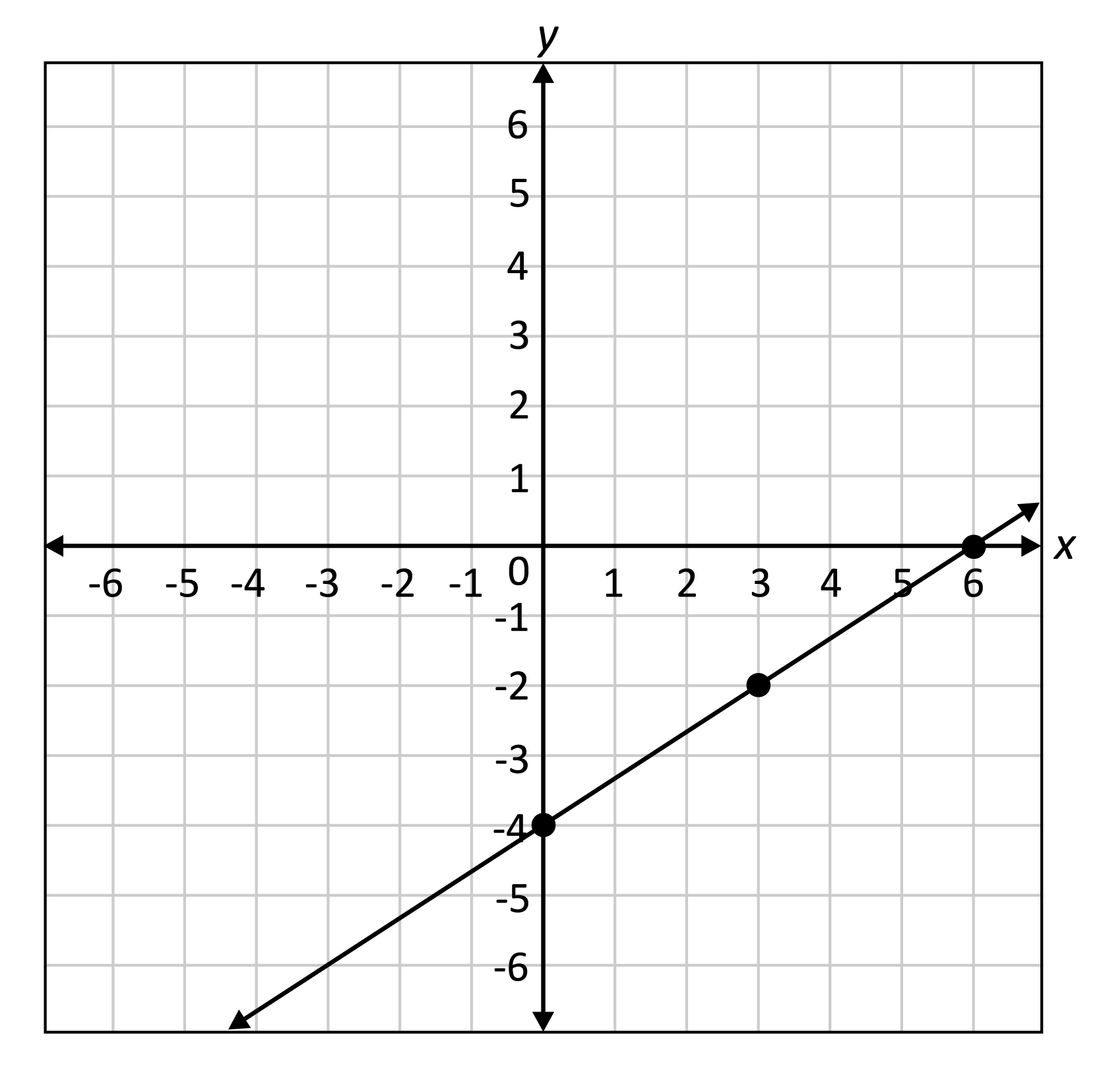
The y-intercept is -4.
300
Solve the linear equation below.
-12x + 18 = 126
x = -9
300
If a data points are plotted on a graph and they create a curved line, does the graph represent a linear equation?
No, linear equations create straight lines.
400
What is slope?
The word slope is the ratio that describes the steepness and direction of a line.
400
Can a linear equation have a y-intercept of 0?
Yes, if the line passes through the origin (0,0), then the y-intercept is 0.
400
Solve the linear equation below.
4(x + 8) = 44
x = 3
400
The horizontal axis is called the?
x-axis
500
What is the significance of a slope of zero in a linear equation?
A slope of zero in a linear equation means that the line is horizontal.
500
Given the linear equations below, what would the y-intercept of the line be?
y = -2x + 12
The y-intercept would be +12
500
Solve the linear equation below.
12(x - 4) = 134
x = 15
500
Where are the four quadrants located in a graph?
Quadrant I has positive x and y values, Quadrant II has negative x and positive y, Quadrant III has negative x and y, and Quadrant IV has positive x and negative