PERIODIC TABLE
Miscellaneous
Chemical Bonds
Chemical Reactions
Names and Formulas
100
Group 18 on the periodic table
Noble Gases
100
The smallest particles that still have unique properties and cannot be split any smaller has been given this name.
Element
100
Electrons are transferred in this type of bond.
Ionic
100
A solution changes from blue to green. Which indicator of a chemical reaction is observed?
Colour Change
100
Write the formula for Beryllium Sulfide.
BeS
200
Magnesium, calcium, and beryllium belong to this family of reactive metals
Alkaline Earth Metals (Group 2)
200
What hazard does this symbol represent?
Explosive, This WHMIS symbol warns that a product may explode if heated, shocked, or dropped.
200
Electrons are shared in this type of bond.
Covalent Bond
200
Bubbles forming during a reaction indicate this.
Gas Produced
200
Name the compound MgI₂.
Magnesium Iodide
300
How many valence electrons does oxygen have?
6
300
Particle Theory rests on four main postulates. One states that particles are always ______.
Moving / In motion
300
The type of Bond in MgO
Ionic
300
A new solid formed during a reaction is called this.
Precipitate
300
Write the formula for Silicon Tetrafluoride.
SiF₄
400
An atom has an atomic mass of 24 and an atomic number of 12. How many neutrons does it have?
12 neutrons
400
What hazard does this symbol represent?
Oxidizer, This WHMIS symbol warns that a substance can make a fire burn more intensely by supplying oxygen.
400
Is N₂O₅ ionic or covalent? Explain why.
Covalent Bond, Nitrogen and oxygen are both non-metals.
400
Condensation is what type of change?
Physical Change
400
Name the compound Fe₃P₂
Iron(II) Phosphide
500
What element does not follow the trick used to determine the number of valence electrons?
Helium (only 2 electrons on the outermost shell)
500
A scientist changes the amount of light a plant receives and measures its height. Identify the independent and dependent variables.
Independent Variable: Amount of light
Dependent Variable: Plant height
500
Based on the model shown, is this compound ionic or covalent? Explain your reasoning and identify two elements that could form this compound.
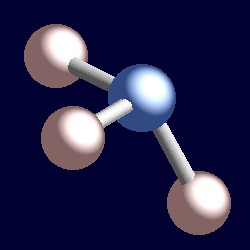
Covalent. Nitrogen and hydrogen are non-metals, so they share electrons. N goes from 5 to a stable 8 valence electrons, while each H goes from 1 to a stable 2 electrons.
500
What are 4 signs of chemical changes?
- Gas Produced
- Colour Change
- Precipitate
- Temperature Change
500
Name the compound PbS₂ and explain how you determined it.
Lead(IV) Sulfide
- Sulfide (S²⁻)
- Two sulfides = -4 total, Lead must be +4
- Lead(IV) Sulfide