FLUID & ELECTROLYTE BALANCE
ACID-BASE BALANCE
RESPIRATORY SYSTEM
NUTRITION & METABOLISM
ENDOCRINE SYSTEM
100
A patient taking loop diuretics is MOST at risk for losing what electrolyte?
Potassium
100
A solution with a lower concentration of hydrogen ions, also called "basic solution"
Alkaline solution
100
This organ provides a passageway for air to reach the lungs from the outside.
Trachea (windpipe)
100
This organ aids in the digestion of lipids through the production of bile.
The liver
100
Glands that secrete their products into ducts that empty onto a surface or cavity. (Ex. sweat and salivary glands)
Exocrine glands
200
A basic mechanism for adjusting intake to compensate for excess output of body fluid.
Thirst mechanism
200
An arterial blood pH lower than 7.35 indicates what?
Acidosis
200
A life-threatening condition caused by Hib infection most common in children.
Epiglottitis
200
The process of splitting a glucose molecule into two pyruvic acid molecules and two ATP molecules.
Glycolysis
200
This hormone stimulates the breakdown of bone and causes an increase in blood calcium concentration.
Parathyroid hormone (PTH)
300
What hormone is released when blood volume becomes TOO HIGH and the body needs to get rid of sodium and water?
ANH (Atrial Natriuretic Hormone)
300
Substances that prevent a sharp change in the pH of fluid when an acid or base is added to it.
Chemical buffers
300
What is the term for collapsed lung tissue or collapsed alveoli?
Atelectasis
300
The energy that must be produced per hour by catabolic reactions just to keep the body alive, awake, and comfortably warm.
Basal metabolic rate (BMR)
300
The body senses a decrease in blood glucose. As a result, the endocrine cells in the pancreas start to slow the production and release of insulin. This is an example of what?
Negative feedback
400
A "water pushing force" that pushes fluid out of the blood in capillaries into the interstitial fluid.
Capillary blood pressure
400
A patient with slow respirations after an opioid overdose is likely developing what imbalance?
Respiratory acidosis
400
A process where gas is exchanged between the blood in systemic capillaries and the cells of the systemic body tissues.
Internal respiration
400
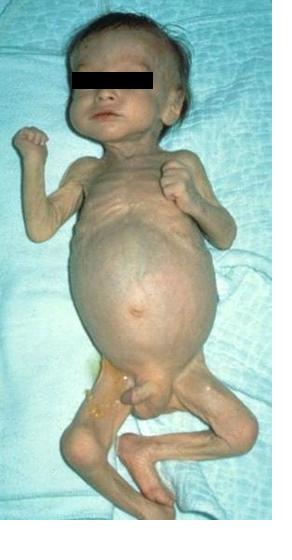 What is this?
Marasmus
400
This hormone is produced in a tissue and diffuses to act on cells within that tissue.
Prostaglandins
500
A patient with muscle weakness, diminished reflexes, and fatigue likely has what electrolyte imbalance?
Hypercalcemia
500
A patient in DKA begins hyperventilating due to a drop in pH. What is this an example of?
Compensation
500
Volume moved into or out of the respiratory tract during a typical respiratory cycle.
Tidal volume (TV)
500
Transfer of heat energy to cooler air that is continually flowing away from the skin.
Convection
500
What is this?
Exopthalmos seen in Graves disease