Throughout A&P
Skeletal
Muscular
Nervous
Endocrine
Circulatory
Lymphatic/
Immune
Immune
Respiratory
100
What is the microscopic study of tissues? There are 4 categories of tissues, name one.
Histology. Connective, nervous, epithelial, or muscle.
100
Name and describe one of the fractures we learned about in this class.
transverse, comminuted, greenstick, spiral, oblique, segmental, open (compound)
100
Name 3 types of muscle and specify the striated one(s).
skeletal, cardiac, and smooth
100
Name a structure in the brain that you would only see if the brain is cut in half (along medial plane)
corpus callosum, thalamus, hypothalamus, pituitary . . .
100
Define hormone in 2 words (you can use more, but it only takes 2)
chemical messenger
100
There is a part of the heart that is called the heart's pacemaker. Name it and give the chamber where it is located.
SA node, right atrium
100
We have a lot of "first line" defenses in our arsenal of nonspecific defenses. What is an example of a first line defense?
skin, mucus, tears, cilia, stomach acid
100
What is the word we use that means "pertaining to the lungs?"
pulmonary
110
Stand in anatomical position and then use your right hand to show the distal portion of your femoral region on your left.
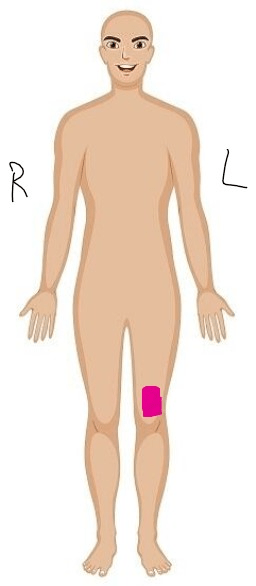
110
We learned 5 functions of the skeletal system. Name 3 of them.
produce blood cells, give structure/support, store minerals, protect organs, enables movement
110
Name 2 places that you would find smooth muscle at work in a different organ system.
digestive system - stomach, sphincters
circulatory system - artery walls
respiratory system - diaphragm, bronchioles
urinary - bladder
110
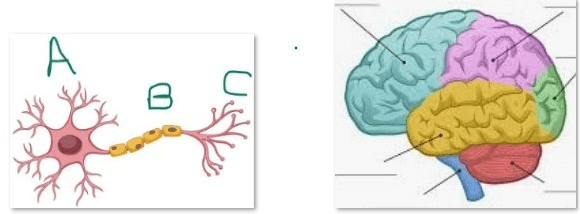
dendrite, cell body, axon, myelin sheath (schwann cells) axon terminal
frontal, parietal, occipital, cerebellum, brainstem, temporal
110
Name an organ that is in the endocrine system and also the digestive system
pancreas
110
There are 3 types of blood vessels and each has a unique structure that makes it suited for it's function. Choose one and relate its form to its function.
arteries - muscular walls -
veins - valves
capillaries - tiny, branching, walls one cell thick
110
Give the better, more science-y names for nonspecific immunity and specific immunity.
innate and adaptive (or acquired)
110
What part of the lungs participates directly in O2/CO2 gas exchange?
alveoli
120
The two major divisions of the human body both begin with the letter A. What are they?
Axial and Appendicular
120
What is a reduction?
Realigning a fractured bone
120
Which of the following shortens when a muscle contracts?
A. filament B. sarcomere C. tendon D. muscle fiber
B. sarcomere
120
what do we call the electrical wave that travels down the neuron and jumps to the next neuron?
action potential
120
What two hormones are involved in the homeostasis of blood glucose?
insulin and glucagon
120
Name the top and bottom number in blood pressure. Name a healthy blood pressure.
systolic, diastolic. healthy is at or below 120/80
120
What are three things that happen in a typical inflammatory response? (ex: you stab your finger with a fish hook)
pain, swelling, redness, chemicals released, vasodilation, certain white blood cells converge
120
Choose one of the lung volumes - name and describe what it is.
TV, IRV, ERV, RV, TLC
explained
130
In every unit this year, we discussed how body systems working alone or together maintain homeostasis. What is homeostasis? Give an example.
homeostasis - maintaining internal balance
many examples
130
Listen first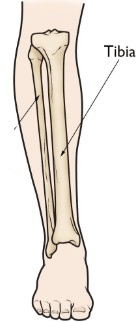
fibula - posterior, lateral, or posterio-lateral
130
Distinguish between the origin and insertion of a muscle.
origin is the proximal, less movable attachment site. insertion is the distal, more movable attachment site.
130
The brain's cortex (outer layer) is covered with bumps and grooves. Give the correct name for at least one of these and explain why the cortex is folded like this.
Gyrus/gyri, sulcus/sulci This increases surface area (for processing)
130
A homeostatic response that counteracts the original stimulus
Ex. parathyroid hormone raises low blood calcium and thyroid hormone lowers high blood calcium.
negative feedback loop
130
Blood under low pressure has to return, against gravity to the heart. Name two things that help it get there.
Valves in veins prevent back flow, and the "muscular pump" (contracting body muscles) help squeeze it back toward the heart.
130
Name the parts of the lymphatic system 6 possible answers, give me 4.
lymph, lymph vessels, lymph nodes, thymus, spleen, tonsils (or other lymphoid tissue)
130
Name a disease of the lung that we learned about in here, and describe it.
pneumonia, emphysema, etc
150
1) Name and demonstrate one of the body planes and 2) name a body cavity and one organ located therein.
PLANES - sagittal, medial, transverse, coronal (frontal) CAVITIES - cranial, thoracic, abdominal, pelvic, vertebral, etc.
150
When learning about joints, we focused on one type that includes ball and socket, and hinge joints. What type of joint are these?
synovial
150
We learned 6 different features of a muscle that can be used to name it. Give 3 of those features and an example for each.
size - maximus shape - trapezius
location - tibialis fiber orientation - oblique
# heads - biceps movement - flexor
150
Name a structure in the middle of the brain that cannot be seen without cutting the brain in half. Give the function of that structure.
corpus callosum, thalamus, hypothalamus, pituitary . . .
150
How do endocrine disruptors work in our bodies and give an example of one.
They disrupt normal hormone action (mimicking, blocking, etc) Ex. plastics, fragrances, pesticides
150
The EKG is made up of several segments. Choose one of those segments and explain what is happening in the heart at that time.
p wave - atria depolarize
qrs complex - ventricles depolarize/atria repolarize
st interval - heart pumps
t wave - ventricles repolarize
150
how does a vaccine work?
It is a killed or weakened pathogen (virus) that allows your body to develop antibodies to protect you in subsequent encounters
150
What is the name of lung function testing and what is the one lung volume that cannot be measured?
spirometry - RV (residual volume)