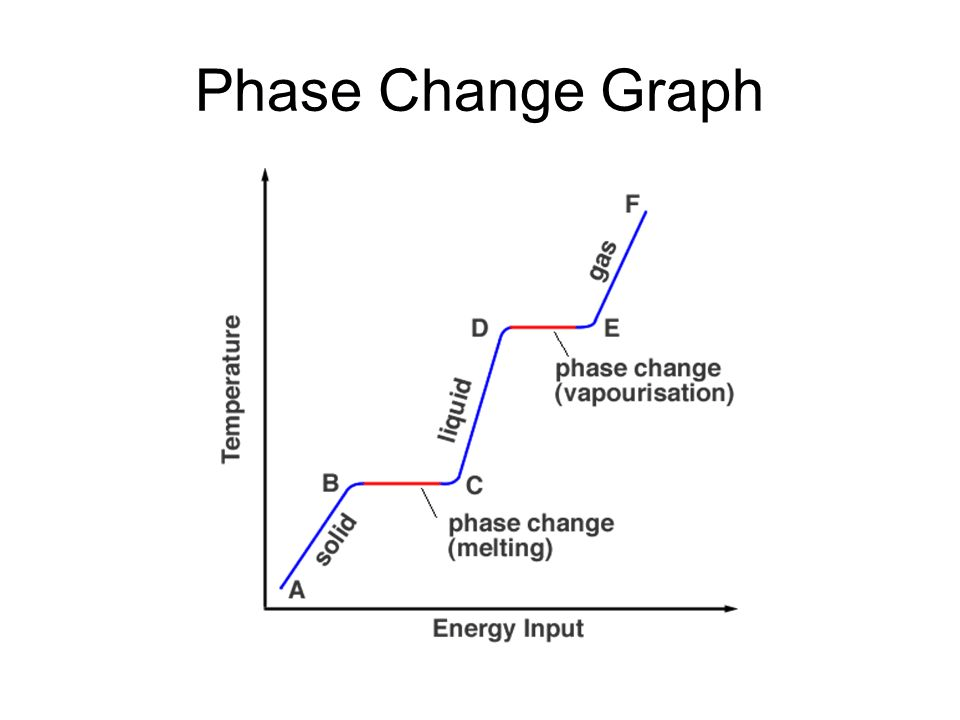
Temperature
Heat
Calorimetry
Phase Changes
Wild Card
100
The temperature range at which this substance is a liquid: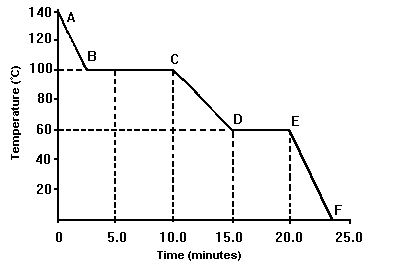
What is 60 oC to 100 oC?
100
The unit used to express the amount of energy absorbed or released during a chemical reaction.
What is joules?
100
Two possible ways to write the units for specific heat capacity.
What are J/goC and J/gK ?
100
As liquid water boils at standard pressure, the temperature remains at 100 degrees Celsius until it has completely evaporates. During this constant temperature, the potential energy _________.
Increases
100
The freezing point of chlorine in Celsius.
What is -101 oC?
200
The Kelvin temperatures that represent the normal freezing point and the normal boiling point of water, respectively.
(Normal = at standard pressure)
What is 273 K and 373 K?
200
If two systems of equal mass but varying temperatures come in contact with each other, heat will flow from the system at...
A. 333 K to the system at 70 oC
B. 293 K to the system at 40 oC
C. 303 K to the system at 20 oC
D. 263 K to the system at 23 oC
C. 303 K to the system at 20 oC
200
The amount of heat absorbed by 11 grams of water that increased in temperature by 5.0°C.
What is 229.9 J?
200
As ethanol solidifies, potential energy __________. This is considered an _____________ process.
decreases, exothermic
200
The temperature value at which the substance on this graph condenses.
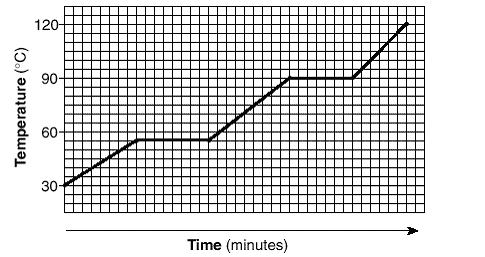
What is 90 oC?
300
The temperature of a liquid that is measured in the Kelvin scale is directly proportional to the _______ _________ __________ of the liquid molecules.
What is average kinetic energy?
300
The heat required to raise the temperature of one gram of a given substance by one degree Kelvin.
What is specific heat capacity?
300
The temperature of 75 grams of water changes from 17°C to 25°C. What is the total number of joules of heat energy absorbed by the water?
2508 J
300
Which phase change represents an exothermic process: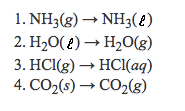
1. NH3(g) --> NH3(l)
300
This line segment represents the solid phase only.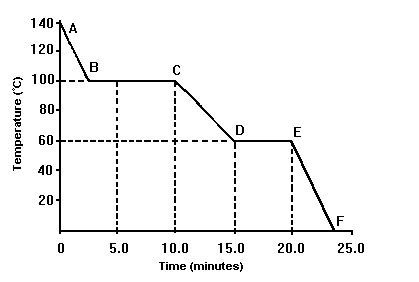
What is EF?
400
Which temperature change indicates an increase in the average kinetic energy of the molecules in a sample?
a) 15°C to 298 K
b) 37°C to 273 K
c) 305 K to 0°C
d) 355 K to 25°C
a) 15°C to 298 K
400
When condensation occurs, it is an ___-thermic process because heat is ________.
exo-, released
400
How much heat energy must be absorbed to completely melt 45.0 grams of H2O(s) at 0°C?
15,030 J
400
The melting point, in degrees Celsius, of the substance represented by this phase change diagram:
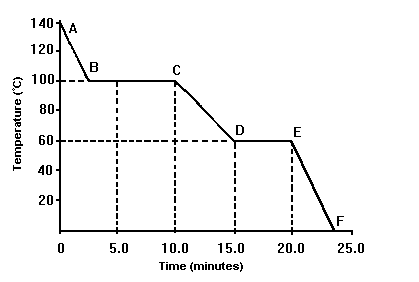
What is 60 degrees Celsius?
400
During which TWO time intervals is the average kinetic energy of the particles of the substance constant while the potential energy of the particles increases?
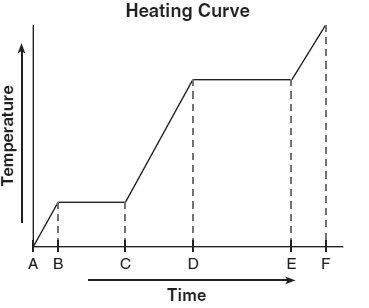
BC and EF
500
A 32-gram sample of water has an initial temperature of 22°C. After the sample absorbs 1346 joules of heat energy, the change in temperature of the sample is...
What is 10oC?
500
How much heat is needed to change 50 grams of ethanol liquid into vapor at its boiling point of 78 degrees Celsius? Heat of vaporization of ethanol is 840.0 J/g.
What is 42,000 Joules?
500
A 120 g sample of metal has a specific heat capacity of 0.89 J/goC. It starts initially at 25oC, and after some time the metal absorbs enough energy to reach a final temperature of 115oC. How much energy was absorbed?
What is 9612 Joules?
500
As a phase change occurs...
A. potential energy remains constant and kinetic energy changes.
B. kinetic energy remains constant and potential energy changes.
C. A sloped line can be observed on a phase change diagram.
D. A flat line can be observed on a phase change diagram.
E. Both B and D
F. Both A and C
E. Both B and D
500
Draw a labeled phase change diagram which represents a solid heating to a liquid and then to a gas. Label each of the seven components of the graph with the appropriate AXIS LABELS, PHASES and ENDOTHERMIC PHASE CHANGES.