A
B
C
D
100
A 77-year-old man is evaluated for anemia that has worsened over the past year. He has fatigue and dyspnea on exertion. He has a history of poorly controlled hypertension. Medications are lisinopril, amlodipine, and hydrochlorothiazide.
On physical examination, blood pressure is 180/100 mm Hg. The remainder of the vital signs and physical examination are unremarkable.
Laboratory studies:
Hemoglobin
8.8 g/dL (88 g/L)
Leukocyte count
6800/μL (6.8 × 10⁹/L)
Mean corpuscular volume
88 fL
Platelet count
414,000/μL (414 × 109/L)
Reticulocyte count
1.2% of erythrocytes
Creatinine
3.2 mg/dL (283 μmol/L)
Ferritin
150 ng/mL (150 μg/L)
Iron
70 μg/dL (13 μmol/L)
Total iron-binding capacity
300 μg/dL (54 μmol/L)
Stool is negative for occult blood. Peripheral blood smear demonstrates normal leukocyte and erythrocyte morphology.
Ultrasound shows small echogenic kidneys bilaterally.
Which of the following is the most likely diagnosis?
Anemia of inflammation
Anemia of kidney disease
Microangiopathic hemolytic anemia
Myelodysplastic syndrome
100
A 32-year-old man is evaluated for easy bruising. He has no other medical problems; takes no medications, recreational drugs, or supplements; and does not drink alcohol.
On physical examination, vital signs are normal. Two small ecchymoses are noted on the left thigh; he also has one small bruise on the right upper arm. No petechiae are visible. He has no lymphadenopathy or hepatosplenomegaly.
Laboratory studies:
Hemoglobin
14.5 g/dL (145 g/L)
Leukocyte count
5500/μL (5.5 × 10⁹/L)
Mean corpuscular volume
85 fL
Platelet count
44,000/μL (44 × 109/L)
Reticulocyte count
1.2% of erythrocytes
Creatinine
0.7 mg/dL (61.9 μmol/L)
Urinalysis
Normal
Peripheral blood smear is unremarkable.
Which of the following are the most appropriate diagnostic tests?
Antinuclear antibodies and complement level
Antiplatelet antibodies and direct antiglobulin test
HIV and hepatitis C virus
Vitamin B12 and folate levels
100
A 48-year-old woman is evaluated in the emergency department for right leg swelling and pain of 1 week's duration. She reports no recent surgery, injuries, periods of immobility, or long airplane flights. Medical history is unremarkable. She takes no medications.
On physical examination, vital signs are normal. BMI is 20. Oxygen saturation is 99% breathing ambient air. Pitting edema extends to the knee on the right leg, and the right calf is 4 cm larger than the left calf. Pulses are intact, and capillary refill is normal.
Duplex ultrasound shows an acute thrombosis of the right femoral vein.
Which of the following is the most appropriate management?
Anticoagulation for 3 months
Anticoagulation for 3 months plus inferior vena cava filter
Extended anticoagulation
Thrombolytic therapy
100
A 68-year-old woman is evaluated in the emergency department for swelling in her right leg of 3 days' duration. She completed therapy for breast cancer 1 month ago. She takes no medications.
On physical examination, vital signs are normal. She has swelling of the right lower extremity from the foot to the thigh with pitting edema.
Which of the following is the most appropriate test?
Calculate the Pulmonary Embolism Rule-Out Criteria score
CT angiography
D-dimer measurement
Duplex ultrasonography
200
A 68-year-old woman is seen in consultation regarding recently diagnosed JAK2 V617F mutation–positive essential thrombocythemia. She is asymptomatic, has no other medical problems, and takes no medications.
On physical examination, vital signs are normal. The spleen is palpable 2 cm below the left costal margin.
Laboratory studies show a hemoglobin level of 13.5 g/dL (135 g/L), leukocyte count of 6000/μL (6 × 10⁹/L), and platelet count of 685,000/μL (685 × 109/L).
Which of the following is the most appropriate treatment?
Aspirin
Hydroxyurea plus aspirin
Ruxolitinib
Stem cell transplantation
200
A 72-year-old man is evaluated for progressive fatigue of several months' duration. Medical history is significant for carcinoma of the bladder diagnosed 6 years ago, which was treated with combination chemotherapy and radiation, cystectomy, and creation of a urinary diversion pouch with resection of 50 cm of ileum. He takes omeprazole for gastroesophageal reflux disease.
Vital signs and the remainder of the physical examination are noncontributory.
Laboratory studies:
Hemoglobin
8.8 g/dL (88 g/L)
Leukocyte count
4000/μL (4 × 10⁹/L)
Mean corpuscular volume
110 fL
Platelet count
140,000/μL (140 × 109/L)
Reticulocyte count
1% of erythrocytes
Alanine aminotransferase
30 U/L
Aspartate aminotransferase
50 U/L
Bilirubin
Total
3.5 mg/dL (59.9 μmol/L)
Direct
0.5 mg/dL (8.6 μmol/L)
Lactate dehydrogenase
400 U/L
Peripheral blood smear is shown.
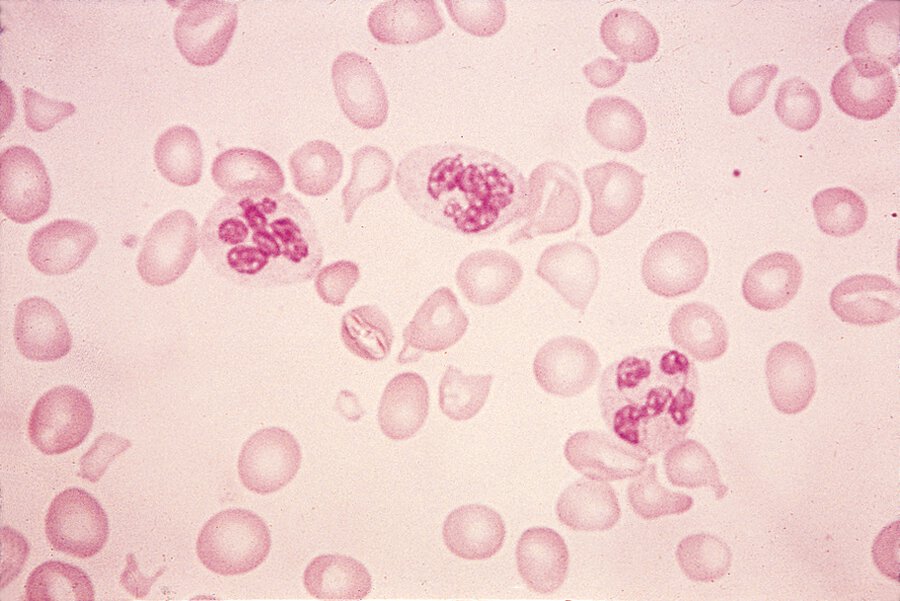
Which of the following is the most likely cause of this patient's anemia?
Hypothyroidism
Immune-mediated hemolytic anemia
Impaired vitamin B12 absorption
Liver disease
200
A 70-year-old man is evaluated for recently discovered erythrocytosis. Other than daytime sleepiness, he feels well. He has a 50 pack-year history of smoking and continues to smoke. He also has obesity, hypertension, and obstructive sleep apnea. He is nonadherent with continuous positive airway pressure (CPAP) ventilation because of discomfort. His only medication is lisinopril.
On physical examination, vital signs are normal. BMI is 35. Oxygen saturation is 98% breathing ambient air. The examination is unremarkable.
Laboratory studies:
Erythropoietin
33 mU/mL (33 U/L)
Hematocrit
52%
Leukocyte count
8000/μL (8 × 10⁹/L)
Platelet count
185,000/μL (185 × 109/L)
Genetic testing is negative for the JAK2 V617F mutation.
He receives brief behavioral intervention for smoking cessation and is offered varenicline. He is referred to sleep medicine to discuss strategies to decrease discomfort with CPAP and to improve adherence.
Which of the following is the most appropriate additional management?
Bone marrow biopsy
Hydroxyurea
Phlebotomy
Ruxolitinib
No further testing or interventions
200
A 77-year-old man undergoes follow-up evaluation for macrocytic anemia discovered last week on a routine complete blood count. He was diagnosed with polycythemia vera 12 months ago. Treatment consists of the antimetabolite hydroxyurea. Before starting hydroxyurea, vitamin B12 and folate levels were normal. His only other medication is a multivitamin with folic acid.
On physical examination, vital signs and the physical examination are normal.
Laboratory studies:
Haptoglobin
Normal
Hemoglobin
12 g/dL (120 g/L)
Leukocyte count
3000/μL (3 × 10⁹/L)
Mean corpuscular volume
115 fL
Platelet count
140,000/μL (140 × 109/L)
Reticulocyte count
1% of erythrocytes
Bilirubin
Normal
Lactate dehydrogenase
Normal
Peripheral blood smear demonstrates macrocytosis and hyperchromia.
Which of the following is the most likely cause of the patient's macrocytic anemia?
Hydroxyurea
Immune-mediated hemolytic anemia
Paroxysmal nocturnal hemoglobinuria
Vitamin B12 deficiency
300
68-year-old woman is seen in consultation 3 weeks following right hemicolectomy for stage III colon cancer. Medical history is otherwise unremarkable, and she takes no medications.
Physical examination is unremarkable, and the surgical site is healing well.
Chemotherapy with 5-fluorouracil, leucovorin, and oxaliplatin is planned.
Which of the following is most appropriate venous thromboembolism risk management for this patient?
Calculate the Khorana score
Initiate apixaban
Initiate low-molecular-weight heparin
Initiate warfarin
300
A 68-year-old woman is evaluated in the emergency department for abdominal and back pain and hypotension. Medical history is significant for atrial fibrillation. Medications are dabigatran and metoprolol.
On physical examination, temperature is 37.0 °C (98.6 °F), blood pressure is 88/60 mm Hg, pulse rate is 120/min and irregular, and respiration rate is 20/min. Oxygen saturation is 96% breathing ambient air. Cardiopulmonary examination is normal. The abdomen is tender. Ecchymoses are noted on the left flank.
Laboratory studies:
Activated partial thromboplastin time
52 s
Hemoglobin
8.4 g/dL (84 g/L)
Leukocyte count
11,600/μL (11.6 × 10⁹/L)
Platelet count
428,000/μL (428 × 109/L)
INR
1.6
CT scan shows a large retroperitoneal hemorrhage.
Which of the following is the most appropriate treatment?
Andexanet alfa
4-Factor prothrombin complex concentrate
Idarucizumab
Plasma
300
A 35-year-old man is evaluated in the emergency department for a 2-day history of swelling in his left leg. His mother was diagnosed with a venous thromboembolism at age 50 years. The patient can identify no provoking event. He is otherwise well and takes no medications.
On physical examination, vital signs are normal. The entire left lower extremity is swollen.
Lupus anticoagulant, anticardiolipin antibody, and anti–β2-glycoprotein antibody testing is normal.
Duplex ultrasonography confirms deep venous thrombosis in the left femoral vein.
Which of the following should be measured now to inform immediate treatment ?
Antithrombin
Factor V Leiden
Proteins C and S
No additional testing
300
A 75-year-old man is hospitalized with sepsis secondary to community-acquired pneumonia. He has been otherwise well before hospital admission and was taking no medications.
On physical examination, temperature is 39.4 °C (102.9 °F), blood pressure is 90/52 mm Hg, pulse rate is 110/min, and respiration rate is 16/min. Oxygen saturation is 92% using a nonrebreathing mask. Cardiac examination reveals tachycardia. Bilateral basilar pulmonary crackles are noted.
Laboratory studies:
Activated partial thromboplastin time
55 s
D-dimer
2.8 μg/mL (2.8 mg/L)
Hemoglobin
9.1 g/dL (91 g/L)
Leukocyte count
14,000/μL (14 × 109/L)
Platelet count
55,000/μL (55 × 109/L)
Prothrombin time
19 s
Fibrinogen
105 mg/dL (1.05 g/L)
Peripheral blood smear is shown.

Cultures are collected. Fluid resuscitation is provided with 0.9% saline, and broad-spectrum antibiotics are initiated.
Which of the following is the most appropriate initial treatment for the coagulopathy?
Eculizumab
Prednisone
Therapeutic plasma exchange
No additional treatment
400
A 35-year-old man is evaluated during a routine visit for β-thalassemia intermedia. One year ago, he began requiring erythrocyte transfusions every 4 to 6 months for symptomatic anemia. He has no other symptoms or medical problems, and his only medication is folic acid.
On physical examination, vital signs are normal. Frontal bossing, macrocephaly, scleral icterus, and splenomegaly are present and unchanged from previous examination. The remainder of the physical examination is unremarkable.
Laboratory studies show a hemoglobin level of 7.9 g/dL (79 g/L), leukocyte count of 6400/μL (6.4 × 10⁹/L), and platelet count of 110,000/μL (110 × 109/L). Iron studies were at the higher limit of normal one and a half years ago.
Which of the following is the most appropriate additional management?
Abdominal ultrasonography
Iron studies
Prophylactic anticoagulation
Splenectomy
400
A 64-year-old man is evaluated following a recent diagnosis of multiple myeloma. Diagnosis was based on a monoclonal spike on serum protein electrophoresis, confirmatory bone marrow biopsy, and two lytic lesions on bone imaging. Serum calcium level and kidney function are normal, and he has not experienced any infections.
He received a herpes zoster virus vaccination at age 60 years, receives annual influenza vaccination, and received the COVID-19 vaccination series.
Chemotherapy with bortezomib, lenalidomide, and dexamethasone is planned to begin in 14 days.
Which of the following prophylactic therapies is indicated today?
Acyclovir
Intravenous immune globulin
Levofloxacin
Pneumococcal vaccine
400
A 27-year-old woman is evaluated for spontaneous bruising. She reports a history of heavy menses since menarche, requiring treatment for iron deficiency anemia. Her mother and maternal uncle also have a history of bleeding. She takes no medications.
On physical examination, vital signs are normal. She has ecchymoses on her extremities, but her skin texture and joint mobility are normal. The remainder of the examination is unremarkable.
Laboratory studies:
Activated partial thromboplastin time
37 s
Hemoglobin
11.5 g/dL (115 g/L)
Leukocyte count
8000/μL (8 × 10⁹/L)
Mean corpuscular volume
78 fL
Platelet count
140,000/μL (140 × 109/L)
Prothrombin time
13 s
Factor VIII
40%
The platelet function testing result is abnormal.
Which of the following is the most likely diagnosis?
Ehlers-Danlos syndrome
Hemophilia A carrier
Immune thrombocytopenic purpura
von Willebrand disease
400
A 22-year-old man is admitted to the ICU for hypotension, tachycardia, hypoxia, and respiratory failure requiring intubation. He developed a fever, tachycardia, and malaise 12 hours ago. He has B-cell acute lymphoblastic leukemia that has relapsed multiple times; he received therapy with chimeric antigen receptor (CAR) T cells 4 days ago.
On physical examination, temperature is 40.0 °C (104.0 °F), blood pressure is 80/50 mm Hg, pulse rate is 140/min, and respiration rate is 36/min. Oxygen saturation is 80% breathing high-flow oxygen. No jugular venous distension is noted. Diffuse crackles are heard on pulmonary examination.
Laboratory studies show a leukocyte count of 2400/μL (2.4 × 10⁹/L) (reduced from 12,000/μL [12 × 109/L]) with 20% lymphoblasts (reduced from 80%) following CAR-T cell therapy. Serum creatinine is 2 mg/dL (176.8 μmol/L); serum electrolyte and urate levels are normal.
Which of the following is the most likely diagnosis?
Cytokine release syndrome
Progressive acute lymphoblastic leukemia
Tumor lysis syndrome
Venous thromboembolism