1
2
3
4
5
100
A freshwater protist lives in an environment where the surrounding water is less concentrated than the fluid inside its cell. The cell membrane allows water to move out slowly but limits the movement of many dissolved substances.
What term best describes this property of the cell membrane that helps the protist maintain homeostasis?
A. Active transport
B. Selective permeability
C. Simple diffusion
D. Impermeability
B. Selective permeability
100
A white blood cell engulfs a large bacterial cell by surrounding it and enclosing it within a vesicle. This process is called phagocytosis.
Which statement correctly describes phagocytosis?
A. Phagocytosis is a type of endocytosis, which is active transport.
B. Phagocytosis is a type of exocytosis, which is active transport.
C. Phagocytosis is a type of endocytosis, which is passive transport.
D. Phagocytosis is a type of exocytosis, which is passive transport.
A. Phagocytosis is a type of endocytosis, which is active transport.
100
A cell has been exposed to a chemical that damages its mitochondria. As a result, the cell can no longer produce ATP efficiently. Which of the following transport processes would be most affected by the lack of ATP?
A. Diffusion
B. Osmosis
C. Active transport
D. Facilitated diffusion
Active transport
100
After swimming in the ocean, a person notices their fingers appear wrinkled. Nearby, seaweed that has also been exposed to the salt water appears wilted. Which of the following best describes what is happening at the cellular level?
A. Plant cells burst as water enters the vacuole, while skin cells lose water from the cytoplasm and shrink.
B. Plant cells become flaccid as water leaves the vacuole, while skin cells shrink as water leaves the cytoplasm.
C. Plant cells maintain turgor pressure and remain firm, while skin cells shrink as water leaves the cytoplasm.
D. Plant cells become plasmolyzed as the cell membrane pulls away from the wall, while skin cells swell as water enters the cytoplasm.
B. Plant cells become flaccid as water leaves the vacuole, while skin cells shrink as water leaves the cytoplasm.
200
A scientist places a carrot cell and a red blood cell in distilled water. The image below shows the cells immediately after being placed in the water.
Describe what will most likely occur to each cell after the cells have been in the hypotonic solution for some time?
The carrot cell has a cell wall, so the cell swells, while the blood cell has only a cell membrane, so the cell bursts.
200
WHat type of passive transport is shown?
Facilitated diffusion
200
Students learned about the functions of various organelles and recorded their notes on notecards. List two functions of the plasma membrane.
Provide boundary
regulates materials in and out of the cell
200
What is the primary structural composition of the cell membrane?
A. A fluid phospholipid bilayer with embedded proteins
B. A rigid phospholipid bilayer with embedded carbohydrates
C. A fluid protein bilayer with embedded phospholipids
D. A rigid lipid layer with embedded structural proteins
A. A fluid phospholipid bilayer with embedded proteins
300
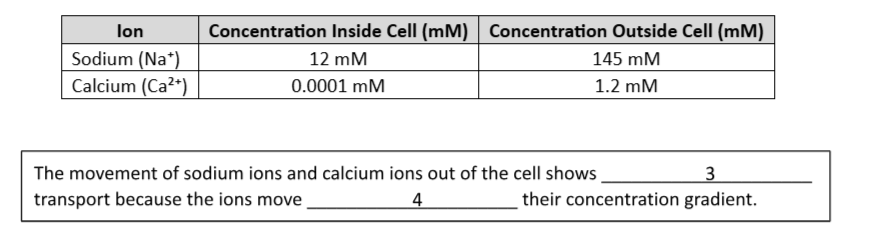
Fill in the blanks
Active
against
300
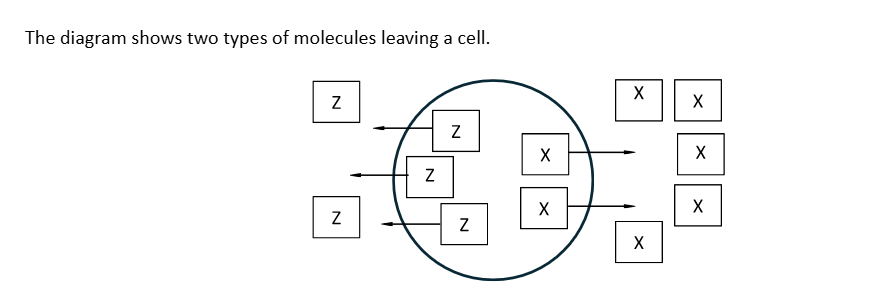
Correctly identify the processes responsible for the movement of these molecules.
Z passive
X active
300
The table below describes the functions of various biomolecules in the cell membrane. Determine whether
carbohydrates, lipids, or proteins are primarily responsible for each function.
Select the correct answer in each row.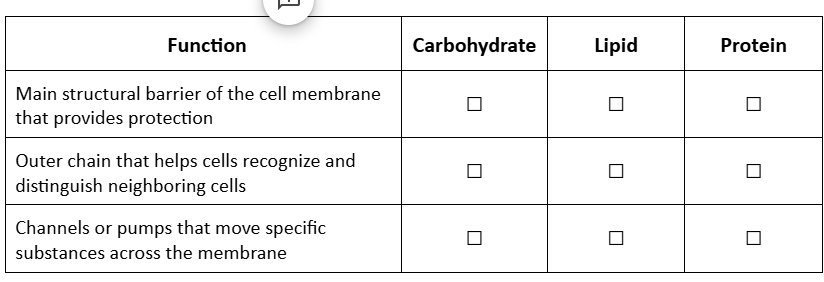
1. Lipid
2. Carb
3. Protein
300
_____19. In a plant cell, the concentration of potassium ions (K⁺) is higher inside the vacuole than in the cytoplasm. The cell must move K⁺ ions into the vacuole against their concentration gradient to maintain this difference.
Which process allows the cell to actively move potassium ions into the vacuole?
A. Osmosis
B. Diffusion
C. Endocytosis
D. Active transport
D. Active transport
300
Which of the following types of molecules can move across a cell membrane using passive transport?
A. Molecules packaged into vesicles
B. Large proteins and nucleic acids
C. Small, nonpolar molecules and ions
D. Polar molecules that require membrane channels
C. Small, nonpolar molecules and ions
400
Cholesterol is one type of lipid found in the cell membrane. Which of the following describes one of its main functions?
A. Forms channels that allow molecules to cross the membrane
B. Acts as a receptor to receive chemical signals
C. Provides markers that help cells recognize each other
D. Maintains the membrane’s fluidity and stability
D. Maintains the membrane’s fluidity and stability
400
A cell is placed in a solution where the concentration of a certain molecule is higher outside the cell than inside. Which what will happen to the molecule and through what type of transport?
The molecule will move into the cell by passive transport, down its concentration gradient.
400
Students observed onion epidermal cells under a microscope. Image A shows onion cells in fresh water, while Image B shows onion cells in salt water.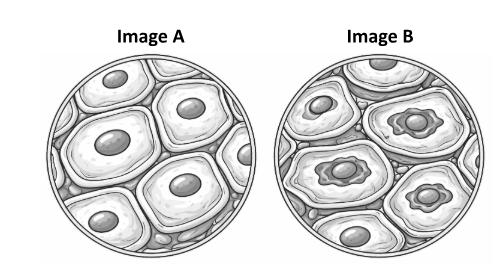
What process best explains the differences observed between the cells in Image A and Image B?
Osmosis moved water into the cells from the surrounding solution in Image A and out of the cells into the surrounding solution in Image B.
400
Which description best explains how molecules are arranged in the cell membrane?
A. Phospholipids have hydrophilic heads facing outward and hydrophobic tails facing inward, which form a two-layered barrier.
B. Carbohydrates have hydrophilic heads facing outward and hydrophobic tails facing inward, which create a
two-layered structure for cell support.
C. Phospholipids have hydrophobic heads facing outward and hydrophilic tails facing inward, which produce
a single-layered membrane.
D. Proteins have hydrophilic heads facing outward and hydrophobic tails facing inward, which make a double layer that controls transport.
A. Phospholipids have hydrophilic heads facing outward and hydrophobic tails facing inward, which form a two-layered barrier.
400
Which of the following correctly describes the roles of the carbohydrate chain of glycoproteins and glycolipids in the cell membrane?
A. They help with cell recognition and communication.
B. They store energy and provide structural support.
C. They store genetic information and prevent water movement.
D. They form a barrier that blocks all molecules.
A. They help with cell recognition and communication.
500
A biology class conducted an experiment to investigate how water moves across a selectively permeable membrane. Students first placed an egg in vinegar for 24 hours to dissolve the shell, leaving only the membrane intact. The egg, which is approximately 90% water, was then placed in a beaker containing 100% distilled water. The image below shows the egg in the beaker of water.
what is most likely to happen to the egg?
C. Water will move into the egg, which will cause the egg to swell.
500
A potato strip is placed in a hypertonic solution. Which graph best represents the change in the mass of the potato strip over time?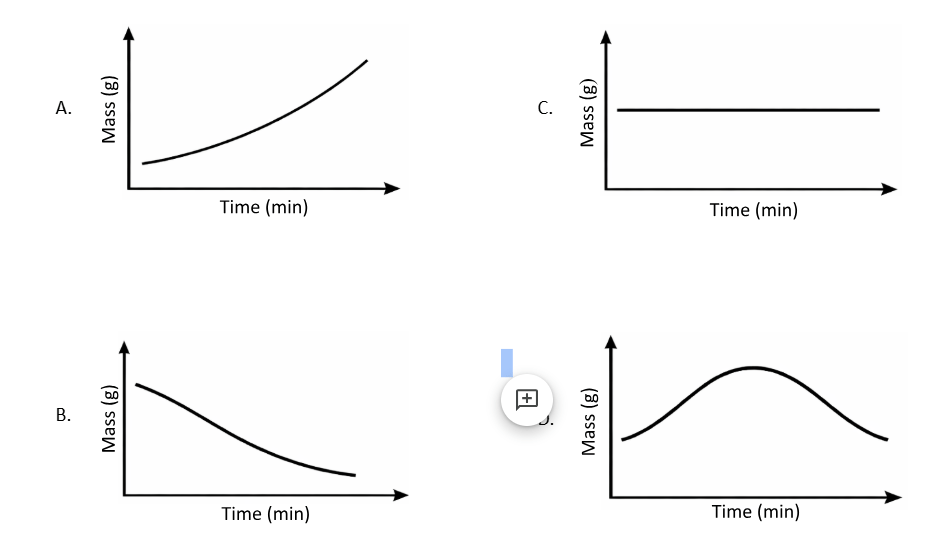
B
500
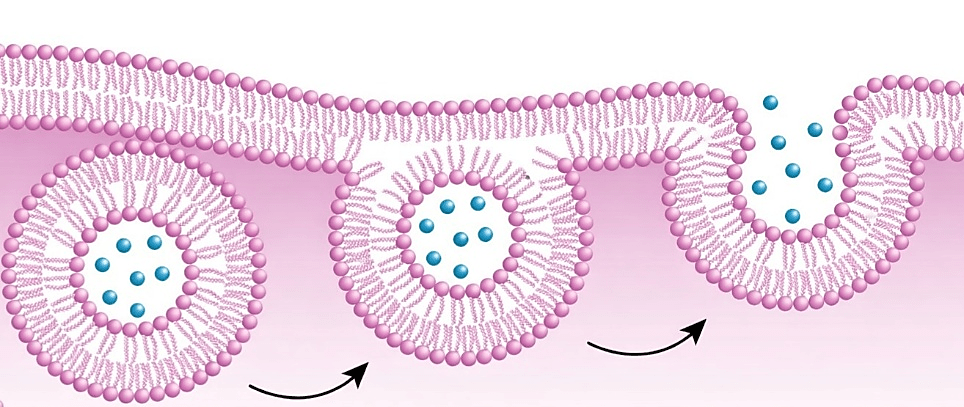
Which statements best describe the type of transport shown in the image?
Select TWO correct answers.
A. The type of transport shown is endocytosis.
B. The type of transport shown is exocytosis.
C. The type of transport shown is facilitated diffusion.
D. The type of transport shown requires energy.
E. The type of transport shown does not require energy.
B. The type of transport shown is exocytosis.
D. The type of transport shown requires energy.
500
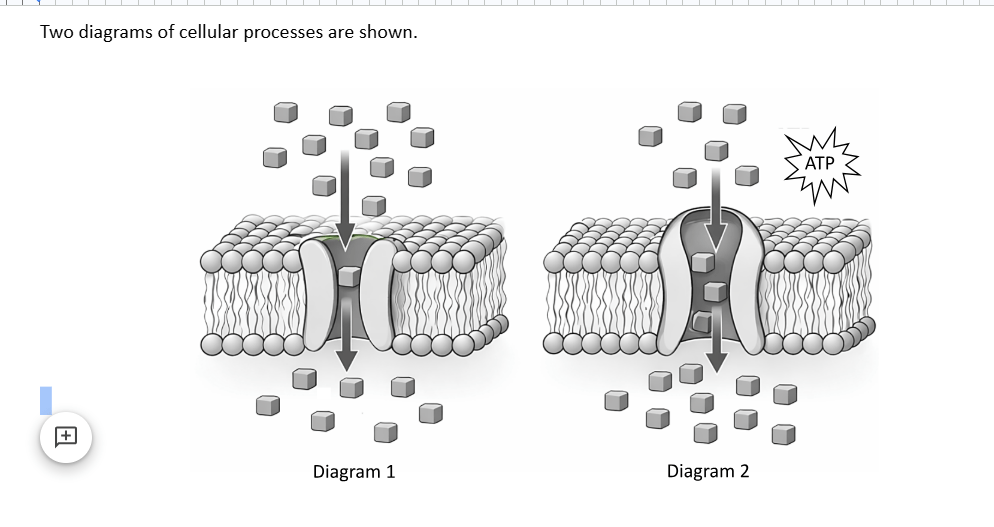
Compare the two diagrams
D. Diagram 1 shows passive transport, and Diagram 2 shows active transport.
In Diagram 1, molecules move from high concentration to low concentration with energy, while in Diagram 2, molecules move from low concentration to high concentration without energy.
500
A student sets up an experiment to observe glucose moving across a selectively permeable membrane from the outside to the inside of a cell. The concentration of glucose on both sides of the membrane is measured over time. The graph below shows the results.
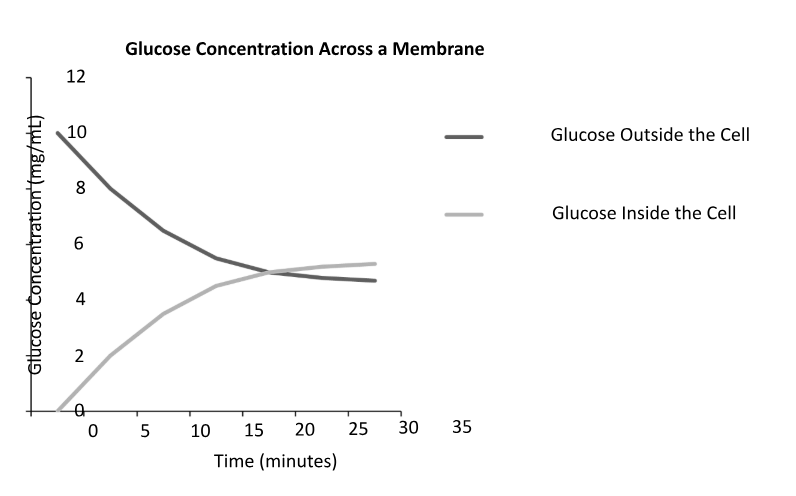
Which process is represented in the graph?
Diffusion