Solar System
Cell Theory
Cells
Taxonomic Groups
Ecosystem
Physical vs Chemical Change
100
In terms of diameter, the planet Saturn is larger than _______ , but smaller than _______.
A. Mercury; Earth
B. Jupiter; Uranus
C. Neptune; Jupiter
D. Uranus; Mars
C. Neptune; Jupiter
100
Which of the following combinations includes two examples that are both made up of cells?
A.bacteria and water
B.air and horses
C.fungi and insects
D.dogs and soil
C.fungi and insects
100
The function of the nucleus in a cell is to -
A.produce food for the organism
B.store excess water and waste
C.control activity and growth of the cell
D.hold all the other organelles
C.control activity and growth of the cell
100
Cells that do not have a nucleus are considered -
A. nonliving
B. eukaryotic
C. prokaryotic
D. multicellular
C. prokaryotic
100
In a particular ecosystem, a black bear feeds on berries from a raspberry bush.
Japanese beetles also feed on the raspberry bushes.
Seeds from fallen fruit take root in the soil below.
These seeds, over time, grow into new raspberry bushes.
Which of the following is an abiotic component of this ecosystem?
A. raspberry plant
B. Japanese beetle
C. soil
D. bear
C. soil
100
Which of these is NOT an indicator of a chemical change?
A.A change in temperature
B.The formation of bubbles
C.A liquid becoming a gas
D.Production of an odor
C.A liquid becoming a gas
200
Which of the following planets has a diameter that is larger than the diameter of the Earth?
A. Venus
B. Mercury
C. Neptune
D. Mars
C. Neptune
200
The hard outer covering that surrounds the cell membrane is the -
A.cell wall
B.cytoplasm
C.nucleus
D.vacuole
A.cell wall
200
Which of the following combinations includes two examples that are both made up of cells?
A. bacteria and water
B. air and horses
C. fungi and insects
D. dogs and soil
C. fungi and insects
200
Which of the following questions would not be used to classify an object as biotic or abiotic?
A. Does it have cells?
B. Does it move?
C. Does it reproduce?
D. Does it use energy?
B. Does it move?
200
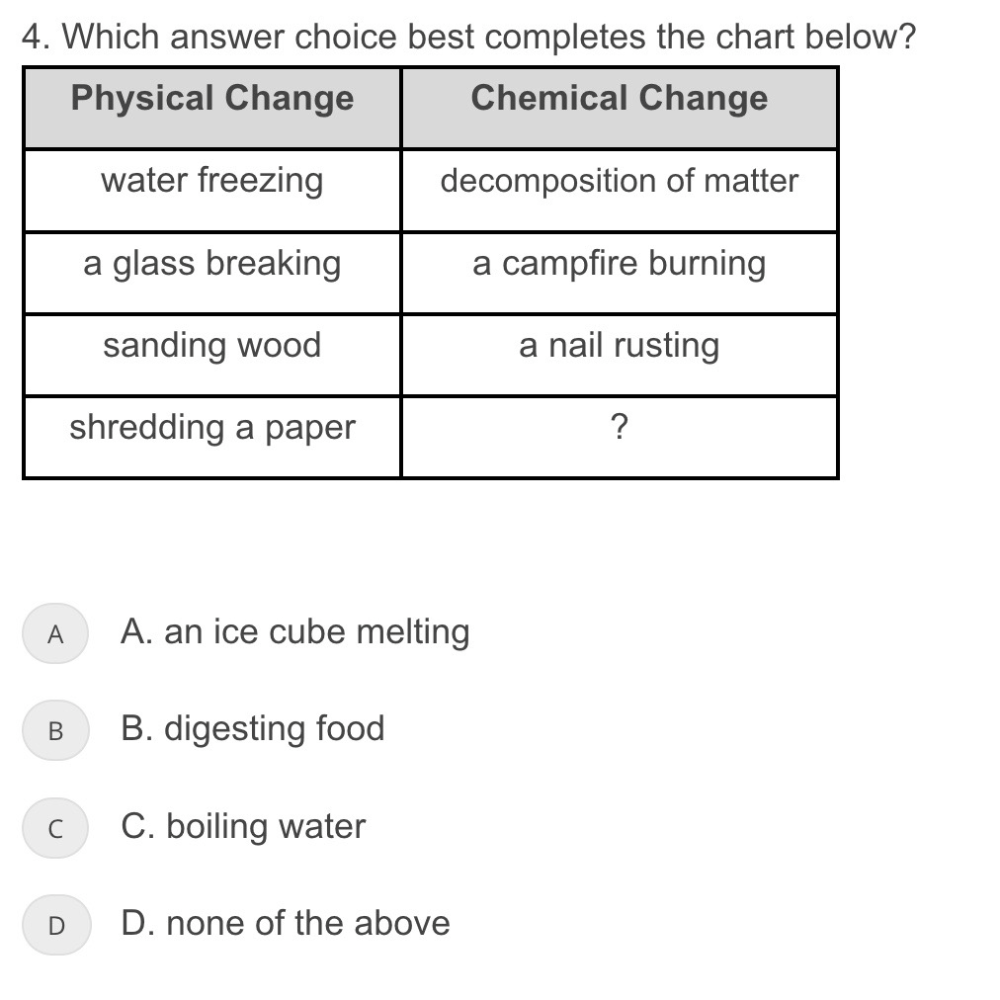
B.Digesting Food
300
Planets in the Solar System revolve around the Sun because
A. the Sun is the most massive object in the Solar System.
B. the Sun is the brightest object in the Solar System.
C. the Sun is the hottest object in the Solar System.
D. the Sun is the slowest object in the Solar System.
A. the Sun is the most massive object in the Solar System
300
Which of the following is not a true statement about cell theory?
A.Cells are the basic units of structure
B.All plants and animals are composed of cells.
C.Organisms grow by increasing the size
D.All new cells are derived from existing cells.
C.Organisms grow by increasing the size
300
Which of the following are the control centers of cells and of the human body?
A.vacuole and brain
B.stomach and ribosomes
C.brain and nucleus
D.cell wall and muscles
C.brain and nucleus
300
Most animal cells are classified as eukaryotic because they -
A. make their own food.
B. are able to reproduce.
C. are sometimes found in plants.
D. have a cell nucleus.
D. have a cell nucleus.
300
The smallest units of life in plants are -
A.cells
B.organs
C.tissues
D.organ systems
A.cells
300
Which of these is NOT an indicator of a chemical change?
A.Emission of heat
B.Color change
C.Formation of a precipitate
D.Formation of a mixture
D.Formation of a mixture
400
What was the first spacecraft to leave our solar system?
A. Viking 1
B. Pioneer 10
C. Voyager 2
D. Pioneer 11
C. Voyager 2
400
In 1673, a scientist named Anton Van Leeuwenhoek discovered -
A.contagious viruses
B.single celled organisms
C.cell membranes
D.organelles
B.single celled organisms
400
Which of the following is not an accurate pairing of cell organelles and organ systems?
A.Integumentary system - cell membrane
B.Circulatory system - cytoplasm
C.Central nervous system - nucleus
D.Excretory system - vacuoles
B.Circulatory system - cytoplasm
400
Which is not one of the kingdoms of Eukarya?
A. Plantae
B. Protista
C. Bacteria
D. Fungi
C. Bacteria
400
Which term identifies tissues working together in an organism to perform specialized functions?
A.cell
B.tissue
C.organ
D.organ system
C.organ
400
A student noticed that an unpleasant odor was emitted after combining two odorless liquids.
This change in matter is a/an -
A.early change
B.physical change
C.chemical change
D.enzyme change
C.chemical change
500
Which of the following basic human needs must be supplied by a space shuttle in order to allow astronauts to travel into space?
A. continuous supply of oxygen
B. temperature control system
C. appropriate pressure conditions
D. all of these
D. all of these
500
Matthias Schleiden examined plant cells, while Theodore Schwann examined animal cells. Both scientists concluded that -
A.plant cells and animal cells perform different functions.
B.all organisms are composed of cells.
C.animal cells have no cell wall.
D.the structures within a cell are called organelles.
B.all organisms are composed of cells.
500
A cell is classified as eukaryotic if it -
A.has a membrane enclosed nucleus.
B.has a flexible cell wall.
C.lacks an enclosed nucleus.
D.has more than one nucleus.
A.has a membrane enclosed nucleus.
500
Which statement below is NOT true of Kingdom Fungi?
A. All fungi are eukaryotic.
B. All fungi are heterotrophic.
C. All fungi are prokaryotic.
D. Fungi reproduce both sexually and asexually.
C. All fungi are prokaryotic.
500
Scientists classify organisms into domains based on -
A. similar characteristics
B. differences in DNA
C. their lifespan
D. biomes in which they live
A. similar characteristics
500
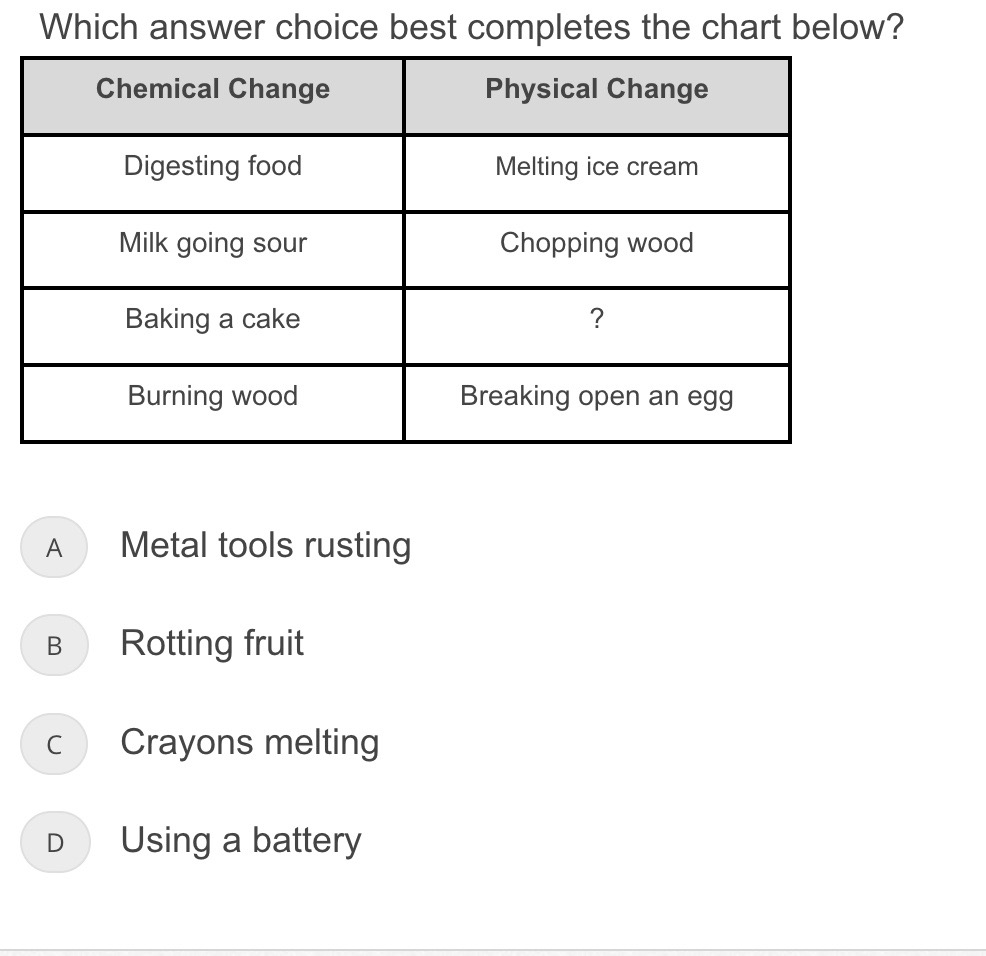
C.Crayons melting