Biomes
Community Ecology
Population Ecology
Misc
Music
100
This biome is characterized by little to no precipitation, and the organisms that inhabit it tend to have adaptations to help them survive long periods of drought.
What is a desert?
100
Mistletoe is a vine that will attach to trees and slowly suck out the water and minerals from its host. What kind of relationship do mistletoe and trees have?
Parasitism.
100
These terms are for when members of a population enter or leave an ecosystem.
What is immigration and emigration?
100

Which trophic level has the least energy available to it?
Tertiary consumer.
100
100
100
200
This biome is the most diverse on Earth and stays warm year-round, it also receives lots of precipitation.
What is a tropical rainforest?
200
Certain species of birds are known to follow groups of army ants. As other insects leave their hiding places to flee the path of the ants, they are eaten by the bird. The relationship between the ant and the bird is what kind?
Commensalism.
200
This is the term for the number of organisms in a population that an ecosystem can support- growth will occur until this line is reached.
What is carrying capacity?
200
Based on this table, estimate the amount of energy available to organisms at trophic level 1.
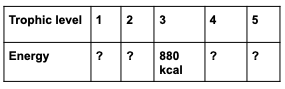
88,000
200
200
200
300
This biome is characterized by sparse trees and broad stretches of flat grassland. Conditions are hot and dry and it is also known as a "tropical grassland".
What is a savannah?
300
Hermit crabs are dependent on the shell of snails for a habitat and will take over unoccupied snail shells. What is the relationship between the hermit crab and the snail?
Commensalism.
300
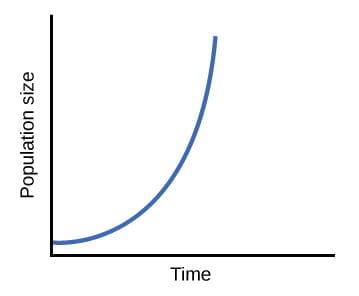
What kind of population growth is this?
Exponential growth.
300
Calculate what percentage of the total population that Species C makes up.
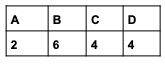
25%
300
300
300
400
This biome is characterized by extremely harsh conditions due to year-round cold. It is found at the northernmost parts of Earth and while there are no trees, short grasses will grow during the brief summer.
What is a tundra?
400
Aphids secrete honeydew from their bodies, which is collected by ants and used as a food source. Ants protect aphids from predators by moving them underground to their colony. What kind of relationship is this?
Mutualism.
400
Provide two examples of density-dependent factors.
-Disease
-Competition
-Predation
400
On the whiteboard, calculate the percent change in population size for species A between generation 1 and 3.
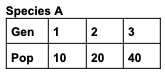
300% increase.
400
400
400
500
This biome is characterized by a variety of temperatures during its four seasons, and supports hardwood trees and complex ecosystems. The northeastern United States is home to this biome.
What is a temperate deciduous forest?
500
An ecologist notices that when the population of species A increases, the population of species B decreases. When the population of species B rises, the population of species A also rises. What kind of relationship can we theorize exists between these two species?
Predator-prey.
500
Calculate the population growth rate per year for species B between years 2 and 4.
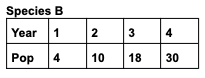
10.
500
500
500