Industrialization Begins
Industrialization Spreads
Technology of the Industrial Age
Industry: The Government and the Economy
Reactions, Society, and the Industrial Age
100
During the early 18th century, most British families lived in rural areas, grew most of their food, and made most of their clothes. However, a commercial revolution happened and the establishment of maritime empires changed the nature of trade. Using raw cotton produced by slave labor in the Americas, the British developed this system, in which merchants provided raw cotton to women who spun it into finished cloth in their own homes. The weakness of this method was it was slow and demand required faster production...we'll eventually get machines to do the weaving.
cottage industry (aka the putting out system)
100
In the early industrial revolution, there was a dynamic shift in manufacturing. Shipbuilding, textiles, and iron supply prior to 1750 were supplied by this country, but shifted to Britain as the "British Miracle" allowed the Brits to undercut the global market. For many reasons, this country would go through a process called de-industrialization. De-industrialization in this country referred to the decline in the relative contribution of the industrial sector to the economy, marked by a reduced share of manufacturing in GDP and employment. This trend is influenced by factors such as the growth of the services sector, challenges in traditional industries, and global economic dynamics.
India
100

Depicted above, the SS Savannah was the first ship of its kind to cross the Atlantic Ocean with one of THESE.
steam engine
100
The shift from mercantilism to free-market trade policies didn't just effect states, but regular people, too. Mass culture developed a culture of _________________ as well as leisure time among the working and middle classes of society. For some, standards of living rose. Producers began to advertise heavily to the middle class, whose members had disposable income, money that can be spent on nonessential goods.
consumerism
100
Of the many profound changes from the Industrial Revolution, THIS made good cheaper, more abundant, and more easily accessible to a greater number of people than every before. This is a good thing, because workers in industrial society were - for the most part - low wage earners.
Mass production
200
By the mid-18th Century, the ______________ and _______________ reduced the time needed to spin yarn and weave cloth. The first allowed a weaver to spin more than one thread at a time. The other used waterpower to drive the other machine.
spinning jenny
water frame
200
By 1900, the United States was a leading industrial force in the world. This term was a key factor in US success. Globally, political upheaval and widespread poverty brought a large number of immigrants to the United States from Europe and East Asia. The construction of railroads facilitated the migration of people to interior regions. These immigrants, as well as migrants from rural areas of the United States provided the ______________ provided the labor force to work in the factories.
Human capital (aka the workforce)
200

The above stamp is from the very first one of these, it was completed in 1869 in Utah.
Transcontinental Railroad
200
The relationship between industry and centralized government was key to modernization in Japan, private investment from overseas also became important. In Japan, when new industries were flourishing, they were sold to these powerful Japanese family business organizations. These are similar to conglomerates in the United States. These would attract investors encouraging innovation in technology. Examples of these that still exist today are Toyota, Mitsubishi, Seiko, and others. These are another example of the adoption of innovative practices in banking and finance that allowed for states to industrialize.
zaibatsu
200

According to this political cartoon, what are the effects of industrialization? There are TWO answers.
Pollution (sewage and industrial run off in the river)
Spread of diseases (Cholera, tuberculosis, typhoid)
300
Eli Whitney created a system of ____________ for manufacturing firearms for the US Military. If a particular component of a machine were to break, the broken component could easily be replaced with a new, identical part. This method would be adopted by Entrepreneurs and repurposed for other products.
Later, Henry Ford would expand this concept of a division of labor by developing the moving ________________ to manufacture his Model T automobiles.
Interchangeable parts
assembly line
300
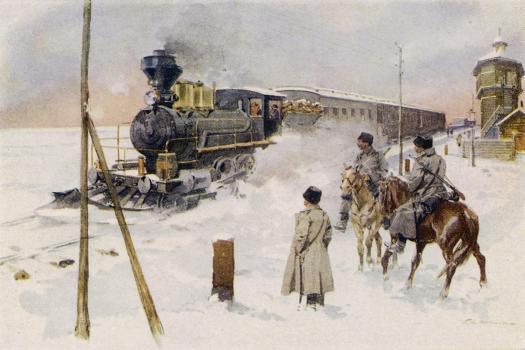
By 1900, Russia would have more than 36,000 miles of railroad connecting its commercial and industrial areas. This railroad stretched from Moscow to the Pacific Ocean allowing Russia to trade easily with countries in East Asia like China and Japan. Russian coal, iron, and steel helped support its development. Despite this progress, Russia's economy remained mostly agricultural until the Communists seized power in 1917. Nevertheless, it serves as an illustration of the significance of the state's active involvement in industrialization for certain nations.
Trans-Siberian Railroad
300
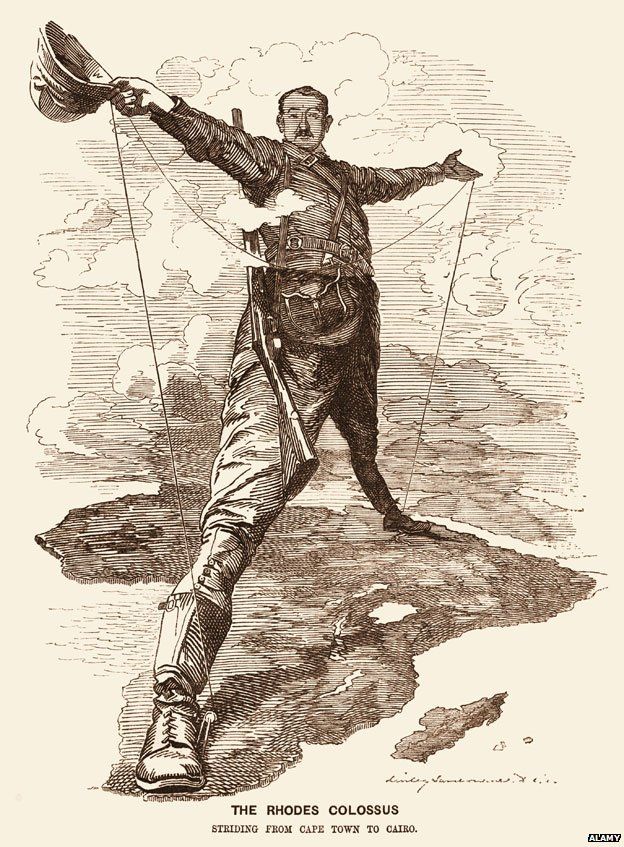
Known as The Rhodes Colossus, this art is a metaphorical representation of British imperial power during the late 19th century, particularly associated with Cecil Rhodes. It suggests the dominance of British influence in Southern Africa and Rhodes' ambitious vision of a Cape-to-Cairo railway connecting British territories across the continent. The metaphor underscores the expansionist and imperialistic ideals of the British Empire during this period, symbolizing the vast reach and control exerted by figures like Rhodes over significant portions of Africa. What's the "rope" he is holding in his hands?
telegraph line
300
Suffering from problems of overexpansion and failure to modernize, the Ottoman Empire underwent attempted coups, declining economic power, and weak leaders throughout the 1800s. In an attempt to modernize, this state of the Ottoman Empire introduced state-sponsored industrial projects such as textile mills, arms factories, and infrastructure development like the construction of canals. It also introduced land reforms to increase agricultural productivity, providing resources for industrialization. While these measures did contribute to some economic growth and modernization, they also resulted in increased state control, heavy taxation, and forced labor, causing social and economic challenges for to this state as British influence would continue to impact attempts at economic independence.
Egypt
300
The new labor patterns of the 18th and 19th centuryies that emerged saw the development of new class identities. At the bottom rungs of the social hierarchy were those who labored in factories and coal mines. Though they helped construct goods rapidly, these workers needed fewer skills, so managers viewed them as easily replaceable. They are known as THIS new term.
Working class (or the working poor)
400
TEAM CHALLENGE
Britain had many environmental and geographic advantages as well as political and social advantages that made it a leader in industrialization.
Name as many as you can. Winning team wins the points.
Access to water and seaways
Abundant Rivers
Mineral resources - Coal and iron
Empire - colonies that acted as sources of food, natural resources, raw materials, cheap labor, and markets.
Strong Navy (dominance on the seas = dominance in trade)
Laissez Faire Government
Patent Laws and Private Property Laws
Population of skilled workers in textiles
400
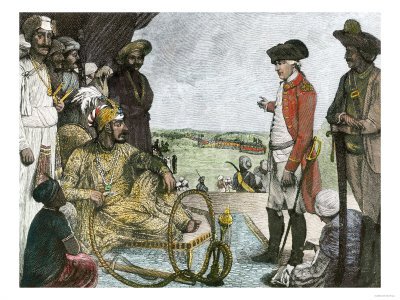
This term refers to the period during which the British East India Company, a trading company, exerted significant control over large parts of the Indian subcontinent. This era began in the mid-18th century, following the Battle of Plassey in 1757, and continued until the Indian (Sepoy) Rebellion of 1857. During this time, the East India Company gradually transformed from a commercial enterprise into a quasi-governmental entity, administering territories, collecting revenue, and maintaining its own military forces. The East India Company's rule was marked by economic exploitation, cultural changes, and the imposition of British legal and administrative systems, laying the foundation for the later direct rule by the British Crown in India. What is the term?
company rule
400
The United States, Great Britain, and Germany were key players in what is known as the second industrial revolution, which occurred in the late 19th and early 20th Centuries. The first industrial revolution were in textiles, steam power, and iron. What were the developments in the second industrial revolution? I have six correct responses. Team with the most gets the point.
Steel Production
Oil
Electricity
Telephones
Radio
Chemicals
400
TEAM CHALLENGE
The market competition was distorted and consumers suffered due to the monopolistic practices employed by government-chartered joint-stock companies like the British South Africa Company.
Some corporations became so powerful that they could form a monopoly. Some became transnational companies - corporations that operate across national boundaries.
There are 5 of these monopolies/corporations listed in Topic 5.7. Team that names the most wins the points.
Standard Oil (Oil - USA - Rockefeller)
Krupp AG (Steel - Germany - Krupp)
DeBeers (Diamonds - Britain - Rhodes)
Hong Kong and Shanghai Banking Corporation (Finance and Investment - Britain/Hong Kong)
Unilever (household goods - Britain/Dutch)
400
A series of reforms in the 19th Century, that included a government modeled after France including a new criminal law code based on the Napoleonic Code, creating secular laws to supersede shari'a courts, free trade, replaced devshirme with a military modeled on the Prussian system (the United States' was, too), public school modeled off the British that bypassed traditional Islamic schooling (which was done by clerics), a single empire wide tax collection agency that looks similar to the IRS replacing tax farmers, and guarantees of life, liberty, and propery...sounds great, right?
But, according to historian James L. Gelvin, these Imperial Edicts was written out verbatim by British ambassador Stratford Cutting and handed to Ottoman officials with instructions to translate it and proclaim it publicly.
To many Ottoman Muslims, these reforms smelled less like reforms and more like fresh evidence of alien power taking over their lives.
But not all Muslims did. Some believed that to beat the Europeans, they needed to play their game...which meant adopting these European "inspired" reforms were necessary.
Tanzimat Reforms
500
You have 2 minutes to draw and label a diagram that models the economic relationship between a metropole and its colony during the period 1750–1900.
Your chart must:
Clearly distinguish metropole and colony (give me an example of each)
Show directional arrows indicating flows
Correctly incorporate and label the following terms:
Raw materials
Manufactured goods
Markets
Labor systems (e.g., coerced labor, wage labor, indentured labor)
Infrastructure (railroads, ports, telegraph, etc.)
I'll check your answer.
500
Key factors contributing to this industrial surge included the development of a well-established banking system, a skilled and disciplined workforce, and a comprehensive education system. The implementation of the Zollverein, a customs union among German states, facilitated the flow of goods and capital, promoting economic integration. Moreover, German industrialization was characterized by innovations and the development of new methods of production in _________, ________, _________. This economic transformation not only propelled Germany to become an industrial powerhouse but also laid the groundwork for its later geopolitical and economic prominence on the global stage.
Name 2 of the 3.
chemicals
steel
machinery
500
The Group in Last Place gets 500 points.
(if there is a tie, it goes to both)
Congrats for being in last place as of this question. Hopefully you're not in last anymore.
500
TEAM CHALLENGE
In early 1850s, US Commodore Matthew Perry sailed into the Tokyo Bay asking and later demanding the Japanese for trade privileges. The arrival of Perry caused Japanese leaders to realize the danger they and their culture was in. In an event known as the Meiji Restoration, the traditional forms of governance (shogun) in Japan was overthrown. Japan would systematically visit Europe and the United States and invite experts to Japan to study Western Institutions. It would eventually lead to a policy of imperial expansion that sought to take advantage of the political and military weakness of neighboring Asian states.
Japan would adopt THESE (specific) reforms that they were able to pay for with a higher agricultural tax. They would be able to rapidly grow their economy as a result.
There are 7 Meiji reforms. Team with the most gets the point.
Constitution: Charter Oath
Established Constitutional Monarchy with a Parliament.
Equality before the law; abolished cruel punishments
Re-organized the military, built a navy, and instituted conscription (mandatory military service for citizens)
Crewed new school system - focus on STEM
Built railroads and roads
Government subsidized industrialization - especially the important ones...like tea, silk, weaponry, shipbuilding, and sake (Japanese rice wine)
500
In the aftermath of the signing of the unequal treaties, the Qing Emperor, feeling pressure to modernize in the 19th century. It developed as a way for the government to face the internal and external problems confronting China. They would advance their military technology, by training Chinese artisans to manufacture items for the military as well as streamlining its tax collection internally as well as making a governmental branch to improve tariff collection. These reforms were met with mixed reviews, including by a future Empress, Cixi, who wanted to protect traditional Chinese society and government. This is an example of the conflict many state's felt as they tried to balance embracing the new realities brought to the world by Industrialization and Westernization while trying to maintain their unique state identity.
Self-Strengthening Movement