Level of Organizations
Body System Interactions
Photosynthesis
Respiration
Data and Science
100
This level of organization is a group of similar cells working together to perform a specific function.
What is a tissue?
100
This body system transports oxygen and nutrients to cells throughout the body.
What is the circulatory system?
100
This gas is released during photosynthesis.
What is oxygen?
100
This process breaks down food to provide energy for cells.
What is cellular respiration?
100
A student changes the light intensity in a photosynthesis investigation and measures the number of oxygen bubbles. Name the independent variable.
What is light intensity?
200
Arrange these levels from simplest to most complex: organ system, organism, cell, organ, tissue.
What is cell → tissue → organ → organ system → organism?
200
These two systems work together most directly when food is broken down and the nutrients are carried to body cells.
What are the digestive and circulatory systems?
200
Name two materials a plant needs for photosynthesis besides light.
What are water and carbon dioxide?
200
This gas is released when cells carry out cellular respiration.
What is carbon dioxide?
200
To compare pulse rates before and after exercise fairly, this part of the procedure should stay the same for each measurement: the amount of time used to count the pulse. Name this type of variable.
What is a controlled variable (or constant)?
300
The stomach is made of muscle tissue, nervous tissue, connective tissue, and epithelial tissue. Because several tissue types work together in it, the stomach is this level of organization.
What is an organ?
300
When a person exercises, breathing rate and heart rate both increase. Explain how this interaction helps maintain homeostasis.
The respiratory system takes in more oxygen and the circulatory system delivers it more quickly to active cells while also helping remove carbon dioxide.
300
Use the graph below. As light intensity increases, the number of oxygen bubbles increases. Identify the process being measured and explain what the graph suggests about light.
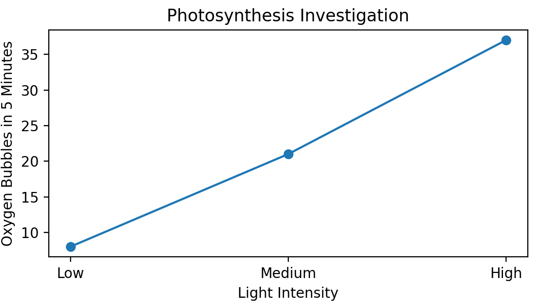
The process is photosynthesis. The graph suggests that greater light intensity increases the rate of photosynthesis under these conditions.
300
Use the data table below. Explain why exhaled air contains much more carbon dioxide than inhaled air.

Body cells produce carbon dioxide during cellular respiration. The circulatory system carries it to the lungs, so exhaled air contains more carbon dioxide.
300
Use the table below. Describe the relationship between exercise time and pulse rate.

As exercise time increases, average pulse rate increases.
400
Cardiac muscle cells form cardiac muscle tissue. Cardiac muscle tissue helps make up the heart. The heart works with blood vessels. Use this evidence to name the most complex level in this sequence.
What is an organ system (the cardiovascular/circulatory system)?
400
The nervous system detects an increase in body temperature. Sweat glands release sweat and blood flow near the skin increases. Name the process these responses help maintain.
What is homeostasis?
400
A plant has water and carbon dioxide available, but it is placed in darkness for several hours. Explain what will most likely happen to its food production and why.
Food production by photosynthesis will decrease greatly or stop because light provides the energy needed for photosynthesis.
400
During a long run, muscle cells use food molecules more rapidly. Predict what happens to the rate of cellular respiration and the release of carbon dioxide.
The rate of cellular respiration increases, and more carbon dioxide is released.
400
A student wants to test whether carbon dioxide availability affects photosynthesis. Explain the best investigation design for this question.
Use identical plants and keep light, water, temperature, and time the same while changing only carbon dioxide availability.
500
A student says, “An organ system is more complex than an organ.” Give one specific example from the human body that supports this statement and explain why it supports it.
Accepted responses will name an organ system such as the digestive or circulatory system and explain that it includes multiple organs working together to carry out a major function.
500
Use the graph below to describe what happens to the respiratory and circulatory systems during exercise and after recovery. Then explain how the data support homeostasis.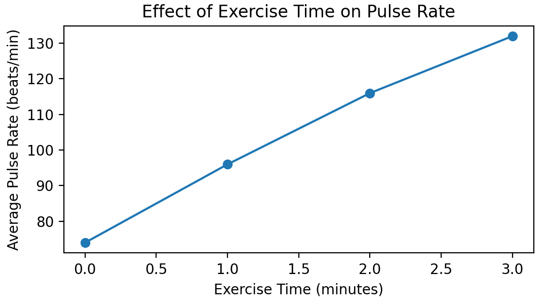
During exercise, pulse and breathing rate increase to meet the body’s greater oxygen and energy demands. During recovery, they move back toward resting levels, showing the body returning to stable internal conditions.
500
Use the data table below. Determine which setup should have the highest rate of photosynthesis and explain how the data show that photosynthesis depends on more than one factor.

Setup 1 should have the highest rate because it has high light, high carbon dioxide, high water, and the greatest oxygen bubble rate. The table shows that lowering light, carbon dioxide, or water lowers oxygen production, so several factors affect photosynthesis.
500
Use the graph below. Two groups of germinating seeds were placed in sealed containers. One group remained active, and one group was cooled. Explain what the graph shows about cellular respiration.
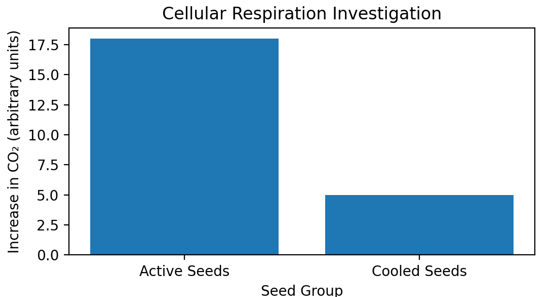
The active seeds produced more carbon dioxide, so they carried out cellular respiration at a greater rate. Cooling slowed cell activity and reduced respiration.
500
Use the table below. A student concludes that light level was the only reason one group produced more oxygen bubbles. Evaluate the conclusion using evidence from the table.

The conclusion is not fully supported because water temperature and plant length also differed. Since more than one variable changed, the investigation does not isolate light as the only cause.