Hydrosphere
River Basins
Ocean Currents
Water Data
Water Quality
100
The scope of understanding the hydrosphere specifically includes which systems?
A. Glacial, Arctic, and Antarctic systems.
B. River basin, stream, and lake systems only.
C. Freshwater, estuarine, and ocean systems.
D. Terrestrial, atmospheric, and biotic systems.
C. Freshwater, estuarine, and ocean systems.
100
When using models to explain the structure of the hydrosphere, which geographic feature is explicitly required for land to sea interactions?
A. Volcanic vents.
B. Glacial moraines.
C. Estuaries.
D. Continental shields.
C. Estuaries.
100
Which pair of factors determines the density of ocean water, thereby driving major ocean currents?
A. Density and pressure.
B. Depth and dissolved oxygen.
C. Temperature and salinity.
D. Nutrients and minerals.
C. Temperature and salinity.
100
When analyzing data to predict water safety in North Carolina, which factor is listed as a necessary physical measurement?
A. Bio-indicators.
B. Nitrates and phosphates.
C. Turbidity.
D. Carbon content.
C. Turbidity.
100
To ensure the good health of humans and the environment, which practice requires people to carefully manage and protect water resources?
A. Analyzing index fossils.
B. Classifying energy resources.
C. Stewardship.
D. Modeling chemical reactions.
C. Stewardship.
200
The specific relationship between humans and the hydrosphere is described as:
A. Competitive.
B. Independent.
C. Reciprocal.
D. Symbiotic.
C. Reciprocal.
200
How do plants contribute to the water distribution on Earth by moving groundwater to the atmosphere, a process necessary to model water availability?
A. Plants absorb water vapor and release water into the soil by evaporation.
B. Plants absorb water vapor and release water into the soil by transpiration.
C. Plants absorb groundwater and release water into the atmosphere by evaporation.
D. Plants absorb groundwater and then release water into the atmosphere by the process of transpiration.
D. Plants absorb groundwater and then release water into the atmosphere by the process of transpiration.
200
What happens to water at the ocean’s surface as it moves from the equator toward the Arctic Ocean, causing it to sink and drive deep currents?
A. The water cools, causing its density to decrease.
B. The water cools, causing its density to increase.
C. The water warms, causing its density to increase.
D. The water cools, causing its humidity to decrease.
B. The water cools, causing its density to increase.
200
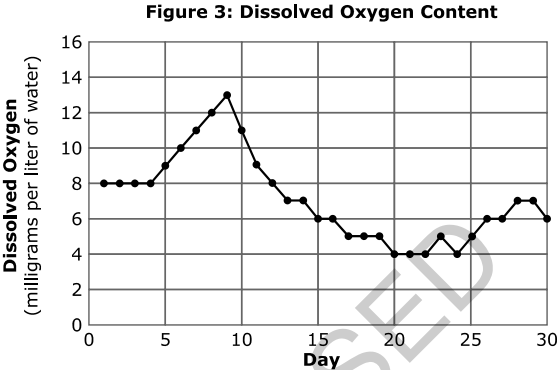
A fish population in Calm Lake is considered unsafe if the dissolved oxygen (DO) content drops below 6 milligrams per liter. Based on data from the figure, on which day did Calm Lake first become unsafe for the fish and remain unsafe for several days?
A. Day 9.
B. Day 12.
C. Day 17.
D. Day 22.
C. Day 17.
200
Which action best represents good stewardship of water resources?
A. Building a dam near wetland areas.
B. Increasing the number of nonessential uses of water.
C. Limiting nonessential usage of water.
D. Preventing the use of all chemicals at water facilities.
C. Limiting nonessential usage of water.
300
To ensure the good health of humans and the environment, the hydrosphere must be monitored. This monitoring often includes checking physical and biological factors required for water safety. Which factors are also necessary for understanding the drivers of ocean systems?
A. Rock composition and chemical reactivity.
B. Temperature and salinity.
C. Fossil records and relative age.
D. Biotic and abiotic factors.
B. Temperature and salinity.
300
In a model of a local river basin connected to an estuary, the primary flow of water is generally from:
A. The estuary into the river basin streams and tributaries.
B. Groundwater reservoirs directly into the deep ocean.
C. Water flowing from streams and tributaries in the river basin into the estuary.
D. Atmospheric water vapor directly into the soil.
C. Water flowing from streams and tributaries in the river basin into the estuary.
300
Major ocean currents impact climate and ecosystems by ensuring the circulation and distribution of which necessary components for marine life forms?
A. Index fossils and rock layers.
B. Nutrients, minerals, and dissolved gases.
C. Elements, compounds, and mixtures.
D. Geothermal and nuclear energy resources.
B. Nutrients, minerals, and dissolved gases.
300
The Calm Lake Investigation noted that algae are photosynthetic and that nutrient pollution involves phosphorus (P) and nitrogen (N). Why are high levels of nitrates and phosphates analyzed in data interpretation?
A. They cause turbidity to decrease, which is unsafe.
B. They directly lower the water's temperature.
C. They are bio-indicators of safe water quality.
D. They are necessary nutrients that can cause excessive algae growth (bio-indicators).
D. They are necessary nutrients that can cause excessive algae growth (bio-indicators).
300
If monitoring of a municipal water supply indicates that water quality standards are not being met due to the presence of harmful substances, what must be implemented or revised?
A. The classification of nearby energy resources.
B. The study of comparative anatomy.
C. Methods of water treatment.
D. The analysis of atmospheric temperature data.
C. Methods of water treatment.
400
Ocean currents distribute resources like dissolved gases and nutrients. To maintain the distribution of these resources and protect life forms in aquatic ecosystems, humans are required to practice:
A. Energy classification.
B. Chemical balancing.
C. Stewardship.
D. Comparative anatomy.
C. Stewardship.
400
Jonathan lives in a town near an estuary that is part of the Windy River basin. If the average precipitation in his town was exceeded every month for four consecutive months, what claim about the estuary’s structure is best supported?
A. The salinity of the estuary would be the same as any other year due to consistent river flow.
B. The estuary will be more salty than average due to lower freshwater runoff.
C. The water availability would decrease due to increased runoff contamination.
D. Precipitation in September was higher than average, so the estuary will be less salty than in years with normal precipitation.
D. Precipitation in September was higher than average, so the estuary will be less salty than in years with normal precipitation.
400
If a sudden event dramatically increased the salinity of surface water in a warm region without changing the temperature, how would this isolated event primarily affect the water's role in driving currents?
A. The water would decrease in density and sink more slowly.
B. The water would decrease in density and rise toward the surface.
C. The water would increase in density and contribute to the sinking process.
D. The change would affect climate but not the current’s density drive.
C. The water would increase in density and contribute to the sinking process.
400
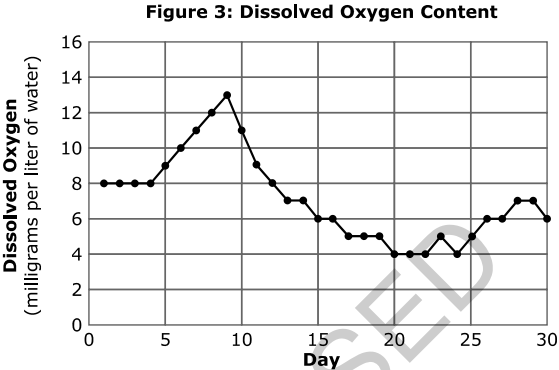
During the Calm Lake Investigation, the algae population decreased sharply around Day 10. Aquatic bacteria feed on dead algae and decrease the dissolved oxygen (DO) content as they reproduce. Which effect would occur immediately after the algae die-off due to increased bacteria activity?
A. A sharp increase in DO due to the removal of photosynthetic organisms.
B. A subsequent sharp drop in DO due to increased decomposition of dead organic matter by bacteria.
C. Increased water potability due to lower turbidity.
D. Decreased bacteria population due to lack of food resources.
B. A subsequent sharp drop in DO due to increased decomposition of dead organic matter by bacteria.
400
A community relies on a reservoir for both generating electricity via a hydroelectric dam and for providing drinking water. If a drought occurs, why is conserving water (stewardship) beneficial?
A. Conserving water would decrease the sustainability of the reservoir.
B. Conserving water would decrease the need for water quality standards.
C. Conserving water would increase the sustainability of the reservoir, increasing the amount of time it could be used for both electricity and human consumption.
D. Conserving water would only affect the hydroelectric output, not the water availability for humans.
C. Conserving water would increase the sustainability of the reservoir, increasing the amount of time it could be used for both electricity and human consumption.
500
Temperature drives major ocean currents. If human activities are responsible for a period of overall warming since 1960, what reciprocal effect would this have on the major currents?
A. Warmer water would increase density, accelerating deep currents.
B. Warmer water would decrease density, potentially impacting the sinking required to drive deep currents.
C. Warmer water would increase salinity, increasing the distribution of minerals.
D. There would be no predicted effect on ocean currents, only on river basins.
B. Warmer water would decrease density, potentially impacting the sinking required to drive deep currents.
500
A student attempts to model water distribution on Earth. The model must accurately link the terrestrial component to the atmospheric component. The most crucial part of this link, where water moves from the ground into the air, is represented by:
A. Water flowing from estuaries into river basins.
B. Groundwater absorption by plants followed by release via transpiration.
C. Water vapor absorption by plant roots.
D. Runoff carrying nutrients from river basins into oceans.
B. Groundwater absorption by plants followed by release via transpiration.
500
A comprehensive model must explain the impact of currents on ecosystems. The most critical function of these currents that supports the distribution of life forms is their ability to:
A. Move warm surface water from the poles toward the equator.
B. Transport dissolved gases (like oxygen) and nutrients throughout the ocean due to the temperature and salinity density gradient.
C. Block runoff from river basins to maintain ocean purity.
D. Separate minerals from elements, thereby increasing ecosystem stability.
B. Transport dissolved gases (like oxygen) and nutrients throughout the ocean due to the temperature and salinity density gradient.
500
When analyzing data showing that dissolved oxygen dropped below 6 mg/L, what corresponding prediction about the bio-indicators (algae) and nutrients (nitrates/phosphates) should be concluded?
A. Bio-indicators were likely thriving due to low nutrient levels.
B. High nutrient levels must have been present earlier, leading to excessive bio-indicator growth and subsequent decomposition, consuming the dissolved oxygen.
C. The temperature must have dropped significantly, increasing the amount of dissolved oxygen available.
D. The water’s pH was likely unstable, independent of nutrient pollution.
B. High nutrient levels must have been present earlier, leading to excessive bio-indicator growth and subsequent decomposition, consuming the dissolved oxygen.
500
Which type of evidence provides the strongest argument that a school or community has successfully maintained the good health of the hydrosphere?
A. Evidence showing local residents limit their consumption of water.
B. Evidence describing the structure of the local river basin.
C. Evidence detailing the types of chemicals used in water treatment.
D. Documented long-term monitoring data confirming that all water quality standards (including physical and biological factors) have been consistently met.
D. Documented long-term monitoring data confirming that all water quality standards (including physical and biological factors) have been consistently met.