Structure of DNA/RNA
SL Replication, Transcription, & Translation
HL - DNA Structure and Replication
HL - Transcription and Gene Expression
HL - Translation
100
Nucleic acids are polymers of nucleotides. What parts of nucleotides are joined together in both DNA and RNA to make these polymers?
A. Large nitrogenous bases with small nitrogenous bases
B. Nitrogenous bases with hexose sugars
C. Nitrogenous bases with phosphates
D. Pentose sugars with phosphates
D. Pentose sugars with phosphates
100
Where are amino acids joined together to make polypeptides?
A. Nucleus
B. Nucleolus
C. Golgi apparatus
D. Ribosomes
D. Ribosomes
100
Which is a valid comparison between prokaryotic and eukaryotic DNA?
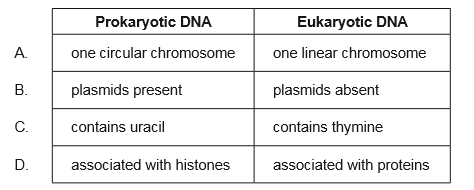
B
100
How can environmental factors affect the expression of genes?
A. By promoting the replication of nucleosomes
B. By inactivating epinephrine
C. By making specific changes to the base sequence of genes
D. By causing the pattern of DNA methylation to be changed
D. By causing the pattern of DNA methylation to be changed
100
What are polysomes?
A. Strings of amino acids
B. Packages of eight histones with DNA
C. Many ribosomes joined to one mRNA
D. Complexes of tRNA with amino acids
C. Many ribosomes joined to one mRNA
200
State two structural features that differ between RNA and DNA. [2]
a. number of strands
OR
(usually) only one strand in RNA/two strands in DNA
b. base composition
OR
uracil only in RNA / thymine only in DNA
c. type of pentose
OR
ribose only in RNA / deoxyribose only in DNA
200
What are introns?
A. Sequences of nucleotides that are removed to form mature RNA in eukaryotes
B. Sequences of nucleotides that are removed to form mature RNA in prokaryotes
C. Sequences that remain in mature RNA after exons have been removed
D. Small pieces of circular DNA that are found in prokaryotes
A. Sequences of nucleotides that are removed to form mature RNA in eukaryotes
200
State one role of nucleosomes in eukaryotic cells.
a. to help to supercoil/pack DNA in chromosomes
b. help to regulate transcription / gene expression
200
Very soon after fertilization, parental epigenetic methylation is reversed in the DNA.
Later, tissue-specific epigenetic modifications are made to the embryonic DNA. The graph follows the degree of methylation from different sources during embryonic development.
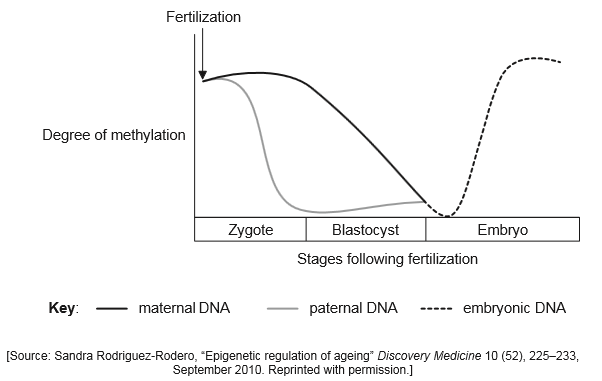
According to the graph, what are the changes in DNA methylation during embryonic development?
A. Only the paternal DNA becomes demethylated.
B. The maternal DNA becomes demethylated first.
C. The methylation patterns of the parents’ DNA are erased before fertilization.
D. The methylation patterns of both parents are erased after fertilization.
D. The methylation patterns of both parents are erased after fertilization.
200
Scientists have heated a solution containing the protein albumin and measured its relative alpha helix content, shown on the graph.
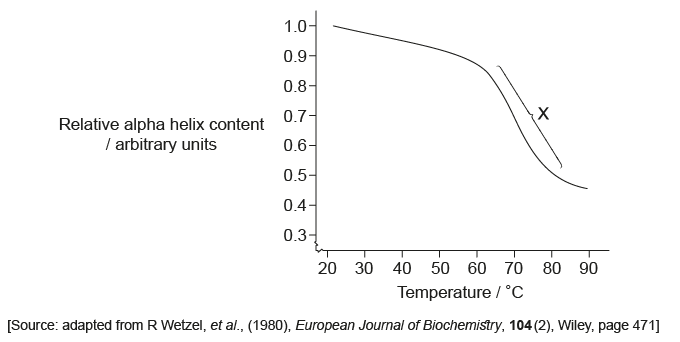
What does the zone labelled X indicate?
A. Rapid increase in beta pleated sheets
B. Rapid formation of hydrogen bonds
C. Rapid increase in denatured protein molecules
D. Rapid decrease in peptide bonds
C. Rapid increase in denatured protein molecules
300
For which discovery about DNA do Watson and Crick receive credit?
A. DNA is the molecule that genes are made of.
B. The amount of adenine equals the amount of thymine in an organism.
C. Phosphate–pentose bonding along the nucleotide backbone is covalent.
D. The shape of DNA is a double helix.
D. The shape of DNA is a double helix.
300
Some regions of DNA do not code for the production of proteins. What are these regions of DNA used as?
A. They have no known function and are recycled to provide nucleotides
B. Gene regulation and coding for production of enzymes used in translation
C. Telomeres and coding for production of tRNA
D. Introns and coding for production of structural proteins
C. Telomeres and coding for production of tRNA
300
Which letter (A–D) indicates where a new nucleotide would attach?
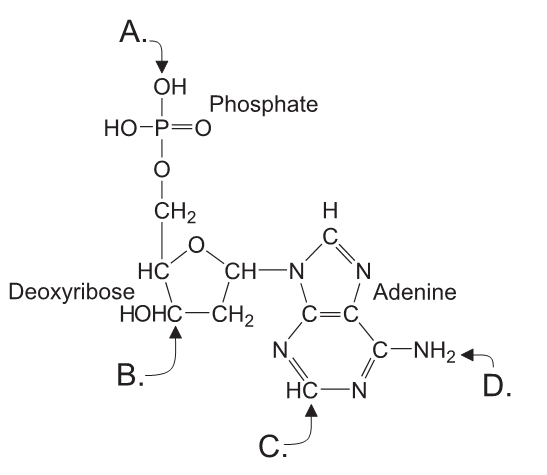
B
300
What is a feature of transcription?
A. Both strands of a DNA molecule act as a template for mRNA.
B. Nucleoside triphosphates become nucleotides by losing three phosphates.
C. RNA polymerase binds to the promoter region.
D. The sense strand acts as a template for mRNA.
C. RNA polymerase binds to the promoter region.
300
Outline primary and quaternary protein structures.
a. (primary structure) is sequence of amino acids;
b. (quaternary structure) is the linking of two or more polypeptides to form one protein;
400
Which parts are indicated by I, II, III and IV of the DNA diagram?
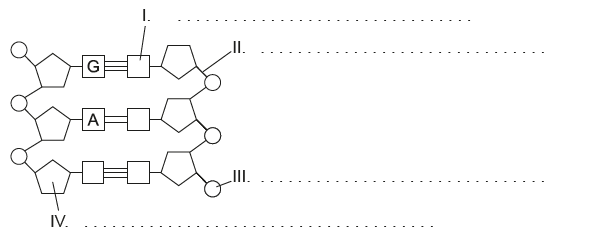

[2]
I. cytosine
II. sugar-phosphate/covalent/phosphodiester bond
III. phosphate
IV. deoxyribose
400
The table shows some codons for five amino acids.
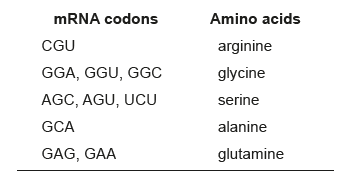
Which of these DNA strands will code for the amino acid sequence glycine-serine-glycine?
A. CCUUCGCCG
B. CCTTCGCCG
C. GGAAGCGGA
D. CCUUCGCCU
B. CCTTCGCCG
400
Outline how Hershey and Chase’s experiment provided evidence for DNA as the genetic material. [3]
a. experiment is meant to determine whether DNA or protein is the genetic material
b. viruses/bacteriophages grown in radioactive S/S35 which enters the protein coat
c. viruses/bacteriophages grown in radioactive P/P32 which enters the DNA
d. «radioactive» viral DNA entered the bacterial cell during infection
OR
«radioactive» viral protein did not enter the bacterial cell during infection
400
Distinguish between transcription and translation. [4]
a. DNA is transcribed AND mRNA is translated
Disallow the first mark, if a candidate gets transcription and translation the wrong way round, but allow marks
after that up to [3 max]
b. transcription produces RNA AND translation produces polypeptide/protein
c. RNA polymerase used in only in transcription and ribosomes only in translation
d. transcription in the nucleus «of eukaryotes» and translation in the cytoplasm
e. tRNA needed for translation but not transcription
f. nucleotides linked in transcription and amino acids in translation
OR
sugar-phosphate/phosphodiester bonds in transcription and peptide bonds in translation
400
Outline the roles of the different binding sites for tRNA on ribosomes during translation. [4]
a. A, P and E binding sites are on the large subunit of the ribosome
b. initiation of translation starts with binding of met-tRNA to the start codon
c. large sub-unit binds with «start» tRNA in the P site
d. A binding site holds the tRNA with the next amino acid to be added
e. peptide bond is formed between the amino acids of the A site and the polypeptide at the P site
f. polypeptide is transferred to the tRNA in the A site
g. the tRNA «with polypeptide» in A site then moves to P site
OR
P binding site holds the tRNA attached to the growing polypeptide
h. E binding site «exit» is where the tRNA «from P site without amino acid» leaves the ribosome
500
Outline how translation depends on complementary base pairing. [3]
a. translation converts a sequence of mRNA nucleotides/codons to a sequence of amino acids/polypeptide/protein
b. «triplets of» nucleotides/bases on «activated» tRNAs pair with complementary «triplets of» nucleotides/bases on mRNA / vice versa
c. base pairing occurs when adenine/A pairs with uracil/U and guanine/G pairs with cytosine/C
d. specific amino acids are attached to specific of tRNA
e. mRNA has codons AND tRNA has anticodons
500
Describe the polymerase chain reaction (PCR), including the role of Taq DNA polymerase. [4]
a. PCR is process by which a small sample of DNA can be amplified/copied many times
b. PCR involves repeated cycling through high and lower temperatures «to promote melting and annealing of DNA strands»
c. «mixture» is heated to high temperatures to break «hydrogen» bonds between strands of DNA/to separate the double-stranded DNA
d. Taq DNA polymerase can withstand high temperatures without denaturing
e. primers bind to «targeted» DNA sequences at lower temp
f. Taq DNA polymerase forms new «double-stranded» DNA by adding «complementary» bases/nucleotides
500
Growth in living organisms includes replication of DNA. Explain DNA replication. [8]
a. helicase unwinds the double helix
b. gyrase/topoisomerase relieves strains during uncoiling
c. helicase separates the two strands of DNA/breaks hydrogen bonds
Accept unzips here but not for mark point a.
d. each single strand acts as a template for a new strand / process is semi-conservative
e. DNA polymerase III can only add nucleotides to the end of an existing chain/to a primer
f. (DNA) primase adds RNA primer/short length of RNA nucleotides
g. DNA polymerase (III) adds nucleotides in a 5’ to 3’ direction
h. complementary base pairing / adenine to thymine and cytosine to guanine
Do not accept letters.
i. DNA polymerase (III) moves towards the replication fork on one strand and away from it on the other strand
j. continuous on the leading strand and discontinuous/fragments formed on the lagging strand
k. DNA polymerase I replaces primers/RNA with DNA
l. ligase joins the fragments together/seals the nicks
500
Explain the control of gene expression in eukaryotes. [8]
a. mRNA conveys genetic information from DNA to the ribosomes «where it guides polypeptide production»
b. gene expression requires the production of specific mRNA «through transcription»
c. most genes are turned off/not being transcribed at any one time/regulated OR some genes are only expressed at certain times
d. some genes are only expressed in certain cells/tissues OR «cell» differentiation involves changes in gene expression
e. transcription factors/proteins can increase/decrease transcription
f. hormones/chemical environment of cell can affect gene expression
g. example of cell environment
eg: auxin/insulin/cytoplasmic gradient in embryo
h. transcription factors/proteins may prevent or enhance the binding of RNA polymerase
i. nucleosomes limit access of transcription factors to DNA/regulate gene expression/transcription OR activate or silence genes
j. DNA methylation/acetylation appears to control gene expression «as epigenetic factor» OR methylated genes are silenced
k. «some» DNA methylation patterns are inherited
l. introns may contain positive or negative gene regulators OR gene expression can be regulated by post-transcriptional modification/splicing/mRNA processing
500
Outline the role of tRNA activating enzymes in translation. [2]
a. ATP «hydrolysis» provides energy for amino acid attachment ✔
b. they attach a specific amino acid to the (3') end / free CCA of a tRNA ✔
c. they do this repeatedly / they attach amino acid to all of the tRNA molecules that have anticodon corresponding to that amino acid