Tectonic Hazards
Rivers
Coastal Environments
Weather & Climate
Weather Monitoring
100
Which type of volcano is characterized by gentle slopes, a broad base, and frequent, relatively gentle eruptions of 'runny' basaltic lava?
Shield volcano
100
In a drainage basin, what is the 'watershed'?
The boundary of high land that separates one drainage basin from another
100
Arrange these coastal landforms in the correct order of formation through erosion: Arch, Cave, Stack, Stump.
Cave -> Arch -> Stack -> Stump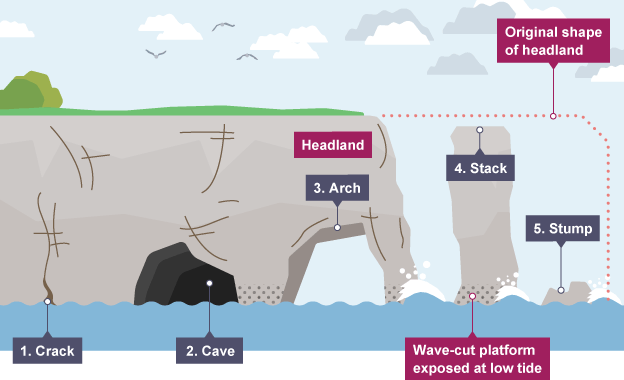
100
Which of these describes the typical daily weather pattern in an Equatorial climate?
Warm, sunny mornings with heavy convectional rain in the mid-afternoon.
100
Why is a Stevenson Screen painted white and made with louvered (slatted) sides?
To reflect sunlight and allow air to circulate freely
200
At which type of plate boundary do plates move away from each other, allowing magma to rise and create new crust?
Constructive (divergent)
200
Which erosional process involves the force of moving water smashing into the river banks and trapping air in cracks, eventually causing the bank to break apart?
Hydraulic action
200
What is 'Longshore Drift'?
The movement of sediment along the coast in a zigzag pattern.
200
Why do many rainforest trees have 'drip tips' on their leaves?
To allow heavy rain to run off quickly and prevent rot or moss growth
200
Which instrument is used to measure humidity?
Hygrometer (Wet-and-dry bulb thermometer)
300
What is the difference between the 'focus' and the 'epicentre' of an earthquake?
The focus is the point of origin underground; the epicentre is the point directly above it on the surface.
300
What are 'levees' and how are they formed naturally?
Natural levees are naturally raised embankments or ridges of sediment that run parallel to riverbanks.
1. Flooding Event: During high flow, a river tops its banks, spreading water across the floodplain.
2. Velocity Decrease & Deposition: As water spreads, friction reduces its speed, limiting its ability to transport sediment.
3. Deposition Sequence: The largest, heaviest material is deposited first, right along the riverbanks, while lighter, smaller material is carried further onto the floodplain.
4. Accumulation: Repeated floods build up these deposits over time, increasing the height of the banks
300
Coral reefs require very specific conditions to grow. Which of the following is a requirement for healthy coral?
B. Warm, clear, and shallow saltwater
300
What is the 'annual temperature range' in a Hot Desert climate typically like?
Around 15-25ºC
Hot deserts have very hot summers and cool winters.
300
How should a rain gauge be 'sited' to ensure an accurate reading?
In an open space, away from trees or buildings, and partially buried in the ground
400
Give 3 economic 'opportunities' provided by volcanic activity.
Ideas such as:
- Geothermal power
- Tourism
- Fertile land for farming
- New land formation
- Mining
400
In the formation of an oxbow lake, what process occurs at the 'neck' of the meander during a flood?
The river erodes through the neck, creating a straight 'cut-off' channel.
During a flood, the river takes the shortest, most efficient route, bypassing the old bend.
400
How is a coastal 'spit' formed?
400
How does deforestation impact the local 'water cycle' in a rainforest?
D. It increases surface runoff and leads to more frequent flooding
400
What does a 'Barometer' measure, and in what units is the data typically recorded?
Air pressure in millibars (mb) or hectopascals (hPa)
500
To reduce the impacts of an earthquake, many countries implement 'Seismic Retrofitting.' What does this involve?
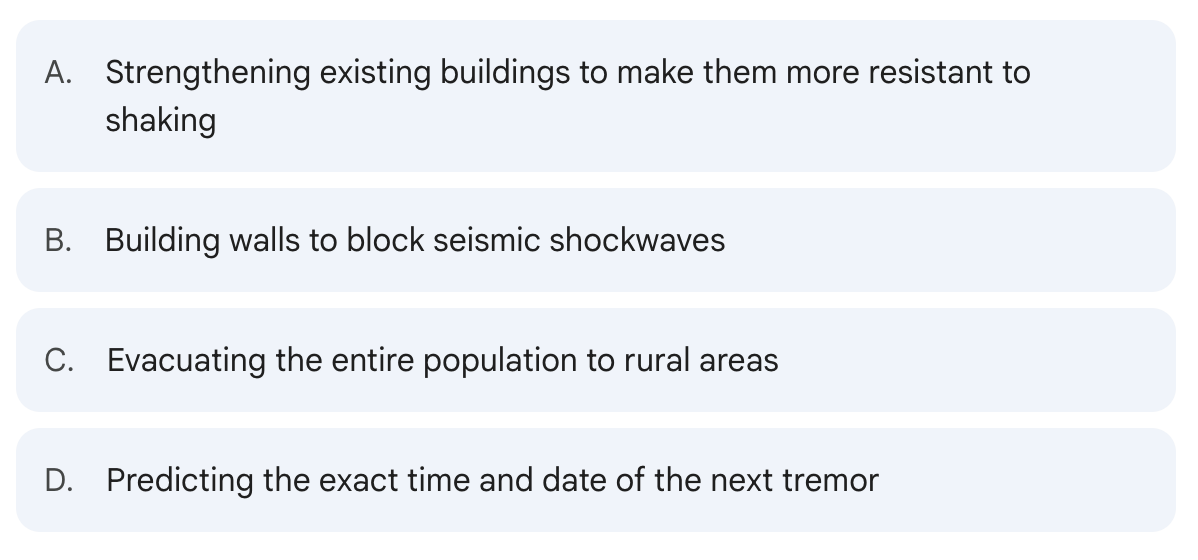
A. Strengthening existing buildings to make them more resistant to shaking
500
Which 'soft engineering' strategy involves allowing a river to flood naturally in certain uninhabited areas to protect high-value urban areas downstream?
Floodplain zoning / creating washlands
500
What is 'Beach Nourishment' and why is it considered a more sustainable management option than a sea wall?
Beach nourishment (or replenishment) is a soft engineering technique that adds large quantities of sand or sediment to a beach to combat erosion, widen the shoreline, and increase its capacity to absorb wave energy. It is considered more sustainable than seawalls because it works with natural processes, protects tourism, and avoids accelerating erosion on adjacent coastlines.
500
In a Hot Desert, why are many animals 'nocturnal'?
B. To conserve moisture and avoid the extreme heat of the day
500
If the maximum temperature for a day was 32ºC and the minimum was 18ºC , what is the 'diurnal range'?
14ºC