Imaginary Numbers
Complex Operations
Real or Imaginary Solutions
Finding Solutions
Misc.
100
Simplify This Expression:
√-16
4i
100
Complete The Following Operations:
(3 + i) + (6 + 2i)
9 + 3i
100
What kind of solutions does the following equation have?
x2 = 4
A) 1 Real B) 2 Real C) 1 Imaginary D) 2 Imaginary
B) 2 Real (x = ± 4)
100
What are the solutions to the following equation?
x2 = 49
x = ± 7
100
State The Quadratic Formula

200
Simplify This Expression FULLY:
-√ -7
-i√ 7
200
Complete The Following Operations:
(10 + 7i) - (6 + 6i)
4 + i
200
What kind of solutions does the following equation have?
x2 = -169
A) 1 Real B) 2 Real C) 1 Imaginary D) 2 Imaginary
D) 2 Imaginary (x = ± 13i)
200
Which is NOT a solution to the equation x2 + 9 = 0
A) 3i B) -3 C) -3i
B) -3
200
What is the part of the quadratic formula circled in red called?
The Discriminant
300
Simplify:
i22
-1
300
Complete The Following Operations:
(20 + 3i) - (4i - 6)
26 - i
300
How many IMAGINARY solutions does x2 + 5 = 0 have?
A) 2 B) 1 C) 0
A) 2 (x = ± i√5)
300
What are the solutions to the following equation?
x2 = -40
x = ± 2i√10
300
Using only the graph, state the nature of the solutions
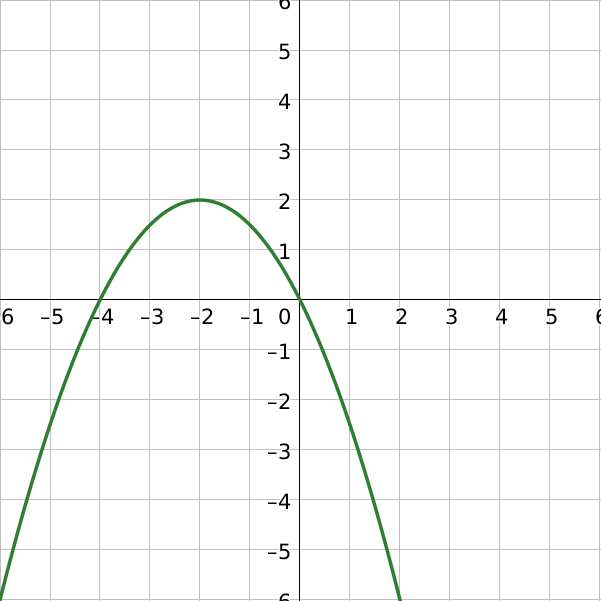
A) 1 Real B) 2 Real C) 1 Imaginary D) 2 Imaginary
Two Real Solutions
400
Simplify:
i39
-i
400
Complete The Following Operations:
(15 - 3i)(4 + 5i)
75 + 63i
400
How many REAL solutions does x2 + 4x + 13 = 0 have?
A) 2 B) 1 C) 0
C) 0
400
Which is a solution to the equation x2 + 2x + 5 = 0? SELECT ALL THAT APPLY
A) −1 + 2i B) −1 + 4i C) −1 - 2i D) −1 - 4i
A) −1 + 2i , C) −1 - 2i
400
Which of the following is equivalent to the complex number shown below:
(4−i)(3−2i)
A) 12 - 11i B) 10−11i C) 10 + 11i D) 14 - 11i
B) 10−11i
500
Simplify This Expression:
√-200
10i√2
500
Complete The Following Operations:
(3 - i)2
8 - 6i
500
What kind of solutions does the following equation have?
5x2 + 2x - 7 = 0
A) 1 Real B) 2 Real C) 1 Imaginary D) 2 Imaginary
B) 2 Real
500
What are the solutions to the following equation?
2x2 - 4x + 7 = 0
X =

500
What is NOT a solution to the quadratic:
2x2+7x−4=0
A) 1/2 B) -1/2 C) -4
B) -1/2