Acquiring Immunity
Emergence of Pathogens
Controlling Pathogen Spread
Immunotherapy
Experimental Design
Ethics
100
List the four ways in which individuals can acquire immunity
Active natural, active artificial, passive natural and passive artificial
100
Describe the difference between an emerging disease and a re-emerging disease.
An emerging disease is one that has not yet been recognised by people (1 mark); a re-emerging disease is one that has reappeared after being eliminated (1 mark).
100
Describe the difference between direct and indirect transmission of disease
A direct transmission is contact with a pathogen directly by inhaling infected droplets, for example (1 mark); an indirect transmission is contact with a pathogen by touching or consuming a contaminated surface or food item, for example (1 mark).
100
Define immunotherapy
A category of medical treatments that change the way the immune system functions.
100
Define: IV, DV, CV
IV - factor being changed.
DV - factor being measured.
CV - factors being controlled to ensure that the experiment is measuring the correlation between IV and DV explicitly.
100
In 1998, Andrew Wakefield and a team of eleven co-authors published a paper in The Lancet in which they claimed that the measles, mumps, and rubella (MMR) vaccine caused colitis (inflammation of the large intestine) and autism spectrum disorders. As it turns out, Wakefield's papers were proven to have had its data altered to suit the conclusions Wakefield wanted.
By altering data used in his 1998 study, Wakefield was not adhering to the bioethical concept of___________
Integrity
200
If someone were to be vaccinated against COVID-19, what type of immunity have they acquired?
Active artificial
200
What is the difference between virulence and contagiousness?
Virulence - likelihood of a pathogen to cause harm or disease
Contagiousness - ability of a pathogen to spread from one organism to another
200
List four ways of directly transmitting a disease.
Ways include inhaling droplets from a cough or sneeze, physical contact, eating or drinking the pathogen, being bitten by a vector, sexual contact.
200
What is the difference between active and suppression immunotherapies?
Activation - induce/ amplify an immune response
Suppresion - prevent / reduce an immune response
200
What is the difference between a control group and a control variable?
Control group - not exposed to the IV
Control variable - a factor that is controlled to ensure that it does not impact the DV
200
In 1998, Andrew Wakefield and a team of eleven co-authors published a paper in The Lancet in which they claimed that the measles, mumps, and rubella (MMR) vaccine caused colitis (inflammation of the large intestine) and autism spectrum disorders. As it turns out, Wakefield's papers were proven to have had its data altered to suit the conclusions Wakefield wanted.
The conducting of invasive and unnecessary tests on children performed by Wakefield and colleagues violates the bioethical principle of _____________
Respect
300
Provide an example of passive natural immunity.
Breastfeeding OR antibodies passed to foetus via placenta before birth
300
Explain how mutations of bacteria can lead to the re-emergence of a disease.
Any two of the following (1 mark each):
A mutation in bacteria could lead to drugs not being able to adhere to their surface and be effective in killing the pathogen.
Mutations can allow bacteria to change a drug’s target, so the drug can no longer fit into the target and have an effect.
Mutations can allow bacteria to develop new cell processes that avoid using a drug’s target.
Mutations can allow bacteria to produce cell wall pumps that actively remove any drugs entering them.
Mutations can allow bacteria to change or destroy drugs so they no longer work.
Mutations to bacterial antigens may result in the memory cells of the immune system no longer recognising them, rendering vaccination or previous exposure ineffective.
300
List three control strategies to prevent the spread of a pathogen.
Vaccination programs
Safe water for drinking and cleaning
Sewage treatment and disposal
Food safety standards and regulations
300
What is the difference between naked monoclonal antibodies and conjugated monoclonal antibodies?
- Naked monoclonal antibodies – monoclonal antibodies that do not have any other molecules attached
- Conjugated monoclonal antibodies – monoclonal antibodies with other molecules attached.
300
What is the difference between qualitative data and quantitative data?
Qualitative – data that is descriptive (in words)
Quantitative – data that is measured and represented numerically
300
Medications involved in the management of AIDS can be very expensive. One reason for this is drug companies deliberately
prolonging patents to drugs, preventing them from being sold for reduced prices.
Explain why this behaviour is unethical, with reference to the bioethical concept of respect.
It results in dishonest reporting of findings.
400
What is herd immunity, and why is it important?
Herd immunity - immunity to an infectious diseases due to very high vaccination rates in a population.
This is important because it protects members of the community who are not or cannot be immunised against the disease.
400
Outline a strategy that would help decrease the chance of a disease re-emerging.
Ensure that there is continual education about the importance of vaccination programs.
Prevent the over-use of antibiotics so that bacteria do not experience as much selection pressure to evolve resistance.
400
What are the two key reasons for diseases re-emerging?
Pathogen resistance to treatment
Decrease in vaccinations
400
Outline the three key ways that monoclonal antibodies can be used to treat cancer
- Antibody-dependent cell-mediated cytotoxicity (ADCC): Monoclonal antibodies bind to cancer cells and interact with cells of the immune system (particularly NK cells), causing them to recognize the antibody-coated cancer cells as foreign and kill it.
- Complement activation: monoclonal antibodies bind to cancer cells and interact with complement proteins, which then destroy the cancerous cell by forming a MAC or enhancing function of other immune cells.
- Checkpoint inhibition: Monoclonal antibodies can be used to block immune checkpoints, meaning the immune system is able to function at a greater capacity and destroy cancer cells more easily
400
A scientist wanted to explore if eating a lot of vitamin C reduced the frequency of illness.
Design an experiment to test this theory.
(1) IV - amount of vitamin C eaten.
(2) DV - frequency of illness over x amount of time.
(3) CVs - any x3
(4) Expected results
400
Sharon carried out an experiment that obtained results that did not support her hypothesis, yet she changed these results prior to publishing her findingsso that her initial hypothesis appeared correct. Identify which bioethical concept is not being adhered to by Sharon’s actions and explain why.
Sharon’s actions are not adhering to the bioethical concept of integrity, which prioritises the honest and accurate reporting of information.
By changing her results post-experiment in order to suit her hypothesis, Sharon is misrepresenting her findings and failing to publish unfavourable results
500
Outline the difference between active and passive immunity.
Active immunity is when an individual has their adaptive immune response activated to produce antibodies and memory T and B cells, whereas in passive immunity the person has antibodies from another organism transferred to them.
Or: Active immunity results in long-term immunity through production of specific antibodies and memory B and T cells, whereas passive immunity lasts for a shorter period of time.
500
Explain why Indigenous Australians were vulnerable to disease when European settlers arrived. (3 marks)
(1) European settlers would have previously been exposed to particular pathogens, meaning that they had natural active immunity to the pathogens.
(2) This means that, when re-exposed to the pathogen, the immune systems of the settlers would already have the memory cells to that pathogen, which would therefore mount a faster immune response.
(3) Indigenous Australians would not have encountered the pathogens brought across by European colonists, so would not have any immunity or antibodies or memory cells.
500
Part of the infectious cycle of a pathogen involves being airborne. Describe a control measure you would advise if you were an epidemiologist.
Any of: wearing face masks / social distancing / reduction of movements / good ventilation / filtering or ventilation and air-conditioning systems
500
Name and outline the two ways that monoclonal antibodies are used to treat autoimmune diseases.
- Cytokine inhibition – monoclonal antibodies can bind to and inhibit cytokines, reducing the immune response.
- B cell and T cell depletion and inhibition – monoclonal antibodies that bind to autoreactive B and T cells can be used to either inhibit these cells or stimulate other immune cells to destroy them.
500
What is the difference between accuracy and precision?
Accuracy – how close the measurement(s) are to the ‘true’ value of the quantity being measured
Precision – how close all the measurements are to each other
500
Precision medicine can be used to develop anticancer drugs that target and silence the gene or genes that cause a particular cancer. The government doesnot provide funding for many of these drugs and patients may need to spend upwards of $100 000 for one course of the treatment, when many courses of the treatment are likely to be needed to prolong life. This leads to unequal access to these lifesaving drugs in society. Identify the bioethical principle that is being breached, and explain why.
Justice
600
Draw a graph to show the number of antibodies after a first vaccination and a booster vaccination. Explain why this change occurs.
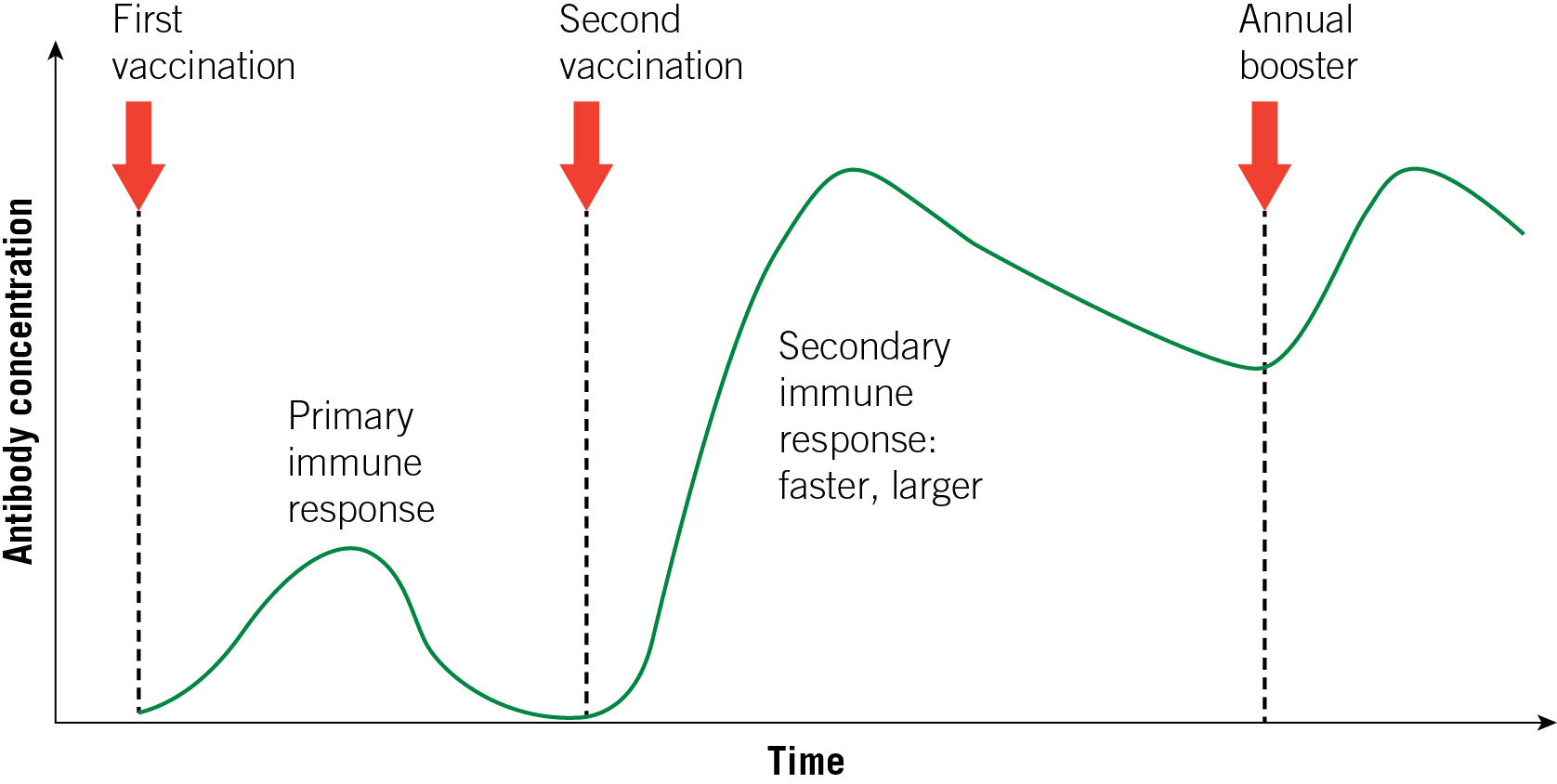
600
Another reason for re-emerging diseases is the decline of vaccination programs. Outline the link between vaccination and herd immunity.
Vaccination usually leads to long-term immunity against a disease (1 mark). If a vaccination program is successful, a large proportion of the population will become immune and protect those who are unable to get the vaccine, resulting in herd immunity (1 mark).
600
- What are antibiotics?
- How does antibiotic resistance occur?
- What is the consequence of antibiotic resistance?
- antibiotics - medication used to treat bacterial diseases
- antibiotic resistance occurs if antibiotics are overused or used inappropriately
- antibiotic resistance - bacteria is no longer affected by the antibiotics
600
How are monoclonal antibodies produced?
1)Scientists identify and isolate an antigen on a desired target cell (ie. A disease- causing cell)
2)Scientists vaccinate an animal (usually mice) with an antigen, resulting in clonal selection and proliferation of a B lymphocyte that is complementary to the antigen.
3)Complementary B lymphocytes are extracted from the mouse’s spleen.
4)B lymphocytes are fused with myeloma cells, forming hybridomas. This fusion must occur because B lymphocytes do not grow well in vitro (outside of a living organism), whereas myeloma cells can grow indefinitely, producing large amounts of antibodies.
5)A hybridoma that produces the appropriate antibody are selected and cloned. This results in mass production of the desired antibody.
6) Antibodies are collected, purified, and administered to the patient
600
Compare random and systematic errors, including what results from each type of error.
Random errors affect the precision of measurements. They are unpredictable variations that occur when not all variables are controlled, and they result in a spread of readings higher or lower than expected.
Systematic errors, on the other hand, affect the accuracy of measurements. They result in readings that differ from ‘true’ values consistently in one direction each time.
600
Based on the bioethical concept of non-maleficence, describe why monoclonal antibodies should not be approved prior to the completion of all clinical trials.
According to the bioethical concept of non-maleficence, harm should be avoided when conducting research
Deliberately inducing tumours in mice involves harming them, and as such this method of antibody creation needs to be ethically evaluated to ensure whether or not it should be used, or how any harms caused can be minimised.