IOL Indications
Cervical Ripening
ARRIVE Trial
Augmentation
100
Your patient is a G1P0 at 35w2d. She has gHTN SI on cHTN. Her blood pressures have been well controlled this pregnancy and she is taking her daily ASA. When do you recommend she deliver?
37w0d or at diagnosis
PIH Indications:
Well-controlled cHTN, no meds- 38-39w
Well-controlled cHTN, meds - 37-39w
Difficulty to control cHTN - 36-37
PreE w/o SF- 37w
PreE w/ SF - 34w if maternal/fetal stability
Medically Indicated Late-Preterm and Early-Term Deliveries: ACOG Committee Opinion, Number 831. Obstet Gynecol. June 30, 2021.
100
Your patient’s bishop score is 8. She does require cervical ripening. True or false?
False
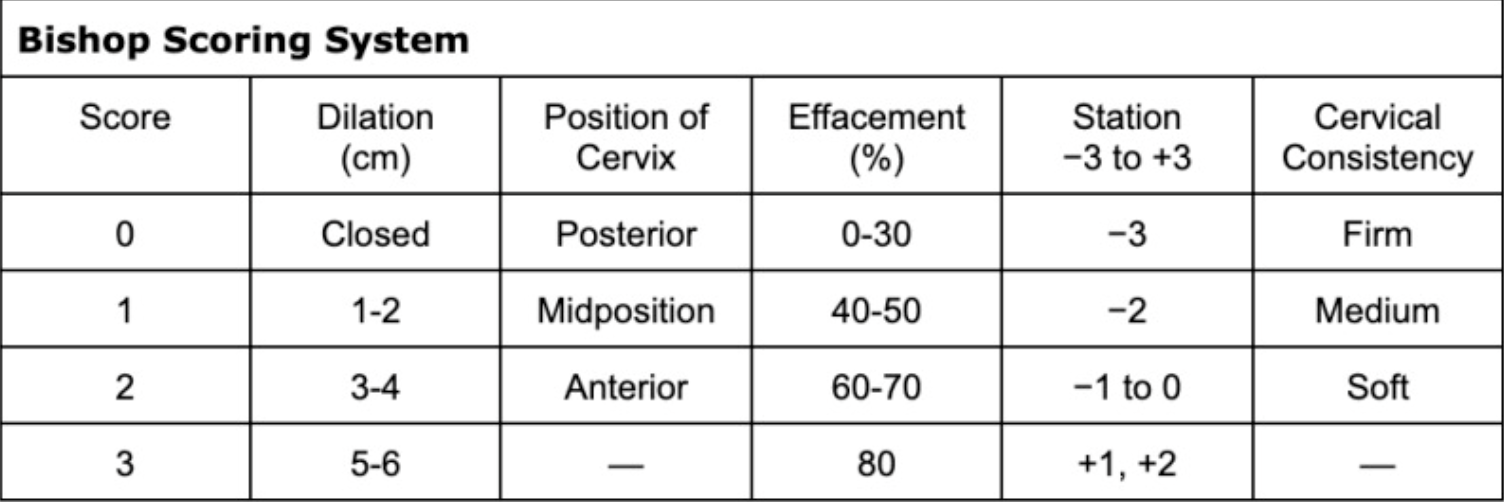
Bishop scores > or equal to 6 indicate a ripe cervix.
100
What did the ARRIVE trial study and what were the primary outcomes?
eIOL vs expectant management, neonatal morbidity and mortality and primary cesarean
Neonatal morbidity and mortality composite score (perinatal death, the need for respiratory support within 72 hours after birth, Apgar score of 3 or less at 5 minutes, hypoxic–ischemic encephalopathy,17 seizure, infection, meconium aspiration syndrome, birth trauma, intracranial or subgaleal hemorrhage, or hypotension requiring vasopressor support)
100
What is ACOG’s definition of arrest of labor in the 1st stage of labor?
No progression in cervical dilation in patients who are at least 6-cm dilated with rupture of membranes despite 4 hours of adequate uterine activity or 6 hours of inadequate uterine activity with oxytocin augmentation
First and Second Stage Labor Management: ACOG Clinical Practice Guideline No. 8. Committee on Clinical Practice Guidelines—Obstetrics Obstetrics and Gynecology. 2024;143(1):144-162. doi:10.1097/AOG.0000000000005447.
200
Your patient is a G2P1 at 34w6d. She tested positive on her 1h GTT but her sugars have been at goal since that time. When do you recommend she deliver?
39w0d-40w6d
GDM Indications:
Pregestational- 39w
Poorly controlled pregestational or prior stillbirth - 36-38w
Well controlled GDMA2- 39w
Poorly controlled GDMA2- Individualized
Medically Indicated Late-Preterm and Early-Term Deliveries: ACOG Committee Opinion, Number 831. Obstet Gynecol. June 30, 2021.
200
What is a contraindication to using misoprostol for cervical ripening and why?
Prior CS or uterine scar due to increased risk of uterine rupture.
Risk is similar with pitocin but pitocin is more easily controlled unlike miso. Misoprostol's half life is 20-40 minutes, unlike pitocin's short half life.
Some reviews of the evidence this is based upon suggest there is insufficient evidence to routinely recommend against misoprostal use in TOLACers but there has been no change in guidance.
Rath W, Tsikouras P. Misoprostol for Labour Induction after Previous Caesarean Section - Forever a "No Go"? Geburtshilfe Frauenheilkd. 2015 Nov;75(11):1140-1147. doi: 10.1055/s-0035-1558171. PMID: 26719597; PMCID: PMC4678051.
200
What were the secondary outcomes studied in the ARRIVE trial?
Neonatal secondary outcomes:birth weight, duration of respiratory support, cephalohematoma, shoulder dystocia, transfusion of blood products, hyperbilirubinemia requiring phototherapy or exchange transfusion, hypoglycemia requiring intravenous therapy, admission to the neonatal intermediate or intensive care unit, and length of hospitalization.
Maternal secondary outcomes: hypertensive disorders of pregnancy (gestational hypertension or preeclampsia), indication for cesarean delivery, operative vaginal delivery, indication for operative vaginal delivery, uterine incisional extensions during cesarean delivery, chorioamnionitis, third-degree or fourth-degree perineal laceration, postpartum hemorrhage, postpartum infection, venous thromboembolism, number of hours in the labor and delivery unit, length of postpartum hospital stay, admission to the intensive care unit, and maternal death.
200
You are discussing augmentation with a patient. Her exam has been 6/60/-2, unchanged for 2 hours, and the fetal head is well applied to the cervix on most recent SVE. She is hesitant to undergo amniotomy due to concern for infection. What do you tell her about the association between amniotomy and infection risk?
ACOG recommends early amniotomy for patients undergoing induction or augmentation when appropriate in the labor course to reduce labor duration. There is no association between amniotomy and risk for infection when controlling for labor course duration.
(Strong rec, high quality evidence)
First and Second Stage Labor Management: ACOG Clinical Practice Guideline No. 8. Committee on Clinical Practice Guidelines—Obstetrics Obstetrics and Gynecology. 2024;143(1):144-162. doi:10.1097/AOG.0000000000005447.
300
Your patient is a G1P0 at 39w5d. She really wants to avoid an induction. She asks you how long it is safe to consider prolonging her pregnancy before an induction is recommended. What do you tell her?
41w0d-42w0d
ACOG recommends IOL for late-term pregnancies to avoid risk of stillbirth and other poor maternal and neonatal outcomes.
300
List two methods of mechanical cervical ripening.
CRB or foley balloon, osmotic dilators
"Laminaria" made of kelp/seaweed product
"Dilapan" made of synthetic material.
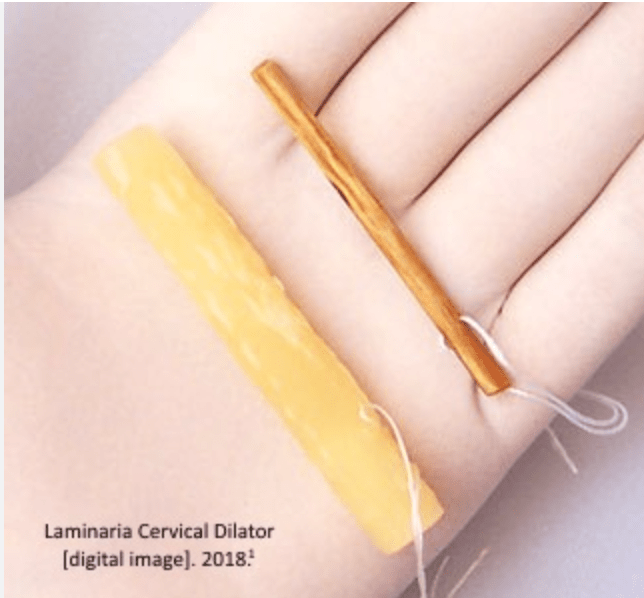
Both not commonly used.
Of note, ACOG is beginning to be more open to starting at-home inductions with outpatient CRB placement 24 hours prior to induction appointment.
300
What were the eligibility criteria for participants
nulliparous, single, vertex, reliable dating, no medical or obstetric complications
300
How rapidly does pitocin start to work and how rapidly does it leave the body after turned off?
Steady state of a dose is achieved at 40 mins, half life is 3-5 mins after turned off.
400
You see a patient in OB triage for labor evaluation. She is a G1P0 at 37w0d with an uncomplicated medical history. Her toco is quiet, but you decide to scan her and notice her MVP is 1.5cm. What do you recommend?
She stay for induction of labor for oligohydramnios.
ACOG states that isolated or otherwise uncomplicated oligo is a reason to deliver at 36-37w gestation or at time of diagnosis if later.
Medically Indicated Late-Preterm and Early-Term Deliveries: ACOG Committee Opinion, Number 831. Obstet Gynecol. June 30, 2021.
400
Misoprostol ripens the cervix through what mechanism? Be specific.
Prostaglandin E1
400
You see a 40 yo G3P2 at 37w2d with pregnancy c/b elevated pre-pregnancy BMI >40. She is dated by a 2T US. She desires elective induction of labor and mentions the ARRIVE trial to you. List the main reason the ARRIVE trial cannot be well applied to her case.
multiparous
AMA was NOT an exclusion criteria
400
ACOG recommends high dose pitocin protocols over low dose pitocin protocols for augmentation. True or false?
False. ACOG states either high or low dose protocols are appropriate for induction and augmentation.
Studies have shown there is no difference in time to delivery, operative delivery, or cesarean rate — but the high-dose approach carries more tachysystole while the low-dose approach may carry more postpartum hemorrhage
500
Your patient is a G3P2 at 34w0d. She has been having itching of her palms and soles for the last week. You send her bile acids and they come back at >100. When do you recommend she deliver as long as she has reassuring antenatal testing until that time?
36w0d
ACOG recommends late preterm delivery at 36w (or at diagnosis is later) for ICP with bile acids >100. For bile acids <100, 36w-39w is appropriate based on clinical stability.
Medically Indicated Late-Preterm and Early-Term Deliveries: ACOG Committee Opinion, Number 831. Obstet Gynecol. June 30, 2021.
500
Calculate the bishop score for a patient with an initial SVE of 1/30/-3, posterior and medium consistency.
2
500
What is one of the limitations or critiques of the ARRIVE trial?
Limited generalizability
Intention to treat analysis used (which is good) but adherence to protocol (expectant management or IOL) was about 90%
Cost of practice change - longer hospitalizations for induction = higher costs
500
Calculate the MVUs on this strip. Are they adequate or inadequate?
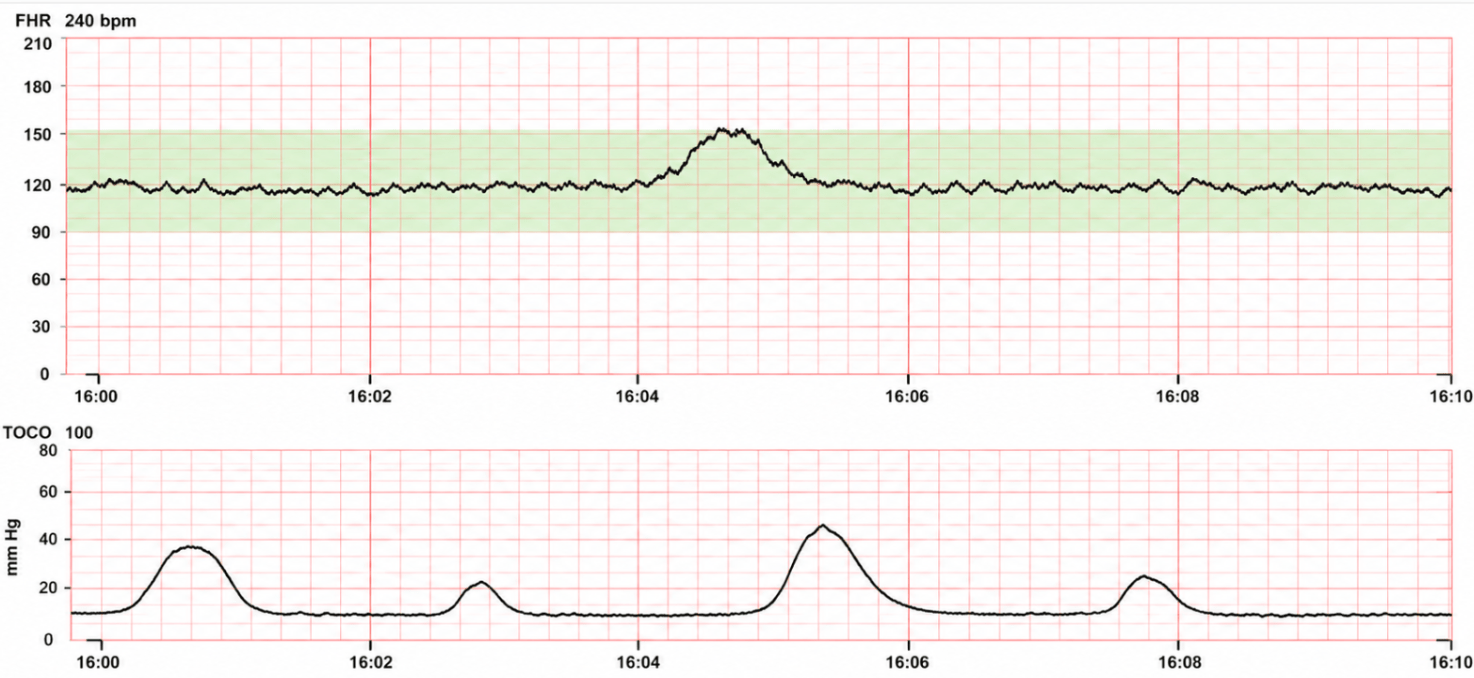
120, inadequate.
Adequate MVUs can only be calculated with an IUPC in place. >200 MVU over a 10 minute period are considered adequate to make cervical change.