Equilateral + Isosceles Triangles
Triangle Congruence
Polygon Angle Sums
\\ o grams
Let's Recall...
100
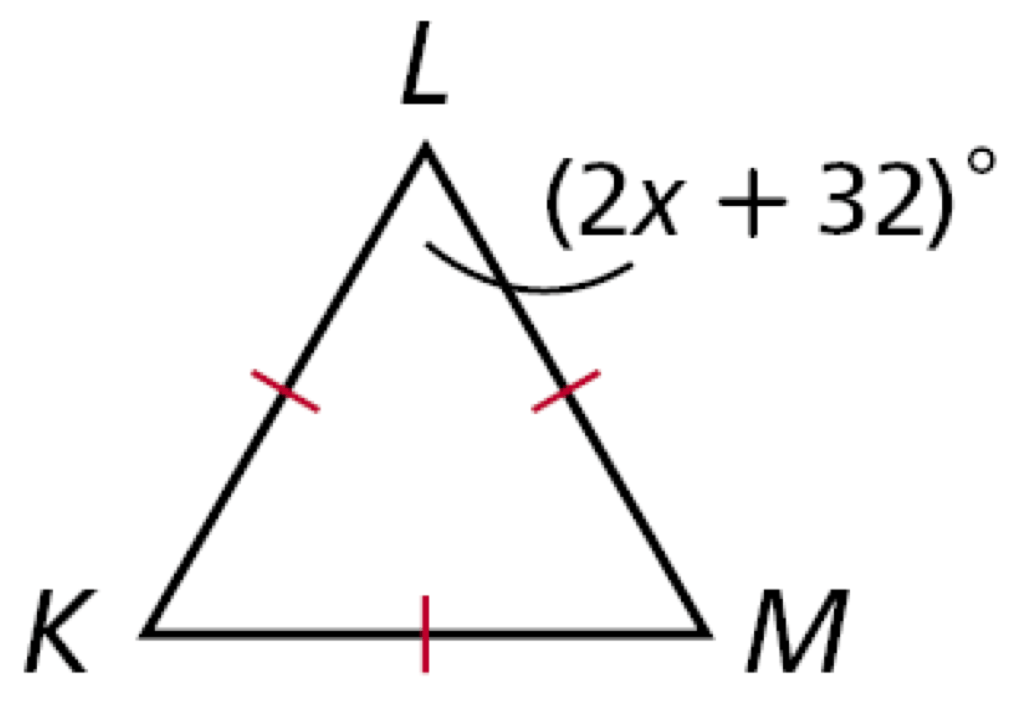
Solve for the value of x.
x = 14
100
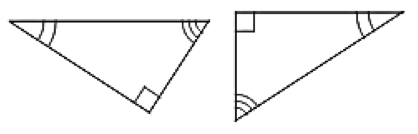 Are the triangles congruent? If so, by what theorem? If not, say "NEI'.
NEI
100
Find the sum of the interior angles of a tetracosagon (405-gon). (#19)
72,540°
100
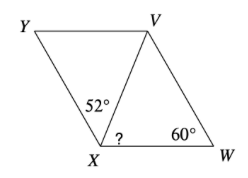 Solve for the missing angle AND state the property of parallelograms used. (#34)
68°, consecutive angles are supplementary
100
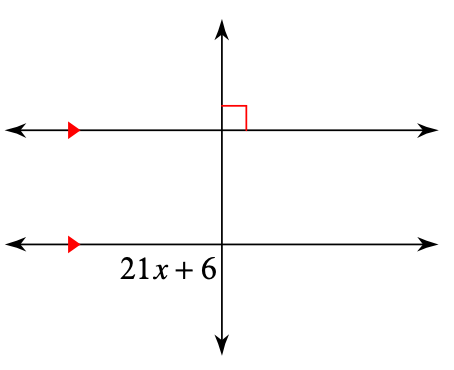 State the angle pair relationship AND solve for x.
Alternate Exterior Angles, x = 4
200
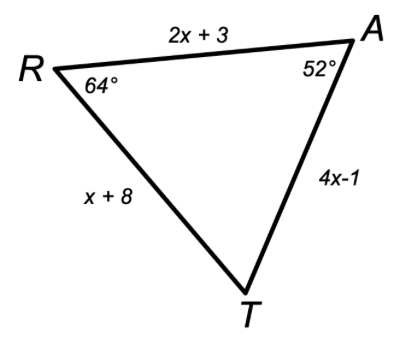 What kind of triangle is ΔRAT? How do you know? (#1)
Isosceles Triangle
200
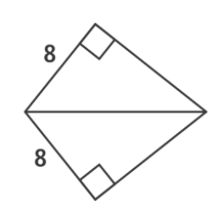 Are the triangles congruent? If so, by what theorem? If not, say "NEI'.
HL
200
Find the measure of one interior angle of a regular 17-gon. If necessary, round to the nearest tenth. (#20)
158.8°
200
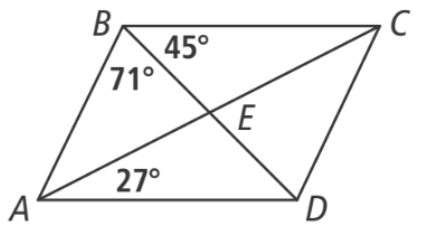 ABCD is a parallelogram. If BE=2x+2, BD=5x-3. Solve for x AND state the parallelogram property used. (#30)
x = 7, diagonals bisect each other
200
Give the new coordinates.
r_{(90°,O)}(-5,2)
(2,5)
300
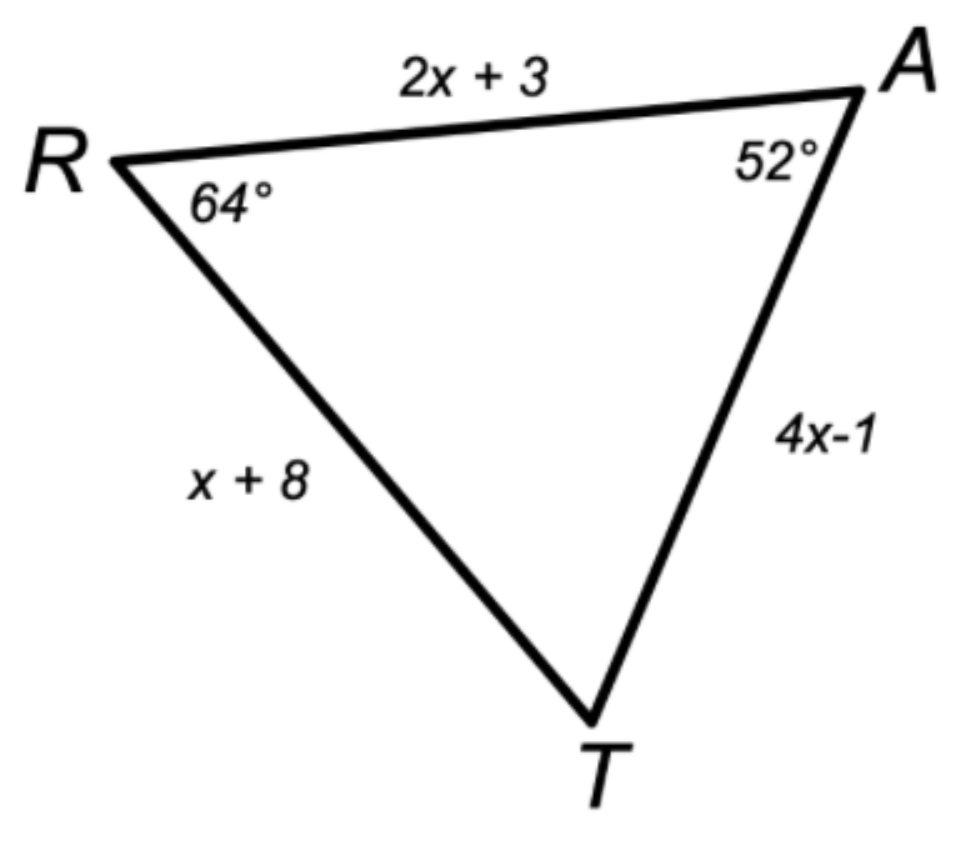 What is the value of x?
x = 2
300
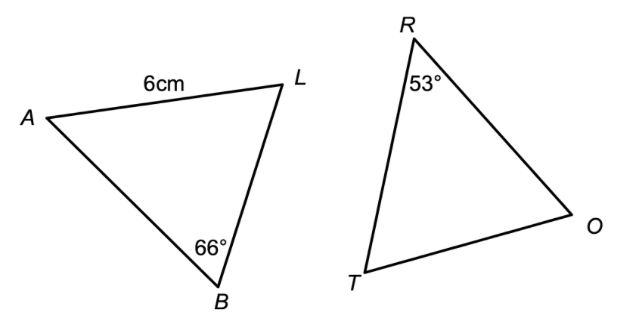 Given ΔLAB ≅ ΔORT, what is m∠O? (#8)
m∠O = 61°
300
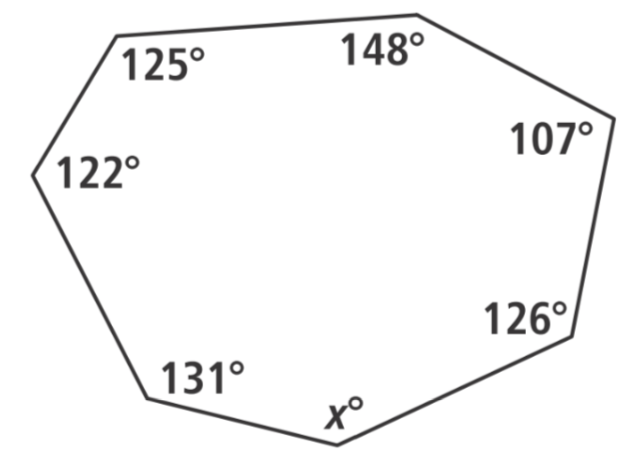 Set up an equation and solve for the value of x using the appropriate angle sum theorem.
141°
300
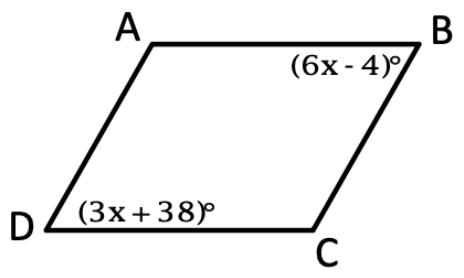 ABCD is a parallelogram. Find m∠A. What property of parallelograms did you use?
m∠A = 100°, opposite angles are congruent
300
Find the distance between the points (1,1) and (4,5).
5
400
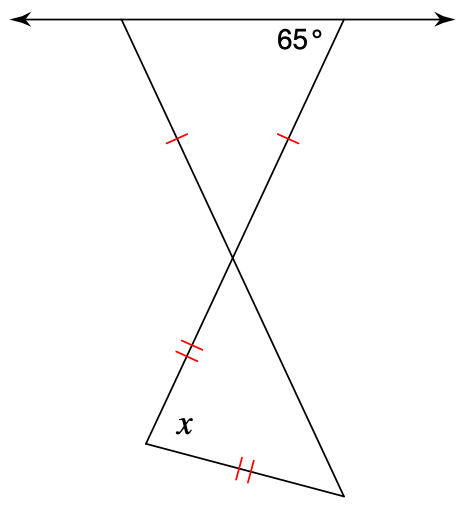 Solve for x. (similar to #13)
x = 80°
400
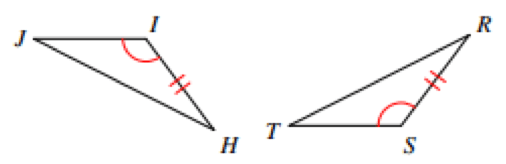 What additional information is needed to prove the triangles are congruent by AAS?
Fill in the blank: _____ ≅ _____
∠J ≅ ∠T
400
A pentagon has interior angles with measures (5x-12°, (2x+100)°, (4x+16)°, (6x+15)°, and (3x+41)°. Find the value of x.
x = 19
400
Answer the following statements with always, sometimes, or never. All must be correct!
1. Parallelograms are ______________ squares. (#24)
2. Squares are ______________ rhombi and rectangles. (#26)
3. The diagonals of a rectangle ______________ bisect opposite angles. (#27)
1. Sometime
2. Always
3. Sometimes
400
State the inverse of the statement.
If a quadrilateral is a square, then it is a rectangle
If a quadrilateral is not a square, then it is not a rectangle.
500
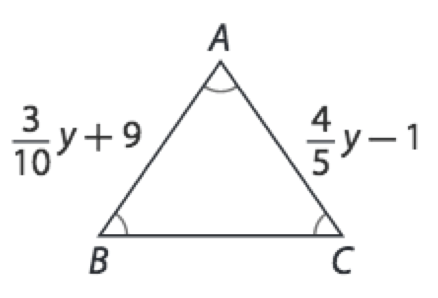
Solve for the value of y.
y = 20
500
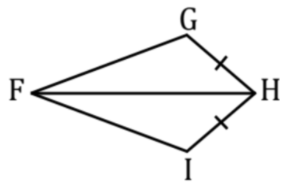
If FH bisects ∠GHI, is there enough information to prove the triangles congruent? If so, by what theorem? If not, say "NEI'.
SAS
500
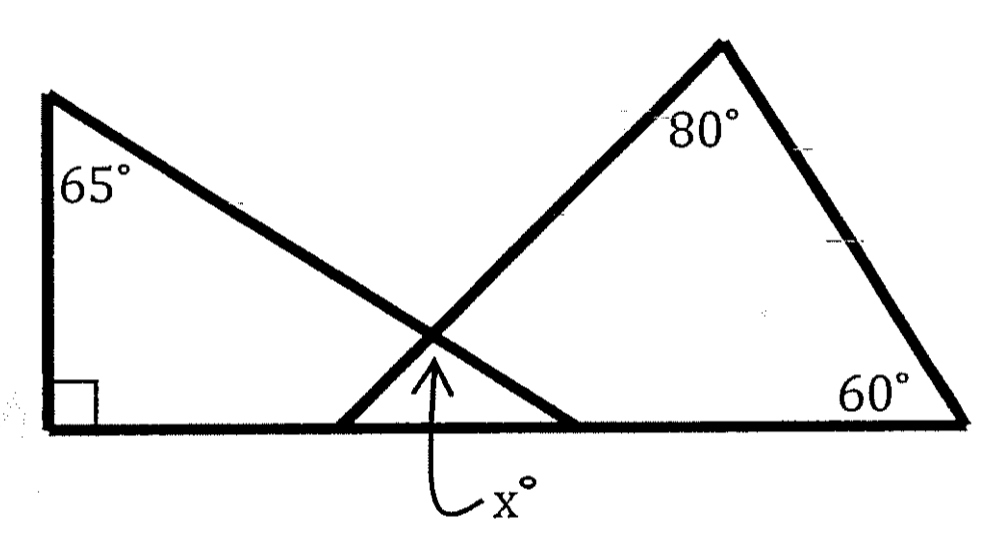 Solve for x.
115°
500
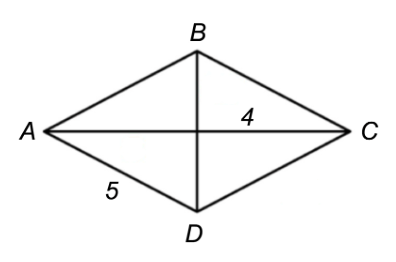 Given that ABCD is a rhombus. If m∠ABD=58°, what is m∠BAC? State the rhombus property you used.
m∠BAC = 32°, diagonals are perpendicular
500
Write the equation of the line that is perpendicular to the given line and goes through the given point.
y=\frac{5}{2}x-2, (5,2)
y=-\frac{2}{5}x+4