Energy
Waves
Force and Motion
Elements etc
Electricity and Magnetism
100
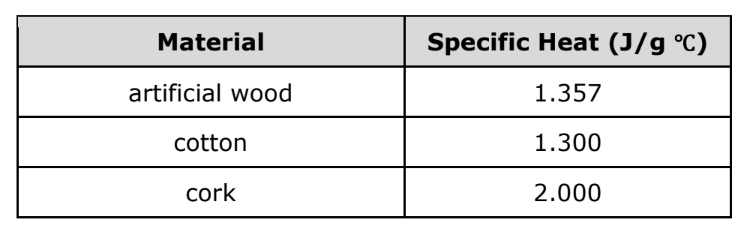 Based on the table, which material would be the BEST for the student’s lunch bag?
A the material with the lowest specific heat
B the material with the highest specific heat
C the artificial wool which has the highest specific heat
D the cork because it takes less heat to raise its temperature
E the cork because it takes more heat to raise its temperature
F the cotton because it takes more heat to raise its temperature
B- The material with the highest specific heat
E- The cork because it takes more heat to raise its temperature.
100
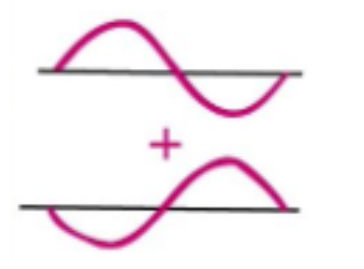
A A straight line
B A wave with higher crests and lower troughs
C A wave identical to wave A
D A wave identical to wave B
A A straight line
100
A teacher dropped three different objects down a 5.0 m vacuum chamber. The teacher then
determined the force on each object given its mass and created the table shown.
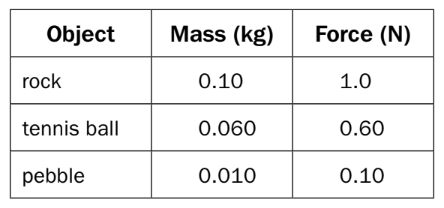
What relationship can be determined based on an analysis of the data?
A Each object has a final velocity that is proportional to its mass.
B Each object has an acceleration that is proportional to its mass.
C All three objects have the same downward acceleration regardless of mass.
D All three objects have the same amount of inertia regardless of mass.
C All three objects have the same downward acceleration regardless of mass.
100
Which of the following elements is known for its malleability and ability to be easily hammered into thin sheets?
A Sulfur
B Nitrogen
C Mercury
D Aluminum
D Aluminum
100
Students in a science class were shown three identical bulbs, each with a resistance of 50 ohms, connected to a 1.5-volt battery as shown in the diagram below. The students were told to assume the resistance of the wire is 0 ohms and make a claim as to which bulb has the most current.
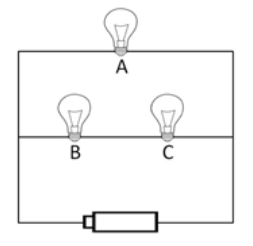
Which student's claim is justified (correct)?
A Student 1: The current in Bulb A is greater than the current in Bulb B and greater than the current in bulb C because Bulb A doesn’t have to share current with bulbs B and C.
B Student 2: The current in Bulb B is less than the current in Bulb C because Bulbs B and C share the same current.
C Student 3: The current in Bulbs B and C is greater than the current in Bulb A because both bulbs are closer to the power source.
D Student 4: The current in each bulb is the same because they are all connected to the same power source.
A Student 1: The current in Bulb A is greater than the current in Bulb B and greater than the current in bulb C because Bulb A doesn’t have to share current with bulbs B and C.
200
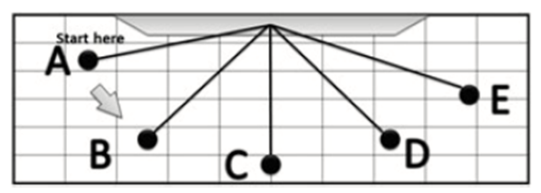
A Total energy increases
B Total energy decreases
C Total energy stays the same
D Total energy increases then decreases
C- Total energy stays the same
200
Which of the following statements are TRUE about mechanical and electromagnetic waves? Select ALL that apply.
A Mechanical waves travel faster than electromagnetic waves.
B Electromagnetic waves do not need a medium through which to travel.
C Mechanical waves have more energy than electromagnetic waves.
D Mechanical waves and electromagnetic waves travel at the same speed through solids.
E Mechanical and electromagnetic waves can undergo the four basic types of wave interactions - reflection, refraction, diffraction, and interference.
B Electromagnetic waves do not need a medium through which to travel.
E Mechanical and electromagnetic waves can undergo the four basic types of wave interactions - reflection, refraction, diffraction, and interference.
200
Use the information and the graph to answer the following question.
A car is being driven at a race track.
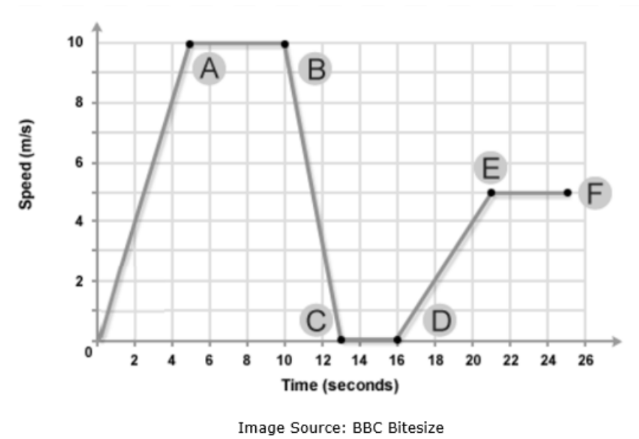
During which segment(s) of the trip was the car stopped?
A Segments A-B
B Segment C-D
C Segments A-B and E-F
D Segments C-D and E-F
B Segment C-D
200
Use the information and table to answer the following question.
The table shows the ionic charges of several elements.

Which element is MOST LIKELY similar to oxygen in that it will form an ion with a 2- charge?
A Helium
B Beryllium
C Phosphorus
D Sulfur
D Sulfur
200
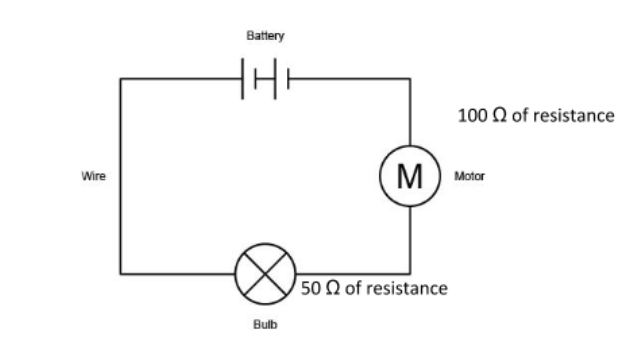
A Replacing the motor with a bulb will increase the current in the circuit.
B Replacing the bulb with a motor will increase the current in the circuit.
C Replacing the bulb with a motor will have no effect on the current in the circuit.
D Replacing the motor with a bulb will have no effect on the current in the circuit.
A Replacing the motor with a bulb will increase the current in the circuit.
300
During a heat transfer investigation, students filled two cups with water. One cup contains 100 mL of cold water, while the other contains 100 mL of hot water. A metal heat wire is placed inside the water of both cups and thermometers are attached to each cup.
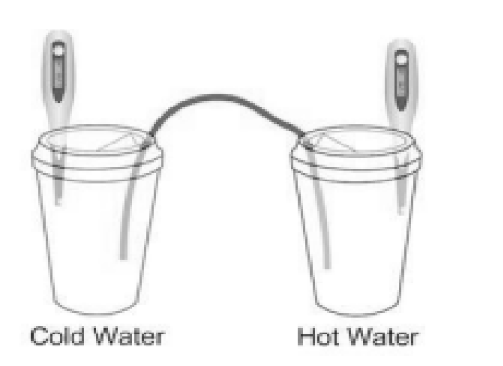
Which of the following BEST explains how the heat is transferred?
A This investigation would not result in any heat being transferred.
B Convection, because the metal wire was heated through convection
currents.
C Radiation, because the metal wire was heated by electromagnetic
waves.
D Conduction, because the metal wire was in direct contact with the water in both containers.
D Conduction, because the metal wire was in direct contact with the water in both containers.
300
Use the table below to answer the question.
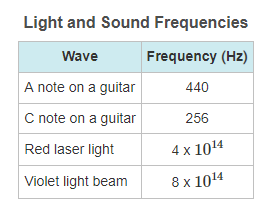
Based on the table and your knowledge of waves, what can you conclude about the wavelength of mechanical waves compared to electromagnetic waves?
A Mechanical waves have greater amplitude.
B Mechanical waves tend to have longer wavelengths.
C Mechanical waves tend to have shorter wavelengths.
D Mechanical waves travel faster than electromagnetic waves.
B Mechanical waves tend to have longer wavelengths.
300
Use the information and table to answer the following question.
A student bounces a ball on the floor from the same height but with varying force and records the data of the bounce height as seen in the table.
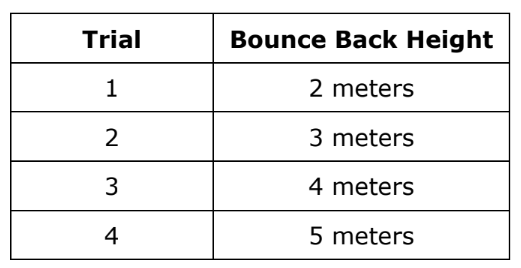
Which of the following statements is the most accurate according to Newton’s Laws of Motions?
A Trial 1 bounces with the greatest amount of force
B Trial 2 bounces with the least amount of force
C Trial 3 bounces with the greatest amount of force
D Trial 4 bounces with the least amount of force
B Trial 2 bounces with the least amount of force
C Trial 3 bounces with the greatest amount of force
300
Use the information and model to answer the following question.
The model shows the models of protons (+), neutrons (N), and electrons (-) in an atom, along with three different models of these subatomic particles.
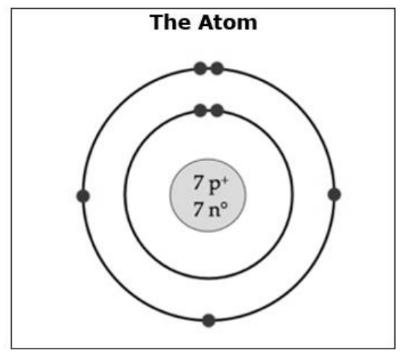
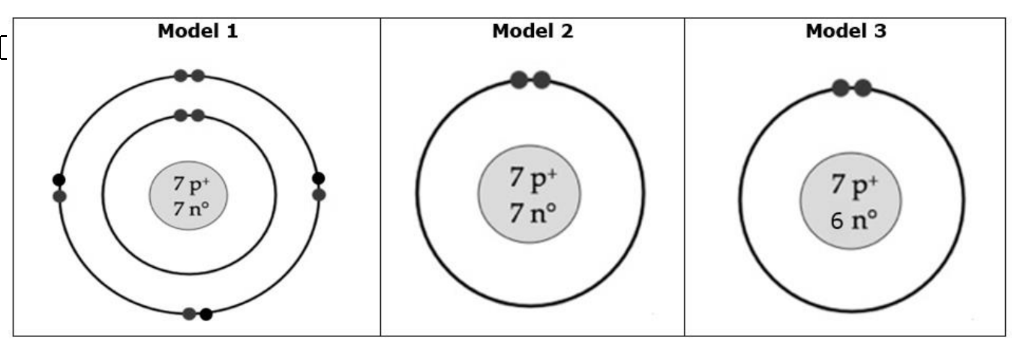
Which of the following identifies the models that represent an ion and an isotope of the original atom?
A Model 1 is an ion; Model 2 is an isotope
B Model 1 is an isotope; Model 2 is an ion
C Model 1 is an ion; Model 3 is an isotope
D Model 2 is an isotope; Model 3 is an ion
C Model 1 is an ion; Model 3 is an isotope
300
A student is building a model of a parallel circuit consisting of a battery, a switch, five light bulbs, and wires. When she connects all of the components of her model, none of the bulbs light up.
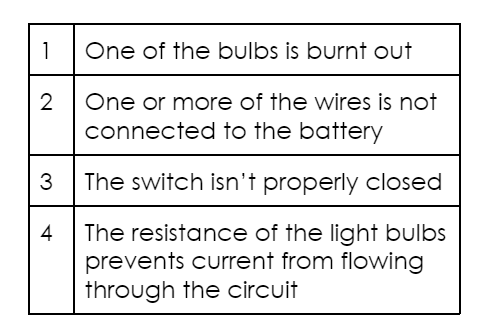
Which of the following could be the problem with her model?
A 1, 2, and 3
B 2, 3, and 4
C 1, 3, and 4
D 1, 2, and 4
B 2, 3, and 4
400
During an investigation about heat transfer, four blocks at different temperatures are stacked.
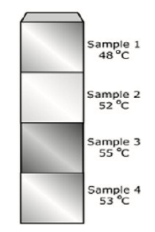
Which is the MOST accurate comparison of changes in average kinetic energy between the blocks?
A Sample 1 will decrease, while Sample 2 will increase
B Sample 2 will decrease, while Sample 3 will increase
C Sample 4 will decrease, while Samples 2 and 3 will increase
D Sample 3 will decrease, while Samples 1, 2 and 4 will increase
D Sample 3 will decrease, while Samples 1, 2 and 4 will increase
400

Which type of waves is this student most likely studying?
A Both waves are light waves
B Both waves are sound waves
C Wave 1 is a light wave and wave 2 is a sound wave
D Wave 1 is a sound wave and wave 2 is a light wave
C Wave 1 is a light wave and wave 2 is a sound wave
400
Students were investigating the motion of objects dropped to Earth from the same height. Four objects were dropped from the same height. Students collected initial data on the objects and recorded it in the table below. Assume there is no air resistance.
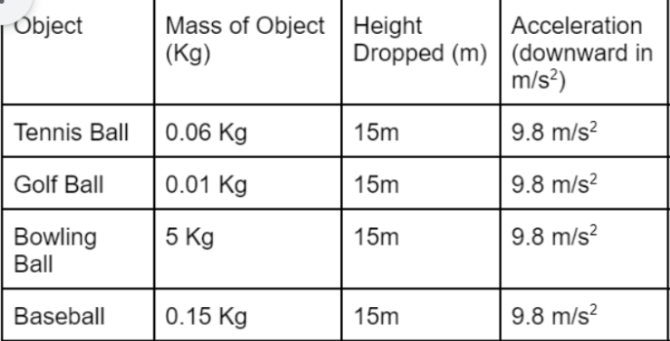
Using the data table, which statements did the students likely conclude from this investigation?
Statement I: All objects hit the ground at the same time.
Statement II: All objects hit the ground with the same force.
Statement III: The bowling ball hit the ground first and the tennis golf ball hit the ground last.
Statement IV: The bowling ball would be predicted to hit the ground with the most force.
A I and II only are true
B I and IV only are true
C III and II only are true
D I, III and IV only are true
B I and IV only are true
400
Use the information to answer the following question.
Students were provided with a sample of a pure element to examine. They made a list of its observable properties:
- Solid at room temperature
- Shiny
- Malleable
- Good conductor of heat
Based on the properties in the list, which element were the students most likely observing?
A carbon
B silicon
C sulfur
D tin
D tin
400
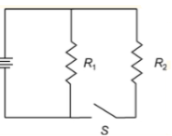
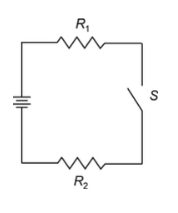
Students were asked to create different types of circuits in a lab. Carlos built a simple circuit with 2 resistors (R1 and R2) and a switch (S). When he opened the switch the current flowed through R1 but not through R2.
Which circuit did he build?
A
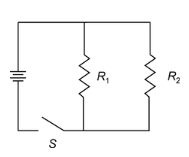
B
C
D
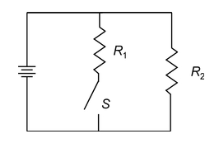
B
500
A boy is riding his bike down a tall hill. At the top of the hill, he has 2800J of potential energy. At the bottom of the hill, when he is going the fastest, his kinetic energy measures 2650J. Which statement below is true?
A The total amount of energy at the bottom of the hill cannot equal the amount at the top, because some of the energy is destroyed.
B The total amount of energy at the bottom of the hill cannot equal the amount at the top, because some of the energy is gained.
C The total amount of energy at the bottom is equal to the amount at the top, but he gained some energy as he traveled due to a higher speed.
D The total amount of energy at the bottom is equal to the amount at the top, but some energy was converted into other forms due to friction.
D The total amount of energy at the bottom is equal to the amount at the top, but some energy was converted into other forms due to friction.
500
Use the information and table to answer the following question.
The table shows the wavelength of different colors on the visible light spectrum.

Based on the data in the table, which statements about the colors on the visible light spectrum are TRUE? Select ALL that apply.
A Yellow light has a higher frequency than blue light.
B Green light has a higher frequency than orange light.
C Red light has the longest wavelength and the lowest frequency.
D Red light has the shortest wavelength and the lowest frequency.
E Violet light has the longest wavelength and the lowest frequency.
F Violet light has the shortest wavelength and the highest frequency.
B Green light has a higher frequency than orange light.
C Red light has the longest wavelength and the lowest frequency.
F Violet light has the shortest wavelength and the highest frequency.
500
To investigate Newton’s second law of motion, a student used a motion sensor and a spring scale to measure the force acting on a lead block as it was pulled in the direction of the arrow, across the top of a table. A diagram of the setup is shown.
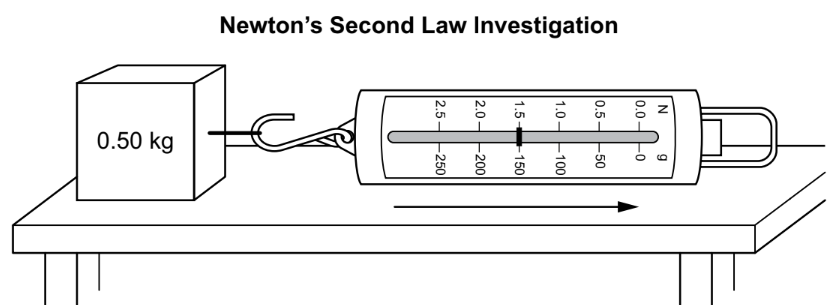
The student measured a force of 1.5 newtons (N) acting on the lead block. The student expected
the block to accelerate in the same direction as the arrow; however, when the block moved across the table, the motion sensor detected a constant velocity. The student interpreted the results and claimed that Newton’s second law does not always apply.
Which explanation BEST describes why the student’s claim is invalid?
A The 1.5 N reading on the spring scale is due to the force of friction acting in the opposite direction of the motion, since the net force is zero at constant velocity. Without friction, the lead block would have accelerated at 0.33 m/s2.
B The 1.5 N reading on the spring scale is due to the net force of 1.5 N to the right acting on the block, as indicated by the constant velocity to the right. Without this force, the lead block would have accelerated at 0.33 m/s2.
C The 1.5 N reading on the spring scale is due to the force of friction acting in the opposite direction of the motion, since the net force is zero at constant velocity. Without friction, the lead block would have accelerated at 3.0 m/s2.
D The 1.5 N reading on the spring scale is due to the net force of 1.5 N to the right acting on the block, as indicated by the constant velocity to the right. Without this force, the lead block would have accelerated at 3.0 m/s2.
C The 1.5 N reading on the spring scale is due to the force of friction acting in the opposite direction of the motion, since the net force is zero at constant velocity. Without friction, the lead block would have accelerated at 3.0 m/s2.
500
Use the information and table to answer the following question.
The data in the table represents unknown element samples.
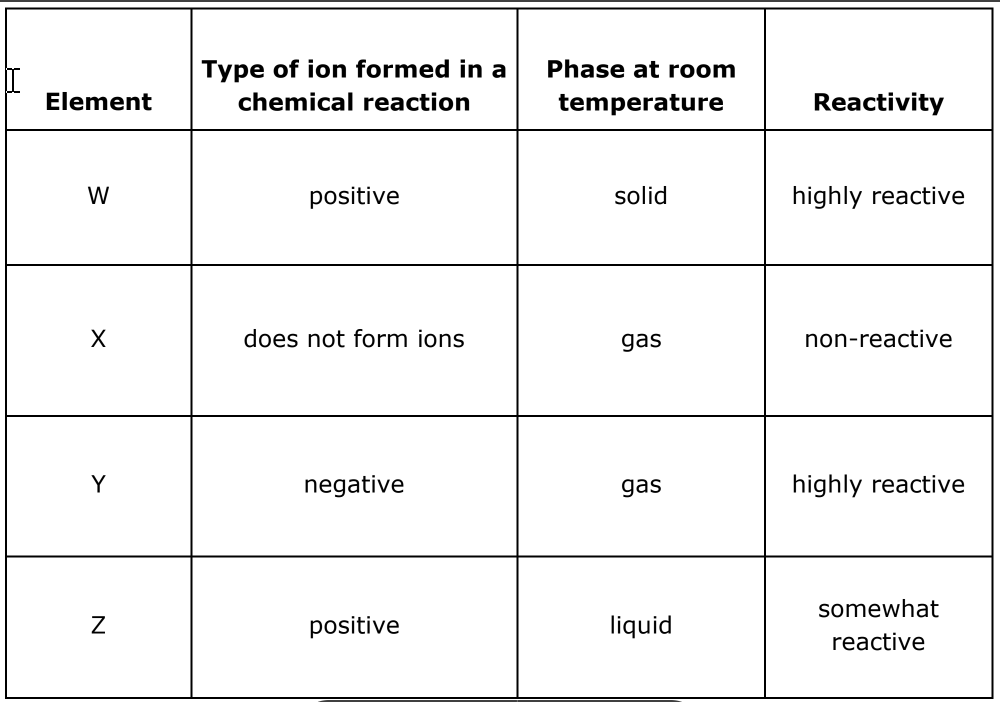
Using your knowledge of periodic properties and trends, how would these elements BEST be classified and why?
A Elements W and Z are metals, Elements X and Y are nonmetals, but Element Y is in Group 18 (noble gas).
B Elements W and Z are metals, Elements X and Y are nonmetals, but Element X is in Group 18 (noble gas).
C Elements W and Z are nonmetals, Elements X and Y are metals, but Element Y is in Group 1 (alkali metal).
D Elements W and Z are nonmetals, but Element W is in Group 17 (halogen). Elements X and Y are metals.
B. Elements W and Z are metals, Elements X and Y are nonmetals, but Element X is in Group 18 (noble gas).
500
Students used an ammeter to record the current through three different resistors as they increased the voltage applied to each resistor. The data collected is shown in the model below.
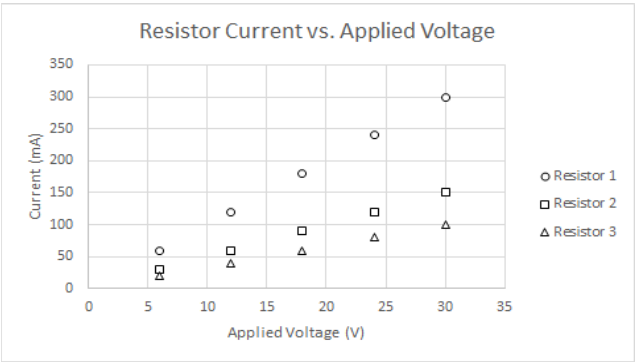
Based on the experimental evidence shown in the graphical model, which claim is best about the resistance values of the three resistors?
A Resistor 1 has the largest resistance because it has the smallest current at each applied voltage.
B Resistor 3 has the largest resistance because it has the largest current at each applied voltage.
C Resistor 1 has the largest resistance because it has the largest current at each applied voltage.
D Resistor 3 has the largest resistance because it has the smallest current at each applied voltage.
D Resistor 3 has the largest resistance because it has the smallest current at each applied voltage.