Polarity/Bond Type
Types of Intermolecular Forces
Intermolecular Forces and Properties
Comparing Intermolecular Forces
100
What type of bond is between two or more metals.
Metallic Bonds
100
What type of intermolecular force is present between nonpolar molecules?
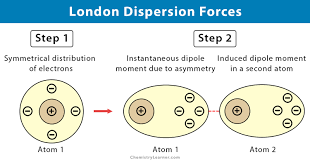 Dispersion
100
Which property of a liquid increases with stronger intermolecular forces: boiling point or volatility (ablility to become a gas at room temperature)?
Boiling Point
100
Between CH4 and NH3, which molecule has stronger intermolecular forces?
NH3, because it has hydrogen bonding.
200
What type of bond is between a metal and a nonmetal?
Ionic Bond.
Bonus: What will the electronegativity difference be between them greater than?
200
Which intermolecular force is present between polar molecules but not involving hydrogen?
Dipole-dipole interactions.
200
True or False: Substances with weak intermolecular forces tend to have lower melting points.
True
200
Which would have a higher boiling point, HCl or Cl2?
HCl, because it has dipole-dipole interactions, while Cl2 only has London dispersion forces.
300
What type of bond is between a nonmetal and a nonmetal?
Covalent Bond
300
What is the strongest type of intermolecular force present in water?
Hydrogen Bonding
Bonus: name what elements participate in hydrogen bonding!
300
Draw the lewis dot diagram for Bcl3 and name the shape and intermolecular forces present
trigonal planar, dispersion forces

300
Which substance has a stronger intermolecular force? Explain why.
Substance A: Boiling point 25C
Substance B: Boiling point 5,000C
Substance B has a stronger intermolecular force because more energy is required to "break" it's atoms/molecules apart.
400
What type of polarity occurs between symmetrical compounds
Non polar
400
Rank these intermolecular forces from weakest to strongest: London dispersion, dipole-dipole, hydrogen bonding.
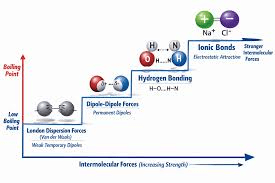 London dispersion, dipole-dipole, hydrogen bonding.
400
What force explains why Oxygen (O2) can dissolve in water (H2O)?
Induced dipole, or Van Der Waals forces.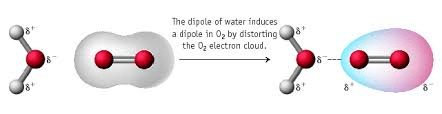
400
Arrange the following in order of increasing boiling point: HCl, CH4, NaCl, H2O
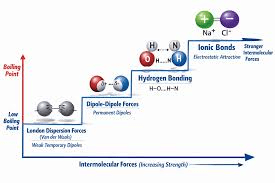 CH4, HCl, H2O, NaCl (boiling point increases with stronger bonds/intermolecular forces).
500
What is the electronegativity range for a polar bond?
.5-1.6
500
Which intermolecular force is responsible for the high boiling point of water?
Hydrogen bonding.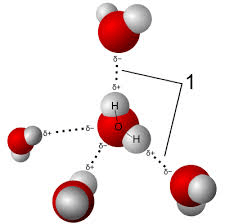
500
Explain why ionic compounds generally have higher melting points than molecular compounds.
Ionic compounds have strong electrostatic forces of attraction between ions, which require more energy to overcome compared to the intermolecular forces in molecular compounds.
500
Between CH4 and SO2, which would have stronger intermolecular forces and why?
SO2, because it is polar and exhibits dipole-dipole interactions, whereas CH4 is nonpolar and only has London dispersion forces.