Energy
Cells
Reactions and Energy of Life
DNA
Mitosis and Cancer
100
This is the term for when energy changes from one form to another.
Energy Transformation
100
What cell parts do all eukaryotic and prokaryotic organisms share?
Cell membrane, DNA, Ribosomes
100
In the chemical equation H2O, what does the subscript 2 tell you?
There are 2 hydrogen atoms in one molecule of water.
100
Name the three parts of a nucleotide.
Sugar molecules, Phosphate group, Nitrogenous Base
100
Why do cells complete cell division? In what phase of the cell cycle does cell division occur?
Cells divide when we are growing, when cells need to be replaced or repaired. It happens during the M phase of the cell cycle.
200
A 2 kg ball is moving at 4 m/s. What is its kinetic energy?
16 J
200
What are the two categories of eukaryotic cells? What cell parts can you use to tell them apart?
Animal and Plant. Plant cells have a cell wall, a central vacuole, and chloroplasts.
200
Write the equation for cellular respiration. Name one reactant and one product from the equation.
C6H12O6 + O2 --> H2O + CO2
Reactants: Glucose and oxygen
Products: water and carbon dioxide
200
Write the complementary strand for this DNA strand.
A T G G C A C T T A A G
T A C C G T G A A T T C
200
How many chromosomes does a cell start with at the beginning of mitosis? How many chromosomes are in each baby cell at the end of mitosis?
Cells start with 92 chromosomes. At the end of mitosis, each baby cell has 46 chromosomes (considered the full genome)
300
In an ideal system, a 3.4 kg ball on a windowsill started with 50 J of PE and 0 J of KE. What is the kinetic energy of the ball when it hits the ground? What is the speed of the ball?
KE = 50 J
v = 5.4 m/s
300
What type of cell is this? Identify two cell parts that are clear in the image.
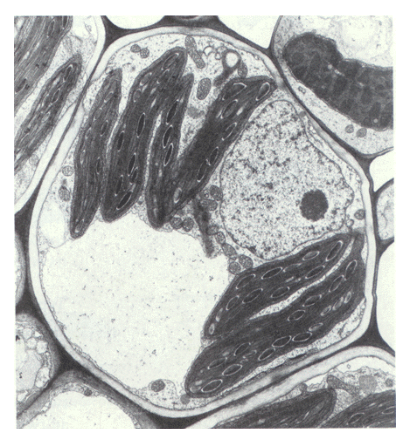
Eukaryotic Plant Cell. Cell Wall, central vacuole, chloroplasts, nucleus, mitochondria
300
What color is the item in the picture? Explain why the item appears to be this color using what you know about light absorption and reflection.
The fire hydrant is red. The item appears red because it absorbs all energies of light except for red. Red light energy is reflected off the item.
300
What are the different forms of DNA? When would DNA be in these forms?
DNA is in chromatin form the majority of the time.
DNA is in chromosome form only when it enters the M phase and the cell is ready to divide.
300
What molecules work at the checkpoints of the cell cycle? What are the jobs of these molecules?
The molecules are proteins. There are stop and go proteins which regulate when cells move to the next phase of the cell cycle.
400
Riding a bike up a hill is a non-ideal system. Using the equation TE(in) = TE(Out), write an equation for the bike when it comes to a stop at the top of the hill that includes two types of energy lost. You can assume the TE(in) for the equation is KE and PE.
KE + PE = PE + AR + Heat
Air resistance and friction are the main losses of energy for this system.
400
What are the energies involved in photosynthesis and cellular respiration?
Photosynthesis is light energy into chemical energy (carbs)
Cellular Respiration is chemical energy (carbs) into chemical energy (ATP)
400
A scientist measures the rate of photosynthesis. Describe TWO different measurements they could take to determine the rate - one using a reactant, one using a product.
Measure the rate of CO2 being consumed. Measure the rate of O2 being produced.
400
What are the order of the phases of the cell cycle? Explain how the cell changes during each phase
During G1 the cell grows to its full size.
During S the cell copies its DNA.
During G2 the cell makes the necessary material for cell division.
During M the cell divides to create identical baby cells.
400
A cell grew to its full size and copied its DNA correctly. It was not able to produce enough energy to complete cell division. Which checkpoint should catch this cell? What should happen to the cell?
The G2 checkpoint should catch the cell. The cell should perform apoptosis, cell death.
500
We used the equation, PE(cw) = KE + PE(proj) +AR + Heat, when completing trebuchet calculations. Calculate the velocity of a .145 kg projectile using these other measurements.
PE(cw) = 25.6 J PE(proj) = 1.2 J AR = 4.5 J Heat = 6.8 J
Solve for KE first.
KE = 13.1 J
v = 13.4 m/s
500
Why do plant cells need to perform cellular respiration if they can already do photosynthesis?
All cells need ATP to do work. The only way to create ATP is through the process of cellular respiration. Photosynthesis allows plants to create the glucose needed for cellular respiration.
500
Describe the relationship between plants and humans. Think about the products and reactants for photosynthesis and cellular respiration for both humans and plants.
Plants produce oxygen when they perform photosynthesis. Oxygen is a reactant of cellular respiration which human do to create ATP for their cells. When human perform cellular respiration, they produce carbon dioxide, which is a reactant in photosynthesis. They benefit each other.
500
Name the enzymes responsible for DNA replication. Briefly explain their role in the process.
Helicase unwinds and breaks apart the two strands of DNA.
DNA polymerase reads the nitrogenous bases and adds the complimentary base to make the new strand of DNA.
500
Explain why there is not one single cure for cancer.
Cancer forms when there is a mutation in the genes for stop and go proteins (proto-once/tumor suppressor genes). These mutations stop the proteins from working correctly at the checkpoints in the cell cycle, which leads to uncontrolled cell division. There are hundreds of these genes along our chromosomes and multiple proteins working at each checkpoint. Every person can have a unique mutation for multiple proteins which can lead to cancer.