WEEK 1
WEEK 2
WEEK 3
WEEK 4
WEEK 5
WEEK 6
WEEK 7
WEEK 8
WEEK 9
WEEK 10
WEEK 10
WEEK 11
WEEK 11
BONUS
100
what is the philosophy of behaviour analysis
radical behaviour - treats overt and covert behaviour as the same except covert is only accessible to the individual
100
In phylogenetic behaviour, stimulus-response relations (reflexes) are based on ________. What is an example of this?
Genetic Endowment. Example: a baby bird opening their mouth when their mother has a worm (no learning required).
100
what is the difference between emitted vs elicited
use emitted in the context of voluntary operant behaviour and elicited in the context of reflexive/respondent behaviour
100
What is the difference between the process of punishment and the procedure of punishment? (what the heck my notes basically say theyre the same thing)
Procedure: behaviour produced a consequence that results in a decrease in future behaviour (contingency)
Process: a temporally extended sequence that includes the occurrence of some particular behaviour, a consequence that the behaviour produces, and a subsequent decrease in that behaviour (behavioural process/mechanism)
100
what is the dual function of stimuli
a stimulus can be an SD for an operant as well as a CS that elicits a CR
100
How do Keller & Schoenfeld (1950) define 'drive'?
"The fact that certain operations can be performed on an organism (for example, depriving it of food) that have an effect upon behaviour which is different from that of other operations”
100
what does ubiquitous refer to and why is it important?
the idea that all behaviour is nearly always under stimulus control
important bc otherwise any behaviour that has ever been reinforced will occur randomly
100
What is the issue with conflating preference assessments and reinforcer assessments?
Preference assessments inform you of a preferred stimulus, but that might not function as a reinforcer. E.g., if all preference options were not effective, they would just choose 'the best of the worst'.
100
what is primary vs secondary reinforcement
primary = unconditioned
secondary = conditioned
100
'Keeping your promises' is a type of _______ correspondence, and _______ is a type of do-say correspondence.
Say-do, telling the truth.
100
What is some evidence that rule-following enhances performance? What are some issues with these studies?
Specification of the relevant response-stimulus relations was related to age (and performance to some extent; Wulfert et al., 1991) - children performed better when they could specify the rules in the task. BUT it could be that age is correlated to both better performance and higher verbal ability, rather than the rule enhancing performance.
100
what is the difference between language and verbal behaviour?
language is studied structurally (syntax, vocab, meaning) rather than functionally
100
what is a disguised mand?
verbal behaviour that looks like a tact but is also under the control of an MO and the tact has been followed by reinforcement for that MO in the past
100
If someone has a phobia of bees and is now scared of flowers - how can we explain this?
Higher-order/second-order conditioning. A bee (CS1) previously has stung (US) the person, and she has noticed that bees hover around flowers (CS2). The “phobic” fear of flowers occurs because of the association of bees (CS1) with flowers (CS2).
200
what is the radical behaviourist perspective on thoughts and feelings
more behaviour to be explained, but not causes of behaviour
200
What is the difference between a fixed/modal action pattern and a response chain?
Modal action patterns are a sequence of reflexive behaviours that will continue even if the initial stimulus is removed (e.g., squirrel burying nuts) - these are phylogenetic. Alternatively, each step in a response chain requires an SD. If the SD is not presented, the chain will not continue (e.g., sickleback fish mating).
200
what does an Sdelta refers to?
anything other than the SD, which includes the absence of the SD or something else that indicates unavailability of reinforcement
200
Define an aversive stimulus. What are the two types?
Events or happenings that organisms escape from, evade, or avoid. There are primary and conditioned aversive stimuli.
200
_____ contingencies nearly always involve _____ contingencies; _____ contingencies often involve _____ contingencies
Operant contingencies nearly always involve respondent contingencies; respondent contingencies often involve operant contingencies
200
Describe the value-altering effects vs the behaviour-altering effects of MOs. What is the issue with the current definition of behaviour-altering effects?
Value: influence the capacity of operant consequences (reinforcers and punishers) to alter the strength of future behaviour
Behaviour: change the current strength of the behaviour related to the consequences affected by the MO. Issue: Claims that all behaviours that have resulted in the consequence, but it is actually determined by the SDs in the environment.
200
what is the difference between differential reinforcement vs differential responding?
differential reinforcement = reinforcing behaviour in the presence of SD and not Sdelta
differential responding = only responding in the presence of the SD and not the Sdelta
200
What are the three types of preference assessment methods?
Free access (given all options at once, see where they allocate their time), paired stimulus, multiple stimulus presentations (lay out all options, see which they pick).
200
what is the general rule of deciding whether something is a conditioned reinforcer or not
stimuli that are predictive of the availability of reinforcers function as conditioned reinforcers
200
Does imitation occur without learning?
Mixed findings, this is very hard to measure because you would need to study babies in their first days of life, before 'learning' occurs. Possible spontaneous imitation in pigeons, and possible imitation of facial expression and finger movement in human infants. Still some challenges with the methodology and the interpretation E.g., tongue protrusions seem to be elicited by a wide variety of stimuli, so is it “imitation”?
200
What are the dimensions of rule-following?
Implicit to explicit, accurate to inaccurate, complex to simple, self vs others (delivering the rule), immediate to delayed (between the response and consequence specified in the rule).
200
what is the controversy with skinners distinction that verbal behaviour is reinforced by mediated of other people?
this is only based on how reinforcement is delivered rather than the form/function of the speakers behaviour - e.g., accidentally pressing button and then someone gives you water would technically be verbal behaviour event though the speakers behaviour did not function to get water
200
what is convergent vs divergent multiple control?
convergent = single response controlled by more than one antecedent
divergent (diverse outcomes) = single antecedent controls more than one response
200
Many punishment contingencies can be reframed as _____ contingencies. E.g., what maintains not driving into oncoming traffic?
Avoidance contingencies. Avoiding driving into oncoming traffic is the contingency for safe driving, instead of the punishment of crashing. Decreases in behaviour are accounted for as an increase in alternative behaviour maintained by negative reinforcement.
300
what is the science of BA
Referred to as the experimental analysis of behaviour (EAB) - Systematic exploration of how specific environmental factors influence behaviours
300
What are the three laws of reflexes? Do these also apply to conditioned stimuli?
1) Threshold (there is a level of intensity where the response will be elicited), 2) Intensity-Magnitude (as the intensity of the stimulus increases, so does the magnitude of the response), 3) Latency (more intense stimulus = shorter latency). No, this does not apply to conditioned stimuli (they are arbitrary).
300
how do we define whether something is a reinforcer?
if increases future behaviour
300
Instead of viewing punishment as the opposite process to reinforcement, how can we view it?
Displacement or elicitation of competing behaviour.
The punishment elicits a response that opposes the current behaviour. E.g., punishing throwing toys by yelling might elicit a ‘fear response’ that causes the child to withdraw, which they can not do at the same time as throwing toys
300
what is Breland's instinctive drift?
reflexive behaviour is either compatible or incompatible with the target behaviour, sometimes a reflexive behaviour will interfere with the operant contingency and prevent reinforcement but you still do it
300
True or false: abolishing operations enhances the punishing values of events and decreases the reinforcing effectiveness of events.
False- abolishing operations reduces the effectiveness of both reinforcing and punishing events. Establishing operations increases the effectiveness of both.
300
what is being relations are selected in operant conditioning - stimulus-behaviour or environment-behaviour
environment-behaviour, it is unlikely that that specific stimulus will ever be encountered again, rather it is the general concept of that environment that will have increased ability to guide specific behaviours
300
What are the two types of multiple stimulus presentation assessments? What are the limitations of each?
With replacement (MSW): put the chosen item back for the next trial. You get a degree of preference (%). Often results in exclusive preference (i.e., they pick the same option every time), so you do not get any info about the preference of other items.
Without replacement (MSWO): the chosen item is removed from the next trial. Gives you a preference ranking, but you do not know the degree of preference. E.g., maybe the preference difference between rank 1 and 2 is huge, but between 2 and 3 is very small.
300
what is the key advantage of backward chaining?
that the individual contacts the terminal reinforcer immediately and everytime
300
What is a behavioural explanation for mirror neurons firing when being poked with a needle, and when seeing someone else being poked with a needle?
Respondent Conditioning. Needle approaching skin has been paired with pain (US), needle = CS. This generalises to needles approaching someone else's skin. CR generalises.
300
verbal behaviour is shaped and maintained by the _____ ________
verbal community
300
who pioneered stimulus equivalence research?
SIDMAN
300
How can avoidance behaviours be harmful?
Avoiding places you might encounter the CS means there are fewer opportunities for extinction - so behaviours such as phobias endure.
400
what is pragmatism?
If a theory is useful , it is good; if one theory is more useful than another, then it is better
400
Define habituation. What are three general properties of habituation?
Repeated exposure to the US results in a decline in the magnitude of the UR.
1) The response decrease is very large initially, and then levels out. 2) If the US is withheld and then returns, we will see spontaneous recovery. 3) Each series of US presentations results in faster habituation.
400
why did initial research suggest that extrinsic rewards reduce intrinsic motivation?
because they characterised social praise as intrinsic motivation for the control condition and referred used tangibles that were delivered late or not at all for reinforcement
400
What type of consequence is a 'time out'? What are the different types?
Negative punishment (usually).
Exclusionary timeout: physically removed from the environment. Non-Exclusionary timeout: stay in the environment, but they are ignored/not allowed to participate in the activity
400
what is sign tracking?
when the SD takes on properties of the US and elicits respondent behaviour
400
MOs: Involve a change in ____ of the organism caused by the manipulation of the _______ - leading to a change in _____ of reinforcers or punishers, and behavioural effects.
State, environment, effectiveness.
400
how will the generalisation gradient look if you do discrimination training for all stimuli other than SD vs if you only use extinction for stimuli on one side of SD
discrimination training = peak at original stimuli
extinction for one side = peak shift in opposite direction
400
What are some limitations of the free access method, using the proportion of time as its measure?
Time can be allocated to only one stimulus (so you get no info about other stimuli), sometimes highly preferred stimuli take less time to interact with; time allocated can be influenced by other things (e.g., if they are hungry or have already been playing with toys).
400
what are 4 factors that influence conditioned reinforcer effectiveness?
1. frequency of the predicted reinforcer (how reliably it is predicted)
2. motivating operations - when you have MO the conditioned reinforcer will be more effective
3. Delay to the predicted reinforcer - how fast does US/terminal reinforcer follow
4. variable schedules to US - bc sometimes it is a short interval to US (textbook????)
400
Brain activity is ______.
Behaviour
400
does verbal behaviour operate on the environment directly or indirectly?
indirectly - effect is mediated through other people
400
why is stimulus equivalence different from other behaviour principles?
learned relations in absence of direct reinforcement training
400
If you are thirsty (water-deprived) and the beverage that you have access to requires a bottle opener, the sight of the bottle opener will function as both a SD and a ________________.
Conditioned reinforcer.
500
what is immediate vs remote causation and which is more critical to BA
Immediate causation: respondent behaviour/reflexive
Remote causation: operant behaviour
Remote causation is more critical to many behavioural phenomena since we can intervene
500
When reflexive behaviour is effected by history and environmental effects, we say the behaviour is ________.
Ontogenetic. E.g., salivating for food (phylogenetic), and learning to salivate when seeing the McDonald's sign (ontogenetic).
500
what is the premack principle?
high frequency behaviour can be a reinforcer for low frequency behaviour - e.g., response deprivation of preferred activity until after completing X of less preferred activity
500
What are some guides to effective punishment? (hint: punishment must be applied....)
Immediately, consistently, suddenly, at maximum value, briefly, and on every occurrence of the targeted behaviour.
500
what is autoshaping?
presents an operandum followed by food which results in the animal directly operating/doing target response on the operandum
500
Under the previous (popular) MO definition, what are some issues with confirming the value and behaviour-altering effects?
Value altering: We can not confirm the value-altering effect unless the organism encounters it - this is the effect involving encountering the stimulus
Behaviour-altering effect: behaviour changes before contact with the events/reinforcers.
500
will the peak in the generalisation gradient be higher for highly discriminated response or generalised response
higher peak for discriminated because more responding allocated for original
500
What are concurrent schedules?
When there are two or more possible responses that are incompatible, each with its own schedule of reinforcement.
500
explain the 2 methods used to test the effectiveness of conditioned reinforcers?
new response method: tryusing the conditioned reinforcer to reinforce a new behaviour
established response method - compare responding under extinction conditions either with or without the conditioned reinforcer and compare which condition lasts longer
500
What is the textbook's stance on phylogenetic vs ontogenetic accounts of imitation?
There may be some rudimentary imitation abilities at birth, but learning quickly takes over from there. Majority of imitation is explained by respondent and operant contingencies.
500
which terms describes the listeners behaviour? Rule governed behaviour or verbal behaviour?
rule governed behaviour... verbal behaviour is the speaker
500
how is rule governed behaviour an example of stimulus equivalence?
we have learned that the aspects of the rule correspond to environmental contingencies
500
What is conditional discrimination?
Stimuli that regulate behaviour (SD and SΔ) often depend on the context. E.g., whether it is an SD or SΔ depends on the context/setting.
600
what are the 3 types of selection?
1. Phylogenic Selection (Biological) - Traits that promote survival and reproduction are naturally selected over generations.
2. Ontogenic Selection (Behavioral) -
Operant conditioning—the process where an individual’s behavior is shaped by its consequences within their own lifetime.
3. Cultural Selection (Social) - This level accounts for the evolution of societal practices, norms, and language. Social behaviors that benefit the group (like a new method of tool-making, agricultural techniques, or social cooperation) are reinforced and passed on through imitation and observational learning, becoming a part of the culture's practices
600
What are the four respondent conditioning procedures? Which is the most effective and why?
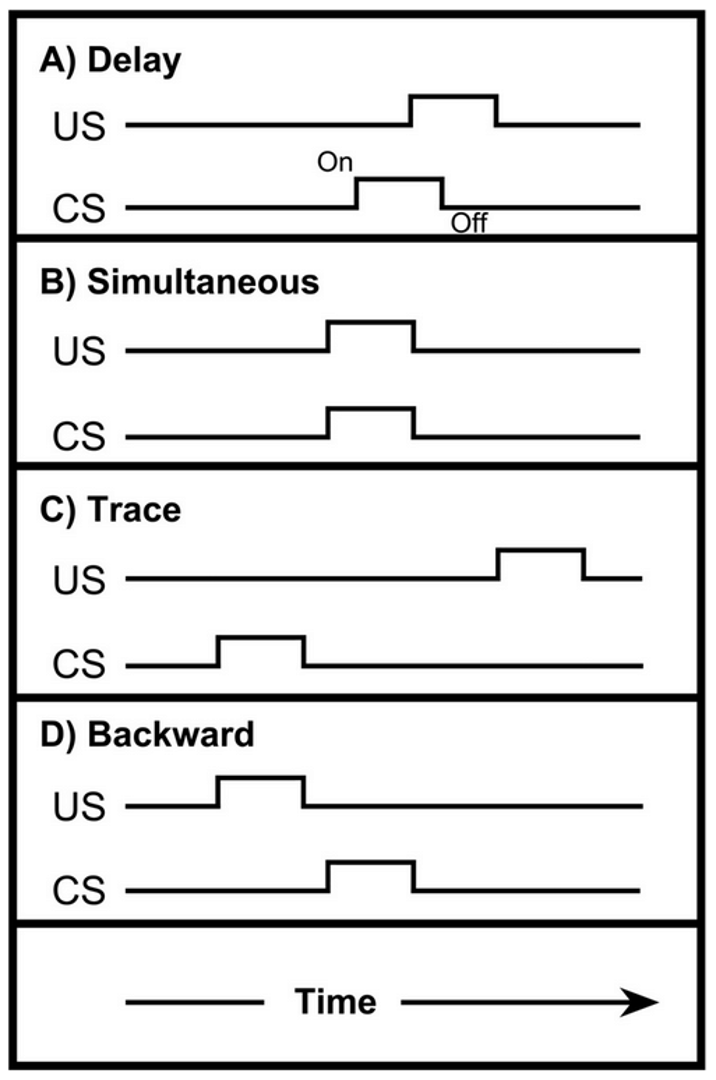 Delay is best because it the CS has predictive power.
600
what are the 2 functions of MOs and which did Tim say is bad and adds no value lol
1. Behaviour altering function
2. Value altering function
- Tim says that the behaviour altering function is bad because it suggests ALL behaviour reinforced in the past will be increased but it is only ones that are relevant to the SD present
600
Parents may be tempted to start with a small/low intensity punishment, and then increase it when behaviour escalates. Why is this a bad idea?
This makes the intensity threshold for effectiveness much higher because habituation happens (i.e., you end up needing to shout very loudly for it to stop the behaviour). It is better to start off with an intense but safe level so the threshold is lower.
600
how does Timberlakes behavioural systems approach explain sign tracking?
environmental stimuli and biological state of organism interact to activate a behavioural subsystem - E.g., sign tracking occurs by SD activating mode associated with acquisition or consumption of food because it has been paired with food in the past
600
Under the current (popular) MO definition, what will happen to behaviour if someone has been deprived of water?
All behaviours that have been previously reinforced with water will increase - e.g., asking in any language, grabbing water yourself, looking for a drinking fountain. BUT this is not the pattern we actually see.
600
concept learning is the lay person terminology for _____ ______
differential reinforcement
600
What pattern of responding do we see on ratio concurrent schedules and VI schedules?
Ratio: they will just respond to the lower ratio to maximise reinforcement. E.g., press VR 3 over VR10.
VI: They will respond on both sides, with priority on the lower VI schedule. E.g., responding lots on the VI 2-minute, and every so often on the VI 10-minute schedule.
600
under what conditions will bad news be a conditioned reinforcer?
if no bad news is good news - uncertainty reduction account
600
What are the operant contingencies of imitation, and how can they explain novel imitations?
SD (model doing the initial behaviour) R (matching response) Reinforcer (social e.g., praise, smiles or natural outcome, e.g., access to toys after imitating a box opening). After many instances of different imitations being reinforced, they develop a generalised imitation repertoire, so can emit novel imitations.
600
is the listener always a listener
no speaker and listener change roles
600
are most verbal stimuli arbitrary?
yes
600
What information do preference assessment surveys give us?
What they say they prefer, but may not actually correlate to behaviour.
700
what is culture according to BA?
Conditions, events, and stimuli arranged by people that regulate human action
700
Which stimuli would likely have higher conditioning potential for a lab study: your daily ringtone, or a sound you have never heard before?
The novel sound. Conditioning is difficult when you are often presented with the CS without the US, because it therefore has low predictive power.
700
MOs modulate the reinforcing or punishing effectiveness of particular events and the ____ of the behaviour by ______ stimuli historically relevant to those events
control, antecedent
700
What should you try to do before you introduce punishment?
Address the reinforcement contingency of the problem behaviour (extinction) and/or provide another behaviour which serves the same function. Punishment should be a last resort.
700
how is biofeedback an example of the respondent-operant interration
learn to control respondent behaviours through operant conditioning
700
How can we distinguish between MOs and SDs if they both have an 'evocative function' according to the current definition?
MOs change the effectiveness, and SDs signal the availability. Ask: Is it changing the effectiveness of the consequence? The SD evokes behaviour that has been reinforced by X only when X functions as a reinforcer; the MO changes the reinforcing effectiveness of X.
700
how do you test concept learning
using novel stimuli
700
What is the matching law? What is an issue with this?
The relative frequency of responses (proportion of responses for one option) is equal to the relative frequency of reinforcement.
B1/(B1 + B2) = R1/(R1 + R2). If 70% of reinforcements are available from option 1, 70% of responding will be allocated there BUT this is a very strict equation and does not account for variation or allow for adjustments
700
what is the observing response procedure used to test whether information is conditioned reinforcement?
given option to peck "observing key" which provides information about which schedule of reinforcement is in effect
700
Sometimes, behaviour (incl. imitation) can occur when an SD is presented, but no reinforcement follows. How can we explain this issue?
Reinforcement comes after the behaviour, and future events can not cause behaviour. It is the learning history of the contingency that drives the behaviour. Correspondence (successful imitation) itself may come to function as a conditioned reinforcer because of its reliable association with reinforcement (respondent conditioning, pairing with reinforcement).
700
practices of the verbal community have evolved over generations through _____ _______
differential reinforcement
700
after you train A=B and B=C what are the 3 types of relations you can derive and what is the outcome of achieving these 3?
Reflexivity = A = A, B = B - learning the concept
Symmetry = trained A = B so derive that B = A
Transitivity = A = C
Equivalence: C=A (combined symmetry & transitivity relation)
700
The generalised matching law is expressed as a _____ instead of a _______. What is the difference?
Ratio, proportion. (behaviour a / behaviour b - instead of behaviour a / behaviour a and b).
800
how are cultural practices developed and maintained?
developed by principles or variation adn selection by consequence. maintained by social conditioning of individual behaviour
800
What is the difference between the procedure of extinction and the process of extinction?
Procedure = repeated presentation of the CS without the US. Process = reduced responses over time.
800
what are some behavioural measures of reinforcer effectiveness?
speed of response acquisition, choice, response rate, behavioural momentum, elasticity of demand etc
800
What are the two types of avoidance?
Signalled (there is a signal/SD for punishment), and unsignalled avoidance (no signal that punishment will occur).
800
what is the relationship between intense physical activity and taste aversion vs preference
Food followed by intense physical activity that makes you nauseas/sick = conditioned taste aversion
Activity followed by food = taste preference
800
Under the revised definition, what are the two functions of MOs?
"Motivating operations modulate the reinforcing or punishing effectiveness of particular kinds of events and the control of behaviour by antecedent stimuli historically relevant to those events". Instead of changing behaviour directly, they change the evocative functions/potentiation of SDs.
800
why might we not see concept learning if only use a few trials
requires many many trials to filter out all the irrelevant features so that the relevant features are the only consistent aspect
800
What do each of these 'logs' mean?
Log (B1/B2) = log a (r1/r2) + log c
Log = behaviour ratio, log a = slope/sensitivity, log c = intercept or bias measure.
800
what is the delay reduction hypothesis?
that stimulus correlated with a reduction in time to reinforcement are more likely to become conditioned reinforcement
800
Why might we not see generalised imitation in children within a lab setting?
There are not enough different imitation examples - hundreds of instances of reinforcement for imitation are required. Additionally, generalised imitation is partially dependent on verbal behaviour.
800
explain the self serving bias in relation how we use words?
we are more likely to give an internal account of our successes and an external account of our failures
800
what is transfer of stimulus function?
when the function of one stimuli is transferred to another because it participates in an equivalence relation with it
800
A person spends 70% of their time on a response that produces 60% of the reinforcement available. What pattern is this? (Note: this is a proportion, not a ratio, but GML is a ratio)
Undermatching: When relatively more behaviour is allocated to the schedule providing less reinforcement than would be predicted by the strict matching law (SML). OR could be bias if responding is consistently higher regardless of changes in reinforcement ratio. (check with Jessie on this).
900
what is the concept that refers to behaviours that have different topography but the same function?
response class
900
What is the difference between renewal and reinstatement?
Renewal is when the CR returns if the CS is presented in a different to the extinction context. Reinstatement is when the CR occurs in the presence of the US (not the CS).
900
what are some methods for determining reinforcer effectiveness?
free operant, discrete trial
900
Can punishment have lasting effects on behaviour?
Punishment, in addition to other procedures (e.g., extinction), can have long lasting effects.
900
what is adjunctive behaviour and what are 2 explanations for its occurrence?
excessive/persistent behaviour that occurs as a side effect of reinforcer delivery
1. adventitious reinforcement - behaviour is accidentally reifnorced since its followed by reinforcer
2. reflexive accounts - interim behaviour fills the gap of waiting so reduces the likelihood of escape so has a survival advantage
900
Alongside changing the evocative function of SDs and the effectiveness of consequent events, what other effects of MOs do we see?
Changes in the degree of generalisation around relevant discriminative stimuli. E.g., high deprivation = more generalisation.
900
gradual change of an aspect of the SD to alter the source of stimulus control is what concept?
fading
900
In an operant chamber: what are 'price' and 'commodities'? What is demand?
Price = schedule of reinforcement (e.g., number of responses needed to gain reinforcement). Commodities = reinforcers. Law of demand states that as the price goes up, the number of reinforcers obtained will go down.
900
in a behaviour chain, which stimulus changes are likely to more reinforcing according to the delay reduction hypothesis?
stimulus changes later in the chain since they are closer to terminal reinforcer
900
What is a behavioural account of the Bobo Doll experiment?
1) The children have a history of generalised imitation training, so they are likely to imitate new behaviours. 2) They observed the adults getting reinforcement, which is an SD that they will get reinforcement for the same behaviour, because they have been paired in the past. E.g., seeing others receive reinforcers for doing X has frequently been followed by me receiving reinforcers for X.
900
what is a mand?
a verbal response that leads to a characteristic reinforcing consequence
BONUS - what does characteristic mean? the specified consequence is only understood because of the training of that verbal community
900
what is the most common format for training and testing equivalence relations? This is also a _______ discrimination procedure
matching-to-sample, a conditional discrimination procedure
900
what is response stereotypy?
a pattern of responding that is repetitive, invariant, adn highly practiced
1000
what is a response heirarchy?
behaviours in response class are organised into a hierarchy based on likelihood of occurrence
1000
What are examples of ABA, AAB, and ABC renewal?
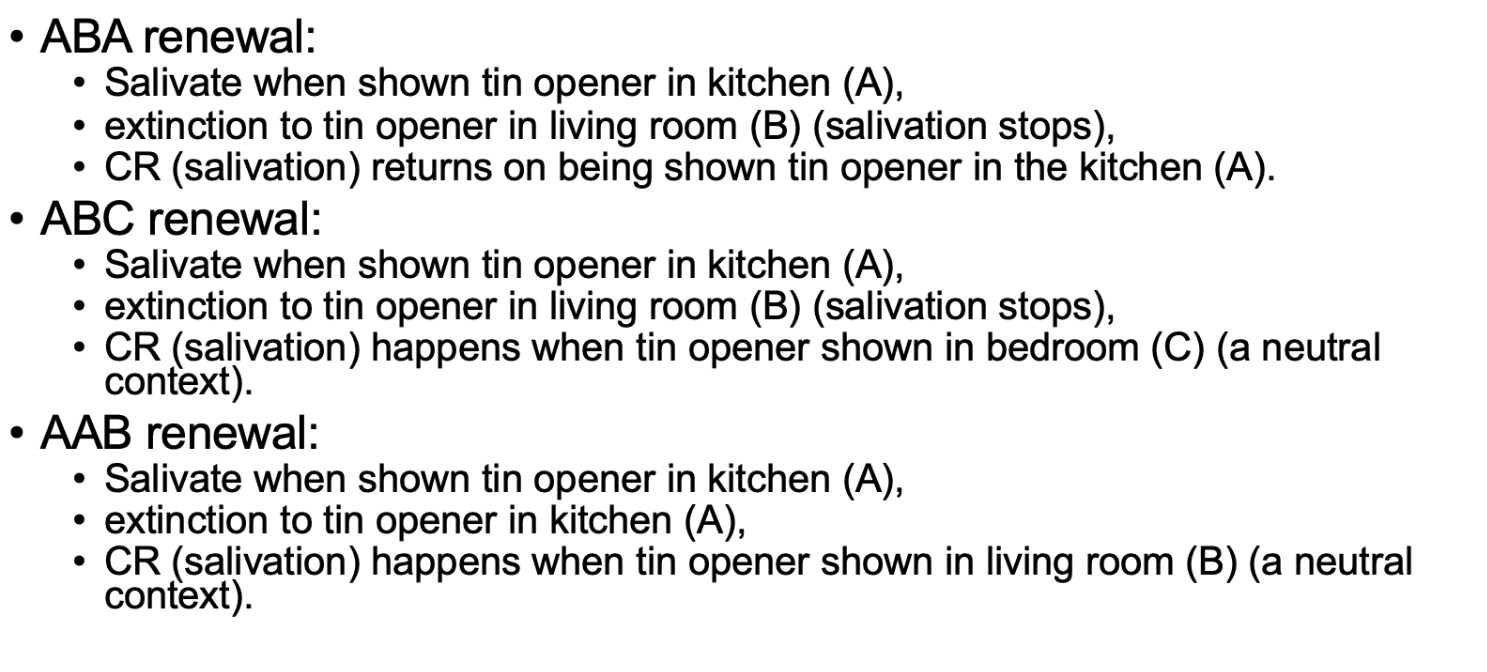
1000
what is a lag schedule?
the current response must differ from the previous X responses to be reinforced
1000
Describe the two-factor theory of avoidance.
An NS is paired with an aversive stimulus, and becomes a CS which elicits a 'fear' response. The organism is not 'avoiding' the US, but escaping the CS, which is negatively reinforced.
1000
what is interim behaviour vs adjunctive behaviour
adjunctive is the scientific term for the phenomena whereas interim behaviour refers to the exact time when the adjunctive behaviour occurs (during the gaps/waiting time)
1000
How can we measure if a stimulus has become a more/less effetice reinforced/punisher?
Speed of response acquisition, Response rate, Response magnitude, Choice, Elasticity of demand, Behavioural momentum, Progressive-ratio breaking points, Others.
1000
what is absolute vs relative stimulus control?
Absolute = stimulus control by an absolute value of a stimulus dimension
Relative = stimulus control by a relative value of a stimulus dimension - correct response relies on comparison to another option e.g., larger - same stimulus can be SD in one situation and Sdelta in another
1000
In the generalised matching law, sensitivity to changes in reinforcement is represented by the ______, and bias towards high/low responding is represented by the _______.
Slope, y-intercept.
1000
what are generalised conditioned reinforcers? provide an example
conditioned reinforcers that predict multiple other reinforcers and so it is likely there will be at least on MO for one of the reinforcers
e.g., money
1000
What is the difference between contingency-based and rule-governed behaviour?
Contingency-based behaviour requires direct contact with contingencies, whereas rule-governed behaviour does not, and is controlled by verbal behaviour.
1000
can a mand be pure?
no a mand is impure because it relies on SDs being present too, not just an MO
1000
what are three types of stimulus arrangements in a match-to-sample procedure
Linear: A-B, B-C
Many to one: Comparison/main stimuli remain the same - B-A, C-A
One to many: Sample stimuli in each class remain the same - A-B, A-C
1000
what were the 2 different conclusion about the effect of reinforcement on response variation?
first experiment concluded that reinforcement would lead to response stereotypy
second experiment showed that if you reinforce variation you get variation so stereotypy is not inevitable
1100
what is the structural approach to behaviour and why does it often result in circular reasoning?
The structural approach defines actions by their physical form, topography, or appearance
Circular reasoning becuase you group similar behaviours together and giving them a label which is used to explain behaviour - e.g., crying, tantrum, and avoiding eye contact as anxiety
1100
Why does the law of magnitide not apply to CS?
Properties of the CS are arbitrary. E.g., a quiet sound might be paired with the US but not a loud sound. You can also modify generalisation through training (e.g., present a similar sound without the US (extinction))
1100
what are some potential outcomes of extinction?
decline in response rate/cessation, extinction burst, extinction-induced variability, extinction induced aggression
1100
Is Sidman avoidance a molar or molecular perspective of avoidance?
Molecular. Moment-to-moment factors that control behaviour (e.g., A B C).
1100
what is species-specific behaviour?
URs that are developed/selected from consequences that make survival more likely so are passed on
1100
How does Michael (1982) conceptualise aversive stimuli, and what is the issue with this view?
Presentation of an aversive stimulus was conceptualised as an EO that establishes the removal of that same stimulus as a reinforcer (e.g., removal of a splinter will only function as a reinforcer if you have a splinter). BUT it is obvious that a stimulus needs to be present to be removed, so we don't need to explain this using MOs. And we already have concepts for this: Aversive stimulus onset = positive punisher, aversive stimulus offset = negative reinforcer.
1100
if whether a stimulus is a SD or a Sdelta depends on another stimulus being present - what is this concept?
Conditional discrimination
1100
In the generalised matching law, what does a slope of more or less than 1 represent?
Less than 1 = under-machining/low sensitivity. The behaviour ratio changes less than the reinforcement ratio. e.g., reinforcer is increased by two units, you may only see 1 unit increase of behaviour.
More than 1 = over-matching/high sensitivity. The behaviour ratio changes to a greater degree than the reinforcer ratio changes.
1100
in regard to token economy, what are 3 the factors that control behaviour that results in tokens?
1. rate at which tokens can be earned
2. rate of opportunities for exchange
3. value of tokens - how many do you need before you can exchange for something
1100
What is a rule-governed vs. a contingency-based account of selecting a small grape instead of a large one to eat?
Contingency-based: in the past, selecting the small grapes has resulted in sweet fruit (reinforcement).
Rule-governed: you have never eaten a grape, someone tells you, "eat the small grapes, they are sweeter" The rule specifies the response and consequence.
1100
a tact is a verbal response proceeded by a ___ _____ SD
nonverbal
1100
how does the paired stimulus test differ from match-to-sample?
paired stimulus test involves delay between presentation of 2 stimulus and no response required but shows you still can learn the relation
1100
what is the partial reinforcement effect?
using intermittent reinforcement schedules to maintain behaviour creates more resistance and higher response rate during extinction
1200
what is the concept that refers to stimuli that vary in topography but have the same effect on behaviour?
stimulus class
1200
Describe the process of higher-order respondent conditioning and provide an example.
A NS is paired with an already established CS. The NS then becomes CS2, which produces the same response as the established CS (CS1). E.g., the sight of a celebrity is a CS that produces a CR (pleasurable emotions). You can then pair that celebrity with a product as they do in advertising. The product (NS) then becomes a CS2 that produces the same CR as the CS1 (celebrity).
1200
what is discriminated extinction?
only in the presence of the Sdelta the response isnt reinforced
1200
What is a molar perspective on avoidance? What is some support for this view?
Larger patterns of environment-behaviour relations that control behaviour. Rats will work to lower the probability of a shock (they still may be shocked) - it is the overall probability/patterns that influence behaviour. Frequency reduction itself functioned as the reinforcing consequence.
1200
what is the stimulus substitution explanation of signtracking/autoshaping/instinctive drift?
The CS has been substituted by the US so elicits same response - this is wrong because the law of reflex does not hold for CS-CR and in some cases the CS response is opposite to US
1200
What are the three suggested 'conditioned motivating operations'?
CMO-S (surrogate): Correlating a stimulus with an unconditioned establishing operation. E..g, a light is shown every time you are deprived of food. Light = a conditioned EO for food.
CMO-R (reflexive): Presentation of a conditioned punisher establishes termination of the conditioned punisher as a reinforcer (basically Sidman avoidance)
CMO-T (transitive): Completion of one link of a behavioural chain results in a stimulus change that establishes the next stimulus change in the chain as a reinforcer.
1200
Stimulus conditions that must be in effect for reinforcement to be available can be summarized as what 3 types of statements
“and,” “or,” and “not”
1200
What is elastic demand vs inelastic demand? How do these look on a graph?
Inelastic = changes in price do not significantly influence responding. Flat slope (less than 1)
Elastic= When changes in price produce greater-than-proportional changes in consumption. Steep slope (more than 1).
1200
if you were to implement a token economy what would you do to make it most effective?
- make it so less effort required to earn token
- make it so tokens can be exchanged frequently
- make it so tokens can be exchanged for a wide variety of reinforcers
- make it so tokens can be exchanged for high-quality/quantity reinforcers
1200
What are the issues with how Skinner defines rules?
Skinner: Rules are verbal discriminative stimuli. Example: “When the bell rings, stand up and walk out of the room.” BUT, the rule is not the SD, the bell is - the behaviour is not reinforced differentially in the presence of the statement, and the statement does not evoke the behaviour. Instead, it changes the function of the bell.
1200
what is the difference between echoic and textual behaviour?
echoic has vocal antecedent whereas textual is visual
1200
MTS procedure emphasises operant or respondent conditioning?
Paired stimulus procedure emphasises operant or respondent conditioning?
MTS = operant
Paired stimulus = respondent
1200
what is polydipsia?
excessive water drinking
1300
______ reinforcers tend to be consumed in equal proportion with one another. For example, if the price of a hot dog goes up, you will see a decrease in hot dog purchases AND ______ purchases.
Complimentary, hot dog buns.
1300
How can response conditioning explain drug tolerance, overdose, and relapse?
Many stimuli (e.g., setting, sight of the drug, relevant people) become CS after pairing with the drug (US). The CS, therefore produce a compensatory response such as lowering heart rate (CR) to counteract the effects of the drug. Drug tolerance: the CR occurs in the presence of CS, so more drugs are needed to achieve the same effect. Overdose: when taking drugs in a different environment, the relevant CS are not in place to trigger the compensatory response (CR), resulting in overdose. Relapse: if you remain in the same environment, you will encounter the CS, which will produce the CR, resulting in feelings of 'cravings' or withdrawal from the drugs.
1300
what is reinstatement in regard to extinction?
return of previously extinguished behaviour after the presentation of the reinforcer
1300
What is learned helplessness, and how can it be reduced?
If an aversive stimulus is inescapable, the organism will stop attempting to escape ('give up') and exhibit behavioural depression. You can reduce this by pre-exposing them to escape training - they will keep trying for much longer.
1300
what is biological preparedness and how do it relate to taste aversion learning?
We are biologically prepared to learn particular elements/features of stimuli over others
- in TAL when given a compound stimulus that later makes you sick you will avoid the element that you are prepared to learn from - e.g., when given blue salty liquid that makes you sick, later rats will avoid clear salty water instead of blue plain water because they rely on taste to learn
1300
Provide some critiques of conditioned motivating operations.
They are not useful in their current form. We already have concepts to explain all of these. E.g., CMO-R (reflexive) = Sidman avoidance and escape, CMO-T (transitive) = SDs, behavioural chains, conditioned reinforcers, and conditional discrimination. The CMO-S (surrogate) effect is not reliably shown in research.
1300
match to sample is an example of _____ discrimination
conditional
1300
What is bias in the generalised matching law?
When the amount of behaviour allocated to one schedule is consistently higher than would be predicted by strict matching, regardless of the reinforcement rates provided on the alternatives. Represented by y-intercept/log c.
1300
when testing conditioned reinforcement - how does a chain schedule of reinforcement compared to a tandem schedule?
chain schedule involves stimulus change that is conditioned reinforcement and SD for next response. Tandem schedule is unsignalled changes (no SDs)
1300
What is a rule?
A function-altering verbal stimulus that names/implies two (or more) events in a contingency.
1300
how is intraverbal different from echoic behaviour?
intraverbal lacks point-to-point correspondence
1300
stimulus equivalence requires _____ exemplar training
multiple
1300
what is the bitonic function in adjunctive behaviour?
the increase, peak, then drop off in behaviour in response to reinforcement interval
1400
What are substitutable reinforcers?
Reinforcers that are readily traded for one another - often functionally and qualitatively similar. This occurs to the extent that increasing the price of one will produce decreases in its consumption and increases in the consumption of its substitute. We can measure the 'change over' point. (e.g., when will you swap from coke/expensive to pepsi/cheap when you prefer coke).
1400
What is the pre-exposure effect and latency inhibition in respondent conditioning?

1400
what is resurgence in regard to extinction?
return of a previously reinforced and extinguished response when a more recently reinforced response is under extinction
1400
How are aversive stimuli and aggression related?
Displaced aggression = aversive stimuli elicit aggression towards organisms that are not the source of punishment (e.g., other rats in a cage). Countercontrol = aggression towards the source.
1400
how does novelty relate to TAL?
if you try something for the first time or in a novel setting it will increase aversion learning
1400
What are two different ways to describe the process of opening a bottle of wine that requires a corkscrew? (Hint: CMO-T vs chains)
CMO-T: Opening the foil and seeing a cork establishes a corkscrew as a reinforcer (it was previously neutral). The cork is an MO (EO).
Chain: The sight of a cork in a bottle of wine functions as an SD for “finding a corkscrew” – the sight of the corkscrew is the next SD in the chain (and functions as a conditioned reinforcer). Another step has just been added to the behavioural chain.
1400
what is conditional vs simple discrimination?
conditional = more than one stimulus
simple = more than one conceptualised as one configuration
1400
Bias in responding can be broken down into what two categories?
Inherent bias (e.g., motivating operations), or preference of reinforcers (if the responses produce different reinforcers).
1400
what are homogenous vs heterogeneous chains? which type do we commonly use to study conditioned reinforcement and which is more common in real life
homogenous = operant response is topographically similar for every response - study
Heterogeneous = different response for each link - real life
1400
Do rules also alter the functions of stimuli in a respondent contingency?
Yes - E.g., “When you hear the bell, you will receive a painful shock.” The bell now elicits respondent behaviour (even without ever being exposed to the bell-shock pairing).
1400
what is autoclitic verbal operant
verbal behaviour that alters the listeners response - e.g., "it looks like", unsure tone of voice
1400
what are some of the procedural consideration in equivalence research?
- number of equivalence classes
- number of stimuli in a class
- type of stimuli used
- number of training/testing trials
- relations tested
- number of training/testing cycles - multiple is better than one block
- stimulus arrangement and testing arrangement - many to one and one to many is best
- simultaneous vs successive presentation
- instruction
1400
adjunctive behaviour is similar to ____ behaviour
displacement
1500
What are items with elastic vs inelastic demand?
Elastic = luxuries (e.g., heroin). Inelastic = necessities (e.g., food). Even if the price is high for food, you will keep responding for it.
1500
What are two effects we see in compound stimuli?
Compound stimuli = Two or more NS associated with a US simultaneously.
Overshadowing: The most 'salient' NS will become a CS, but the weaker one likely won't. Note: 'salient' is subjective and may involve circular reasoning.
Blocking: If one NS was already conditioned, it will block the conditioning of the new NS. Example: if you have already been trained with a light, and you are conditioned with a light and a sound, the sound will not take on a new function as a CS.
1500
is extinction forgetting?
no it is actually learning
1500
What is impending doom?
A regularly occurring aversive condition can disrupt performance during a preceding session. E.g., a student struggles to study because they have a wisdom tooth removal later that day (long-term aversive stimulus).
1500
what is the terminal behaviour in relation to adjunctive behaviour?
the relevant behaviour that occurs as the time for reinforcement gets close
1500
Is hunger a motivating operation?
NO. An MO is an event that causes a change in the state of the organism. In this case, food deprivation is the MO, and hunger is the change in state.
1500
what is social referencing?
looking to reaction of someone to determine whether interacting with stimulus will be reinforced
1500
What are the benefits of using the matching equation for preference assessments?
You can know the ranking AND the degree of difference (through log q), addressing the limitations of other preference assessments. Matching law predicts that a response is influenced by the reinforcement contingent on that specific response, but also by the other reinforcers within the situation.
1500
what is the brief stimulus procedure and what limitation of the new response/established response method account for?
extinction methods do not show sustained responding since CR is not followed by US.
Using brief stimulus procedure - Brief stimulus (e.g., clicker) is intermittently paired with food, then use second order schedule involving 2 chain responses where first is only reinforcer with clicker and second is followed by terminal reinforcer to assess conditioned reinforcer - found that is maintains responding
??????????
1500
How can you distinguish between an SD and a rule?
SD evokes the behaviour, and responses are differentially reinforced in their presence. Alternatively, rules alter the functions of SD, consequences, and other stimuli.
1500
do verbal operants have functional indepndence?
yes but we often dont see functional independence because manding is rarely under the control of the EO alone but rather the EO + SD so when you are doing mand training you are also doing tact training
1500
what is identity vs symbolic matching?
identity = reinforce choosing sample stimulus in array
symbolic = reinforce choose stimulus that has symbolic relation to sample stimulus
1500
in response chains - each stimulus is a ____ and a _____
SD and conditioned reinforcer