Diversity Issues
Name that Standard
Ethical or Unethical
100
True or False?
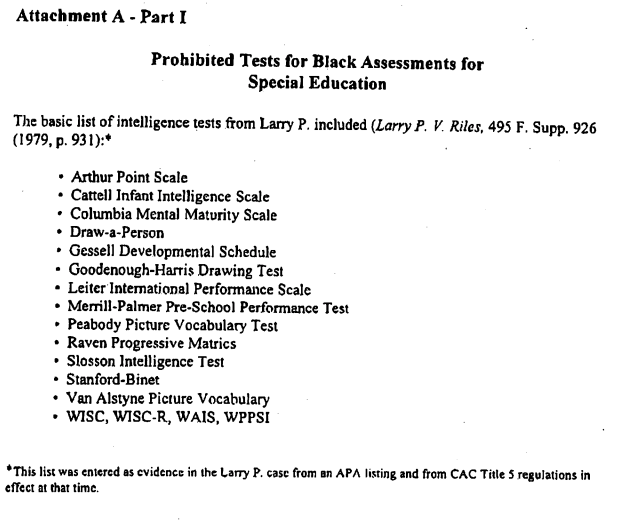
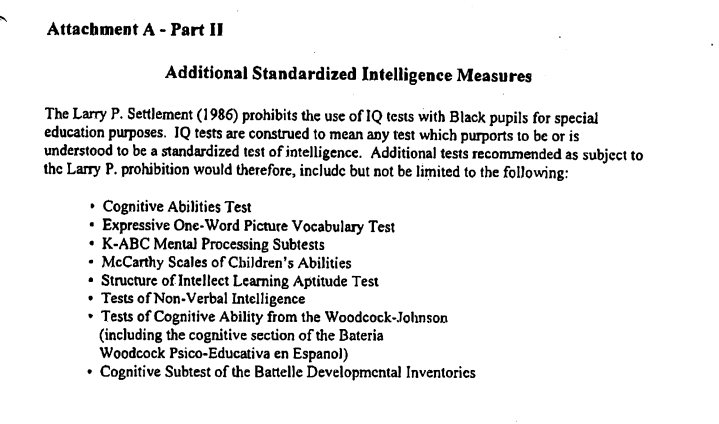
In the state of California, the use of IQ tests is prohibited to assess special education in African-American children.
100
A company asked a psychologist to conduct pre-employment evaluations of potential employees. The psychologist informed each applicant evaluated that she was working for the company, that the company would receive the test results, and that the information would be used in hiring decisions.
3.07 Third party requests for services
100
A previous client asks for a modified copy of her report. She wants to send the evaluation to her university to receive accommodations but asks that you remove her background information section.
Ethical!
4.01 Maintaining Confidentiality
Psychologists have a primary obligation and take reasonable precautions to protect confidential information obtained through or stored in any medium, recognizing that the extent and limits of confidentiality may be regulated by law or established by institutional rules or professional or scientific relationship. (See also Standard 2.05, Delegation of Work to Others .)
4.04 Minimizing Intrusions on Privacy
(a) Psychologists include in written and oral reports and consultations, only information germane to the purpose for which the communication is made.
200
You are assessing a Mexican-American youth who is bilingual in English and Spanish. You give him the English version of the WISC-V. He scores low on the Verbal Comprehension Index. What are your conclusions?
9.02 Use of Assessments
Diana v California State Board of Education (1970) questioned the use of IQ tests on nine Mexican-American students whose primary language was Spanish and later placed in SE classrooms. The plaintiffs argued the students’ low performances were not due to a cognitive deficit, but to their language barrier that made it difficult for them to understand the test questions. The courts agreed and ruled that all school evaluations in California must include nonverbal assessments or assessments in the student's primary language.
200
As an assessment psychologist, you are a die-hard Rorschach fan. So much so that you found and bought a cool Rorschach inkblot shirt on amazon that reads, “what do you see here?”. But upon further investigation, you realize the inkblot is precisely the same as one of the actual cards.
What is the possible standard violation?
9.11 Maintaining Test Security
The term test materials refers to manuals, instruments, protocols, and test questions or stimuli and does not include test data as defined in Standard 9.04, Release of Test Data. Psychologists make reasonable efforts to maintain the integrity and security of test materials and other assessment techniques consistent with law and contractual obligations, and in a manner that permits adherence to this Ethics Code.
200
Testa Battery, Ph.D., was hired to consult with the Central City Fire Department. She put together a series of tests, including the MMPI, Rorschach inkblots, Thematic Apperception Test, Draw-a-Person, and a sentence completion series (i.e., all personality assessment tools) for administration to potential firefighters along with the standard civil service examination. Several of the firefighters protested that such tests constituted an invasion of their privacy.
Unethical
Requests that job applicants reveal personal information that is not clearly relevant to the job in question constitutes an invasion of privacy (Lefkowitz, 2003; Lowman, 2006). Unless Dr. Battery has some basis for documenting the validity of the personality assessment techniques as firefighter selection tools, she appears to have committed an ethics violation.
300
DAILY DOUBLE!
Discussion point: How does the ban on IQ tests in the school setting help African American students? Are there any negatives to the ban on IQ tests?
Great Discussion!
300
A child you are testing becomes highly distressed with the Wisconsin Card Sorting Task and throws the cards off the table. Your supervisor tells you that you need that data for the report and tells you to continue with the administration of the WCST even though they are crying. You disagree with the continuation of administering the test.
Principle A: Beneficence and Nonmaleficence
300
While delivering the Block Design instructions to a 12-year-old child, he enthusiastically finishes your sentence by saying, "...and on some sides, they are red and white." He then tells you that he loved doing this test a few months ago. You proceed to administer the WISC-V anyway.
Unethical!
9.02 Use of Assessments
(a) Psychologists administer, adapt, score, interpret, or use assessment techniques, interviews, tests, or instruments in a manner and for purposes that are appropriate in light of the research on or evidence of the usefulness and proper application of the techniques.
400
True or False?
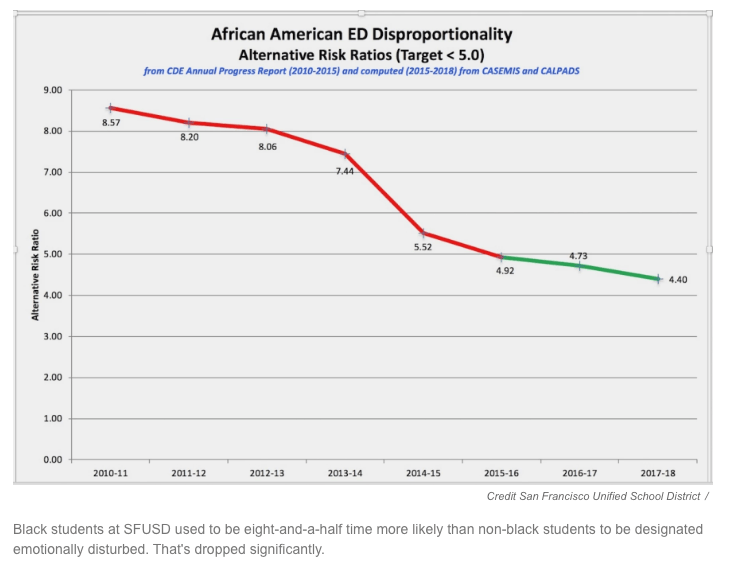
Emotional Disturbance, a qualifying disability for Individualized Educational Programs (IEPs), is disproportionally given to African-American students is the state of California.
400
A referring therapist in your organization wants you to evaluate her client for psychosis. When reviewing the potential client's charts, you see a clear indication of delusions, hallucinations, and paranoia described by the psychiatrist, therapist, and client. You decline the therapist's referral.
9.01 Bases for Assessment
(c) When psychologists conduct a record review or provide consultation or supervision and an individual examination is not warranted or necessary for the opinion, psychologists explain this and the sources of information on which they based their conclusions and recommendations.
400
A psychologist wants to assess whether there has been deterioration in a client’s condition and elects to use the same measure as used in prior assessments, such as the Wechsler Adult Intelligence Scales-III, even if a newer improved version such as the WAIS-IV is now available.
Ethical!
A psychologist may reasonably use an older version of a standardized instrument, but he or she must have an appropriate and valid rationale to justify the practice.