Motivation at Work
Small Talk
Urban Planning
Relationships
Advanced Vocabulary
100
What is the difference between a “reward” and an “incentive”?
A reward is given after good performance; an incentive is designed to encourage good performance before it happens.
100
Give two safe small-talk topics for colleagues at work.
Weather, weekend plans, travel, hobbies., etc.
100
What does “run-down” mean when describing a neighborhood?
Old, damaged, neglected, in bad condition.
100
What is the difference between a snob and someone who simply has high standards?
A snob looks down on others and feels superior; a person with high standards expects quality but doesn’t think they’re better than others.
100
Give two adverbs that mean 100% (complete).
Totally, completely, utterly, absolutely, entirely, wholly.
200
Name two examples of non-cash incentive schemes.
Travel vouchers, merchandise, training grants, team retreats, flexible hours., etc.
200
What is a “conversation stopper”?
A comment that kills the flow of small talk (e.g., complaining too much, overly personal topics).
200
Name two causes of high crime rates in a city.
E.g.: poverty, inequality, lack of education, unemployment.
200
What’s the difference between laid-back and slacker?
Laid-back means relaxed and calm. A slacker avoids work regularly and intentionally.
200
What does “you might as well walk” mean?
Traffic is so slow that walking is just as fast.
300
Why might cash rewards be less effective than non-cash rewards?
People often spend cash on bills and forget it; non-cash rewards feel more memorable and motivating.
300
Define “work spouse.”
A colleague you are very close to emotionally and rely on at work — but it’s a platonic relationship.
300
What is “defensive design”?
Designing public spaces to prevent crime or unwanted behavior (anti-homeless spikes, benches you can’t sleep on).
300
Give one advantage and one disadvantage of dating apps.
E.g.: + Easy to meet people.
– People can be superficial or ghost easily.
300
Define “mugging.”
Attacking someone in public to steal their belongings.
400
What is “company loyalty,” and how can incentive schemes foster it?
Company loyalty = employees’ long-term dedication; incentives show appreciation and increase engagement.
400
Give two examples (phrases) of “exit strategies” to politely leave a conversation.
“I won’t keep you, I know you’re busy,” or “I need to check my email before the meeting.” etc.
400
What does “loitering” mean?
Standing/waiting somewhere with no obvious purpose, often suspiciously.
400
What’s the difference between being incompetent and simply “inexperienced”?
Incompetent means you cannot do something well even with experience. Inexperienced means you’re still learning.
400
Make a sentence using BOTH an exaggeration adverb AND a city vocabulary word.
“The traffic has become dramatically worse — cars just crawl along the road.”
500
Explain the phrase: “Non-cash rewards have a higher perceived value.”
People view experiences (trips, gifts) as more meaningful and memorable than cash.
500
What cultural factors can make small talk difficult in international teams?
Differences in formality, taboo topics, communication style (indirect vs. direct), humor.
500
Give one effective solution for homelessness and explain why it works.
E.g.: “Housing First” programs — because stable housing provides safety, dignity, and supports recovery and employment.
500
Describe the chart below and draw a conclusion based on the data you see.
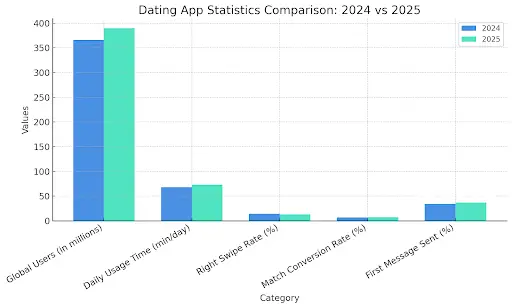
- Global usage is climbing steadily.
- Users are spending more time on dating apps.
- Swipes may be slightly down, but matches and message rates are up.
- Behavioral shifts suggest people are becoming more intentional with their app use.
500
Which trait is more positive, principled or stubborn, and why?
Principled — because decisions come from ethics, not ego.