Asymptote Avenue
may the FUNCTIONS be with you
You spin me right round (like a Unit circle, baby)
Slope around and find out (ROC)
New function, who dis? (transformations)
100
Find the vertical asymptote(s) of the rational function:
f(x)=5/(x-3)
x=3
(Remember vertical asymptotes occur where the denominator is zero)
100
If
f(x) = 3x^2 - 5x + 2
, what is the value of f(-2)?
f(-2) = 24
(Remember Use Parentheses for Negative Inputs)
100
What are the exact (x, y) coordinates for an angle of
\frac{\pi}{3}
radians on the unit circle?
(\frac{1}{2}, \frac{\sqrt{3}}{2})
100
Find the average rate of change of
f(x) =\sqrt(3x+4)
on the interval [-1, 4].
hint:
(Y2-Y1)/(X2-X1)
= 3/5
(Don't over think for this!!!)
100
Identify the parent function. Then describe the transformations that produce the graph of f .
f(x) = ∣x + 7∣
y = ∣x∣ , horizontal shift left 7
200
If the denominator has a higher
f(x)= 2/(x^2+1)
degree than the numerator, like, the horizontal asymptote is always this line.
What is y = 0?
200
A table of values for a function f is given below. If f(x) = a log (x) + b find the values of and . 4 a b.
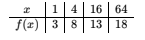
a = 5
b = 3
200
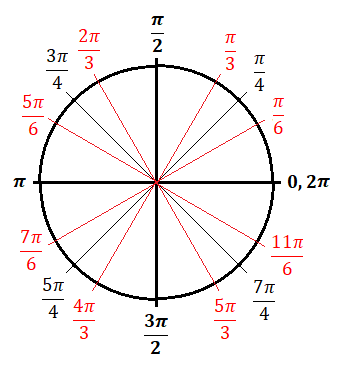
Using the unit Circle, find the value of sin 7π / 6.
-1/2
200
Find the average rate of change of g on the interval [0,2].
= 2
200
Which of the following equations could represent the graph shown?
A) y = ∣x − 1∣ − 2
B) y = ∣x + 1∣ − 3
C) y = −∣x + 1∣ + 3
D) y = ∣ − x∣ + 3
B
300
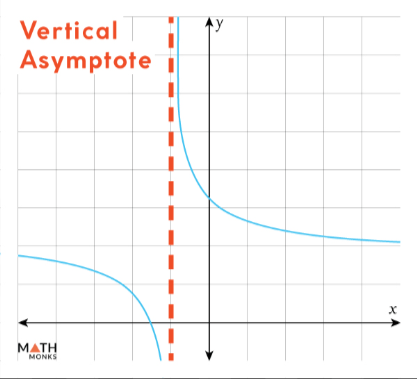
If the graph of a function shoots up to infinity as it gets closer and closer to
x=3
, the line
x=3
is this type of asymptote.
What is a vertical asymptote?
300
An exponential function
f(x) = a \cdot b^x
passes through (0, 4) and (1, 12). What is the base, b, of this function?
3 (The function is f(x) = 4 \cdot 3^x)
300
What is the reference angle, in radians, for
\theta = \frac{7\pi}{4}?
\frac{\pi}{4}
300
Jackie drove miles from her house in Grand Rapids, Michigan to her friend’s house in Ann
Arbor, Michigan. She left her house at 9:25 AM and arrived at 11:15 AM.
What was Jackie’s average speed, in miles per hour? Round to the nearest hundredth.
= 66.55 miles per hour
300
If you take the graph of
y = x^2
and shift it down 4 units, what is the new equation?
y = x^2 - 4
400
If a rational function has a horizontal asymptote at y = -2, this mathematical statement describes its behavior as x decreases without bound.
What is
lim_{x \to -\infty} f(x) = -2
400
Identify all vertical asymptotes, horizontal asymptotes, and holes for the rational function:
h(x) = \frac{2x^2 - 8}{x^2 - x - 6)
- Hole: At x = 2
Vertical Asymptote: x = 3
Horizontal Asymptote: y = 2
(Always Factor First: Before you try to identify asymptotes or end behavior, completely factor both the numerator and denominator.)
400
Solve this:
(1-cos^2x)/sinx
= sin x
400
The total number of hot dogs sold at the concession stand at a football game can be modeled
by the function , where is the total number of hot dogs sold hours after the game
begins. Selected values of are given in the table.
At what rate, on average, are hot dogs sold between?
= 23.14 hot dogs per hour
400
f you take the graph of
y = x^2
and multiply the outside by 3, what is the new equation and how does the shape change?
y = 3x^2
- Effect: This is a vertical stretch. The graph becomes narrower/steeper because all the height values (y-values) are tripled.
500
Consider the behavior of
R(x) = \frac{4x^2 - 1}{2x^2 + 5x - 3} as x \to \infty
and
x \to -\frac{3}{2}
What limits describe its asymptotic behavior?

(The degrees are equal, giving the horizontal limit of 2, and x=-3 leaves a non zero numerator over a zero denominator establishing a vertical asymptote).
500
The population of a Midwestern city is roughly 567,000 people at the start of 2009. Each year the population increases by approximately 6.7% of the previous year's population. Write a function that gives the number of years after 2009, Y (p), until this city reaches a population of p people.
Y(p) = \log_{1.067}\frac{p}{567,000}
500
Solve this:
tan^2-tan^2xsin^2x
=
sin^2x
500
Is the rate of change of f increasing or decreasing at
x = −1?
The rate of change of f is decreasing at x = -1.
500
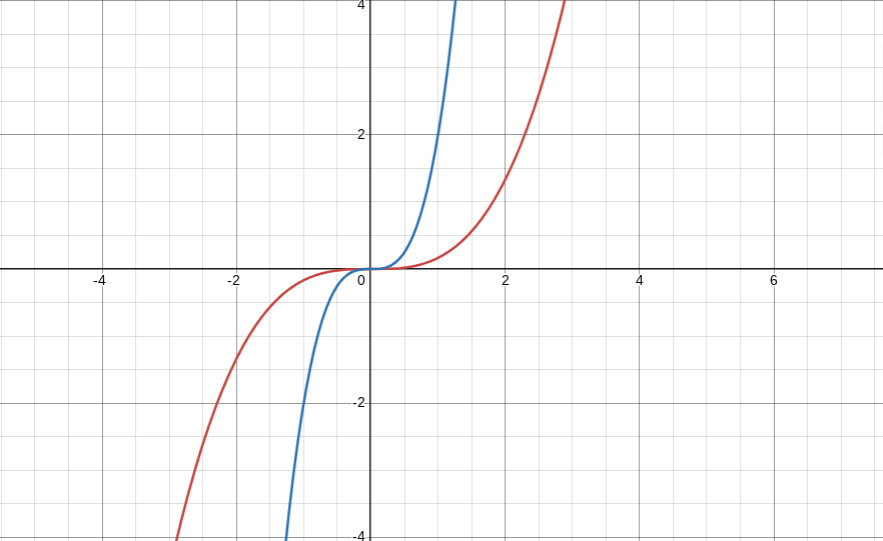
Find the equation for the blue line?
y=2x^{3}