Shelter/Survival Skills
Become a Naturalist
Animals of the Forest
Flora
Navigation
100
Name three examples of edible plants found in Wesselman Woods.
What is mock strawberries, wild onions, dandelions, blackberries, wood sorrel, spice bush, walnuts, paw paw?
100
Herbivore scat is typically described as this shape.
What are round pellets?
100
This bird is the largest species of woodpecker in Indiana.
What is the Pileated woodpecker?
100
This is the name for the winged fruit of maple trees that spins like a helicopter when it falls.
What is a samara?
100
This cardinal direction is found to the left on most maps and is where the sun sets.
What is west?
200
Name a toxic/inedible plant found at Wesselman Woods.
What is pokeweed?
200
RANDOM JEOPARDY: Wesselman Woods is this type of forest.
What is old-growth?
200
Many birds of prey swallow their meals whole, but since they can't digest certain parts like bones and fur, they expel these indigestible remains in this compact form.
What is a pellet?
200
This is the process by which plants make their own food using sunlight.
What is photosynthesis?
200
These posts placed along hiking paths help guide hikers and mark the correct trail.
What is a trail marker or wayfinding sign?
300
A shelter should protect you from these five things.
What is sun, wind, rain, animals, and plants?
300
BONUS JEOPARDY (extra 100 points):
 This animal left these tracks.
What is an opossum?
300
This snake's birthing process is out of the ordinary for reptiles. Instead of laying eggs they give live births.
What is a garter snake?
300
 The leaf pictured comes from this tree.
What is a Tulip?
300
Name three reasons why it is important to stay on a trail.
What is protecting plants and wildlife, preventing erosion, avoiding getting lost, and staying safe from hazards?
400
Bears go through hibernation or a deep, uninterrupted sleep during the winter; whereas reptiles and amphibians, will go through this process defined as a state of lowered activity and metabolism.
What is brumation?
400
These are the three pillars of being a naturalist.
What is observe, document, and respect?
400
This animal is a selective eater, often avoiding certain plants like paw paw, spice bush, and garlic mustard. Instead they eat oak, sweetgum, and maple saplings. Overpopulation of this animal in a forest can lead to the destruction of its ecological health.
What are deer?
400
This word describes leaf arrangements that are appear singly and switch sides as you move up the branch. This creates a distinct zig-zig or staggered pattern.
What is alternate?
400
BONUS JEOPARDY (extra 100 points): You can go east and west on this urban feature which is south of Wesselman Woods.
What is the Lloyd?
500
This is the first, highly combustible material used to catch a spark and start a fire, burning quickly so it can ignite kindling.
What is tinder?
500
This is the term for a person who studies woody plants that make up a forest (for example, oak, pine, and willow).
What is a dendrologist?
500
Turtles have an upper part of their shell, called the carapace, and a lower part called _________.
What is a plastron?
500
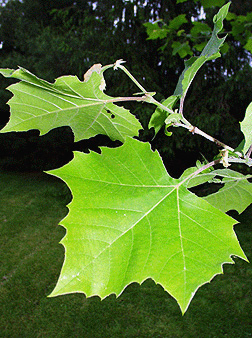
The pictured leaf belongs to this tree which is also known for its peeling white bark.
What is a sycamore?
500
BONUS Jeopardy (extra 100 points): This star, also known as Polaris, has long been used for navigation because it appears to stay fixed in the northern sky.
What is the north star?