Sensory Components of ML&C & Learning vs Performance
Memory & Transfer of Learning
Practice Design & Schedule
(CI & VOP)
(CI & VOP)
Modeling &
Augmented
Feedback
Augmented
Feedback
Distribution of Practice
& Part-Whole Practice
& Part-Whole Practice
100
Is the following example a retention or transfer test?
"Acquisition" - Learning to deadlift in the gym
"Test" - Helping a friend move
Transfer
100
Give the capacity for short term and long term memory:
Short term/working memory: 5-9 bits or items
Long term memory: unlimited
100
Your baseball coach is having everyone practice hitting against 3 different kinds of pitches. The coach told the pitchers to throw any and all kinds in random order.
Contextual Interference
100
To ensure quality coordination patterns are developed, an expert performer is important to model motor skills for learners, however, observing other novice performers learn how to perform the skill is beneficial to learning as well. How/why?
Encourages more active problem solving (information processing) for developing strategies to achieve the movement goal.
*As opposed to just trying to reproduce the movements demonstrated by an expert performer
100
At what point during practice is there the highest level of problem solving?
At the beginning, of a NEW session.
150
What are 2 of the 3 most important types of sensory feedback for motor learning and control?
Visual
Tactile
Proprioceptive
150
What can happen when learning a new skill where the context characteristics are similar, but the movement characteristics are different?
Negative transfer or Interference
150
Interpret the graph below for the following info:
a. What concept was being researched here?
b. Which group did best during acquisition?
c. Which group did best during transfer?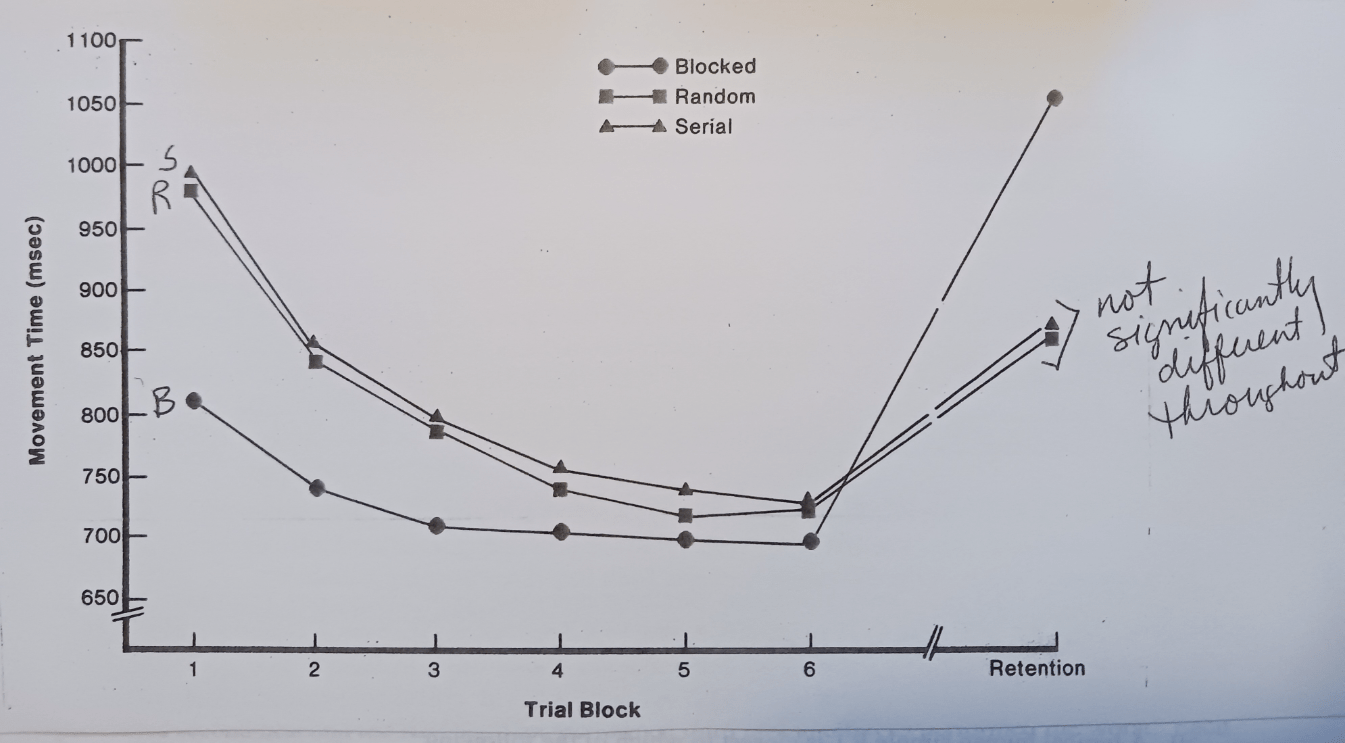
a. Contextual Interference
b. Blocked
c. Random and Serial (were not significantly different)
150
Many studies have been conducted examining the frequency of modeling and/or other feedback during practice. Almost all typically compare "every trial," "every 5 trials," and then 1+ more with larger trial blocks between feedback/modeling.
What is usually superior? What do the findings suggest instructors/coaches should do then during practice sessions?
Let the learners practice a few trials before giving feedback/demonstrating again. Give them time to process their movements and the outcomes before trying to guide their attention.
150
What concept says when practice sessions become monotonous, the lower problem-solving activity results in lower learning levels?
Cognitive Effort Hypothesis
200
What factors (3) affect performance (as opposed to our learning level?)
Physiological (e.g. tired, fatigue, etc.)
Psychological (e.g. anxiety, overconfidence, etc.)
Insensitive scoring (e.g. plateaus don't mean you're not making progress in some way)
200
The following are examples of what?
a. learning your numbers, then basic math skills, then algebra, geometry, calculus and so on
b. learning to read music, then learning guitar scales, then chords, then playing songs
c. learning how to write with your dominant hand, then how to write with your non-dominant hand
d. doing gymnastics when little, developing body awareness, balance, and muscular fitness to then go on and be good at any sport you choose to train
positive transfer of learning
200
What explanation for CI states the effect is due to developing more detailed memory representations of the skill variations, enabling identification of the differences to respond appropriately?
Elaboration/Distinction explanation
200
When a coach is able to give a cue that effectively draws your attention to an aspect of performance that allows you to response appropriately, this is which of Kahneman's 4 factors?
Momentary Intentions
200
Does nascar racing have high or low complexity and organization?
Should it be practiced in parts or as a whole?
High Complexity
Low Organization
Parts
250
Holding something (e.g. a full cup), as in maintaining constant grip and hand/finger/arm positioning is using a. what kind of feedback loop using b. what kind of sensory information?
a. closed feedback loop
b. tactile
250
In movies and shows where someone can't remember an event, the investigators often take them "back to where it happened." What principle supports this idea?
Encoding Specificity Principle
*Specifics about the context in which you learned something is encoded with the skill, so when context cues are present, retention and recall are better
250
What concept is the following example utilizing?
Designing practice sessions with the intent of improving someone's motor response schema by setting as many different parameters for the skill.
Variability of Practice
250
During a driving instruction session, KT forgot her glasses, and by the time it was her turn the sun had set. Driving down the grade, her vision blurry and distorted by the darkness of night, she focused on the illuminated tail lights of the cars in front of her to guide her on the road.
This is an example of a ___________________ feedback setting in which she used the visual ________________ feedback provided by the "required by law" illuminated head & tail lights after sunset.
Low intrinsic (feedback setting)
Augmented
250
Does performing an intricate high level dive from a diving board have high or low complexity and organization?
Should it be practiced in its parts or as a whole?
Low complexity
High Organization
Whole practice
*Some types of "simplification part practice" can be used when learning
300
What is the more common term for
"perception-action coupling" - the spatial & temporal coordination of vision & movement of hands or feet ?
hand-eye-coordination
or
foot-eye-coordination
300
Which long term memory store is the following example?
Through experience, knowing to first pre-heat the oven, then mix the wet ingredients and the dry ingredients separately, then mix them together. Then by the time the oven is ready, the mixture is ready to be placed in the preheated oven.
Procedural
*Required overt physical responses to learn
300
Using scrimmages, practice meets, and "in-house competitions" is an effective form of practice, utilizing what concept?
Transfer appropriate processing
300
Jackson is getting irritated with his football coach because his feedback never helps him improve. He repeats the same things like "keep your back straight" and "push harder." Thankfully his dad encouraged him to join him during his training sessions with an actual weightlifting coach. Her comments were to "brace your abs as if someone is punching them" to maintain core stiffness during squats and to "act like your breaking the bar" to activate the muscles of the arms more during bench press.
What is the difference between Jackson's coach's feedback and his dad's weightlifting coach's? (Type of feedback)
Descriptive vs Prescriptive feedback
300
What type of part practice is being used here?
Instead of barbell front squats, doing goblet squats
How so? Explain how it fits that type of part practice.
Simplification
Due to: lighter weight, easier to handle/control the weight (equipment), less complicated set up and completion steps
Simplification methods that fit this example: lower attention demands, object manipulation, sequencing skill progressions
350
According to the definition of "motor learning," how do we know when learning has actually occurred? (hint: 4 things)
It is inferred by performance,
a change (improvement) in the motor pattern has to have occurred,
the improvement must be fairly permanent,
and be the result of physical practice.
350
Why does making acronyms to memorize info (e.g. AMEE for Kahneman's 4 factors for attention allocation) or putting it to songs make it easier to retain?
creating a memory trace, making it easier to recall
350
What type of practice with regards to massed vs distributed and blocked vs random/serial is being described in the following examples?
a. Lucy has the most trouble passing the soccer ball to her right while running down the field so her coach paired her up with a team mate to go practice just that for 15 minutes straight, over and over again.
b. Gary just started swimming lessons. The whole lesson was just free-style (front crawl).
a & b both: Massed, blocked practice
"a" is a situation of needing to iron out a kink or get reps in to solidify a coordination pattern.
"b" is a situation of gaining a new motor pattern.
350
Interpret this graph and make a general, but comprehensive conclusion based on the results.
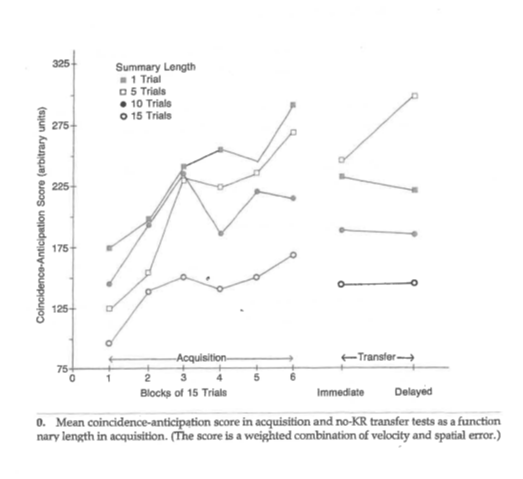
Feedback too frequently is bad (i.e. guidance hypothesis) but so is infrequent feedback.
People need time to process their own sensory feedback and movement outcome, between feedback.
350
What type of part practice is being describes here, for an Olympic Barbell Clean:
1. learning the "Lift-off" - lifting the barbell off the ground to the knees
2. learning the "first pull" - lifting the barbel off the ground, past the knees to the "hip/power position"
3. learning the "second pull" or "high pull" - projecting the barbell from "hip position" up using the powerful hip extension and the arms to pull the par up towards the shoulders
4. learning "the catch" - performing the "high pull" and then rolling the elbows down and under the bar to catch it on your fingers and anterior deltoids
5. learning to put steps 1,2,3 and 4 together - an Olympic Clean
Segmentation
also called "progressive part practice"