Matter
Kinetic Theory
Vocabulary
Temperature Scales
Temperature Conversions (45 seconds to answer)
100
In this state of matter, the particles are packed closely together.
Solid
100
All ________ is composed of tiny particles.
matter
100
The temperature required to change a substance from solid to liquid
melting point
100
The temperature scale which scientists use
Celsius or Kelvin
100
Convert 0 °C to Kelvin.
273 K
200
In what state do molecules move extremely quickly and by bouncing off each other
Gas
200
The amount of _________ that the particles lose from these collisions is negligible.
energy
200
Energy that can be transferred between objects.
Heat
200
The temperature scale that the Imperial system use
Farenheit

200
Convert 100 °C to Kelvin.
373 Kelvin
300
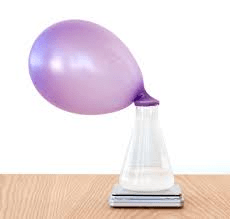 What caused the balloon to expand ?
Increased Temperature
300
Particles are in _________, random motion.
constant
300
process of a solid changing directly to a gas.
sublimation
300
This temperature scale is used by scientists and is based on absolute zero.
Kelvin
300
Convert 68 °F to Celsius.
What is 20 °C?
400
Another name for the states of matter
phases of matter
400
Particles _________ with each other and with the walls of any ___________ in which they are held.
collide/container
400
Average kinetic energy of the particles that make up a substance.
Temperature
400
Water boils at this temperature on the Celsius scale.
100 Celcius
400
Convert 25 °C to Fahrenheit.
What is 77 °F?
500
This is the term used for the total energy inside of a solid, liquid or gas.
Thermal energy
500
Used to measure the amount of kinetic energy in a substance.
Thermometer
500
The temperature required for the liquid to become a gas.
Boiling point
500
If the temperature outside is 32 °F, water would most likely be in this state.
Solid Ice
500
32 °F to Celsius
0 degrees C