Relative Pronouns
Passive Voice
Compound Verbs
Vocabulary
Culture/History
100
What are relative pronouns? Give an example sentence in English.
Relative pronouns provide more info about a noun in the sentence. Example: That is the man WHO lives next door.
100
What is the difference between Active and Passive Voice?
Active Voice: Subject ACTIVELY does the action (the boy HITS his brother)
Passive Voice: Subject PASSIVELY has the action done TO them (the boy IS HIT by his brother)
100
Define two of these prefixes: ab-, ad-, circum-, ex-, re-, sub-
ab = away, from
ad = to, toward
circum = around
ex = out, out of
re = back, again
sub = under
100
Give three Latin words related to Chariot Racing.
Examples: ludi circenses, mappa, equus, raedarius, quadrigae, spina, metae, curriculum, favere, factiones, Albati, Prasini, Veneti, Russati
100
During which period did Roman women have the most elaborate hairstyles? Briefly describe what they looked like.
Roman Empire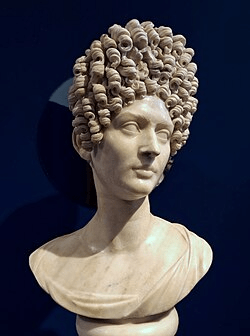
200
In Latin, a relative pronoun must agree with the ____ and _____ of its ______.
gender and number of its antecedent
200
What are the Passive Voice endings in Latin?
-r -mur
-ris -mini
-tur -ntur
200
Define three of these prefixes: con-, de-, inter-, per-, prae-, trans-
con = along with, together, (or just for emphasis)
de= down, down from
inter = between
per = through
prae = in front, ahead
trans = across
200
Give three Latin words related to fire.
examples: fumus, flamma, incendium, ignis, vigiles
200
Who were the vigiles? Give 2 facts about them.
They were a night watch that was part police squad, part fire fighting brigade.
They used buckets of water to help put out fires and sometimes had to break down buildings to create a fire break.
They were established by Emperor Augustus.
300
In Latin, what determines the case of a relative pronoun?
its function in the relative clause
300
Translate into English: portatur, portabatur, portabitur
portatur = (s)he is being carried / is carried
portabatur = (s)he was being carried / was carried
portabitur = (s)he will be carried
300
Define the following verbs: trahere, extrahere
trahere = to drag
extrahere = to drag out
300
Give three Latin words related to the marketplace and shopping.
Examples: taberna, emere, mercator, forum, vendere
300
When was the Great Fire of Rome? Tell me the year AND who was emperor.
64 CE
Emperor Nero
400
Give the missing relative pronouns (singular):
Nominative: _______ quae _______
Genitive: _______ (all the same)
Dative: _______ (all the same)
Accusative: quem _______ _______
Ablative: _______ _______ quo
Nominative: QUI quae QUOD
Genitive: CUIUS (all the same)
Dative: CUI (all the same)
Accusative: quem QUAM QUOD
Ablative: QUO QUĀ quo
400
Translate servabimur and identify the tense, person, and number.
we will be saved
future tense, 1st person plural
400
Define the following verbs: ducere, reducere, traducere
ducere = to lead
reducere = to lead back
traducere = to lead across
400
Define three of the following word: libertus, mendicus, porcus, sella, paries, incola
libertus = freedman
mendicus = beggar
porcus = pig
sella = chair
paries = wall (of a building)
incola = inhabitant
400
Describe a typical chariot race.
Approximately 12 drivers per race, each with (usually) a 4-horse chariot. They raced counter clockwise around the track, completing 7 laps. The official in charge of the races would drop a white cloth (mappa) to signify the start of the race.
500
Give the missing relative pronouns (plural):
Nominative: _______ quae _______
Genitive: _______ quarum _______
Dative: _______ (all the same)
Accusative: quos _______ _______
Ablative: _______ (all the same)
Nominative: QUI quae QUAE
Genitive: QUORUM quarum QUORUM
Dative: QUIBUS (all the same)
Accusative: quos QUAS QUAE
Ablative: QUIBUS (all the same)
500
Translate into Latin: you are seen, you were seen, you will be seen
videris OR videmini
videbaris OR videbamini
videberis OR videbimini
500
In Latin, how would you say: to go, to go back, to enter, to exit
ire, redire, inire, exire
500
Define these relative pronouns: quarum, cui, quibuscum, qui, quae, quod
quarum = whose
cui = to/for whom
quibuscum = with whom
qui = who
quae = who/which
quod = which
500
What were the four main chariot teams? List them in Latin!
Reds (Russati), Greens (Prasani), Blues (Veneti), and Whites (Albati)