Eukaryotic Cell Cycle
Depth of Cell phases
More of Mitosis
Cell Cycle regulation
Cyclin/CDKs and Target protein degradtion
100
What does the cell cycle comprise of(what happens)? How does the cell cycle work in Multicellular organisms?
50 pt bonus: Name 3 physiology facets from cell cycle regulation.
The cell cycle is over cell growth and division, and is tightly controlled. In multicellular organisms- most of the cells DON'T divide, but for the ones that do- the frequency is varies greatly.
Physiology facets from cell cycle regulation include: Nutritional status, metabolic status, DNA damage, pathogenesis, Senescence, Wound response, and developmental stage.
100
1. What are the two overarching things that occur in M phase?
2. Define each of these events.
1.M phase= Mitosis and Cytokinesis.
2a.) Mitosis: nuclear division- duplicated chromosomes are separated into two daughter cells.
2b.) Cytokinesis: cytoplasm division and cell separation.
- Cytokinesis in animals- the cytoplasm is divided and two daughter cells form. A ring of actin and myosin filaments contracts inside the cell membrane, causing it to pinch inward in a cleavage furrow.
Cytokinesis in plants differs with Vesicles being transported to the middle of the dividing cell along microtubules. These vesicles fuse to form a cell plate.
100
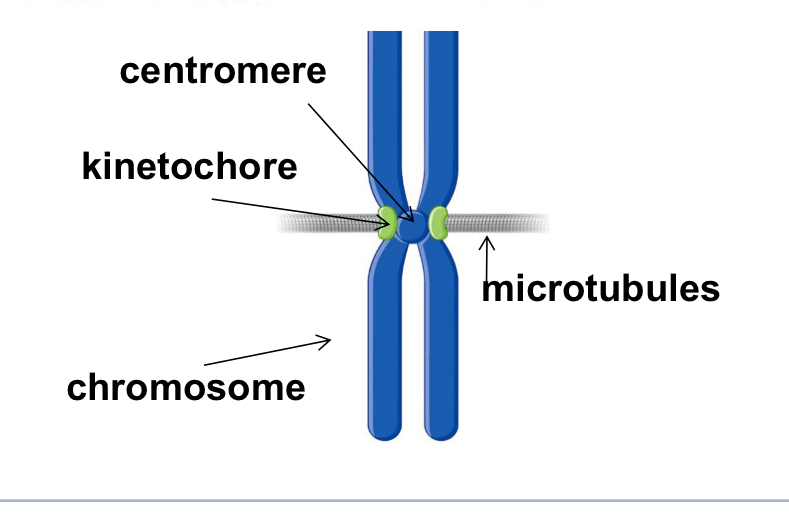
What happens during prometaphase?
During prometaphase, the nuclear envelope breaks down and Microtubules contact to chromosomes at kinetochores.
100
How many major checkpoints are there for the cell cycle? What are they(where are they located)?
5pt. bonus: where is there not a checkpoint?
There are three major checkpoints: Metaphase(M phase), G1, and G2.
There is not a checkpoint between S and G2.
100
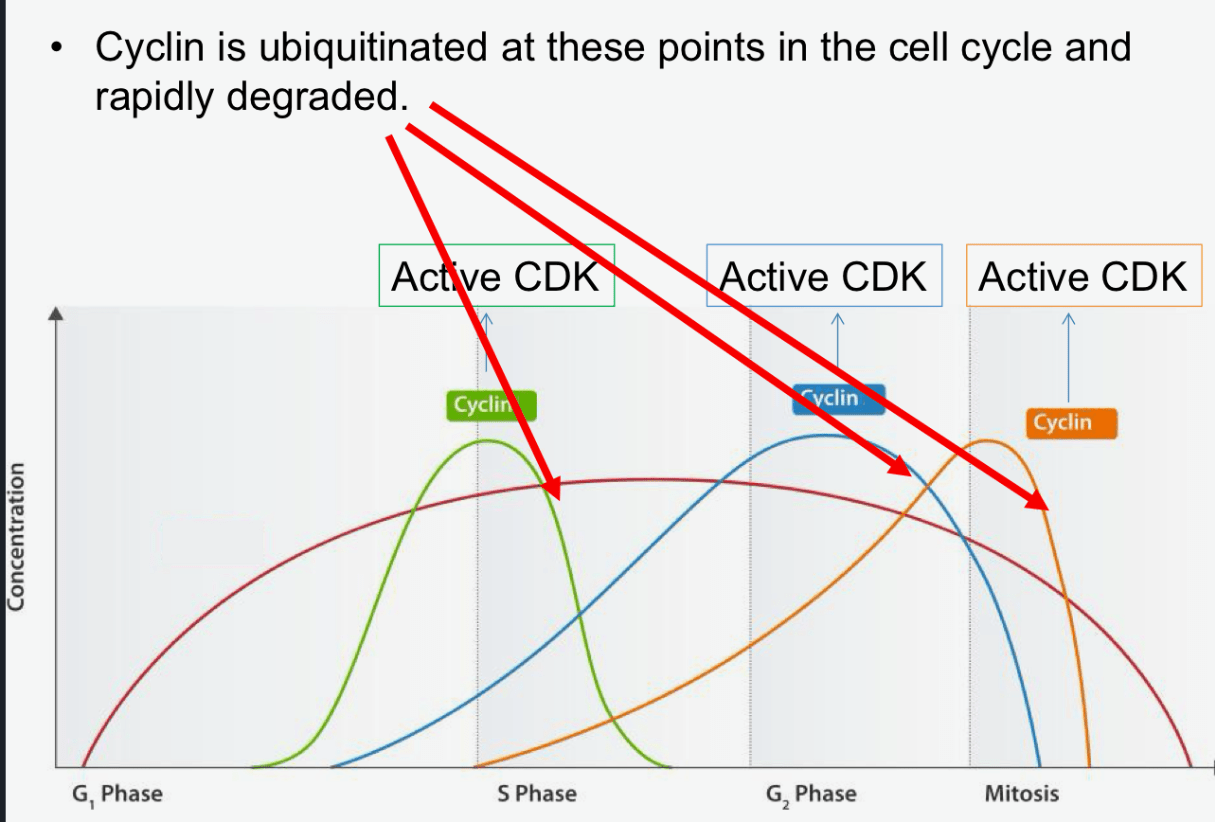
What are cyclins? What do they do?
Do cyclin levels fluctuate or not?
Cyclins are a family of proteins that bind to cyclin-dependent kinases activating them to control progression through the cell cycle and cell division.
Cyclin levels fluctuate in the cell as a key feature of cell cycle control of cyclin accumulation.
Cyclins must accumulate separately for each checkpoint.
200
What are the 4 stages of the cell cycle; in order?
What stages make up interphase?
The 4 stages of the cell cycle are M phase, G1 phase, S phase, and G2 phase.
The stages that make up interphase are G1, S, and G2.
200
What are the 5 phases that comprise of Mitosis; in order?
Prophase, prometaphase, metaphase, anaphase, and telophase.
200
What happens during metaphase?
During metaphase, the chromosomes line up in the middle of the cell.(They are pushed/pulled there by the microtubule motor proteins).
200
What happens to bases?
Bases can be chemically damaged and repaired by excision repair.
200
What do CDKs do? Do CDK levels fluctuate in the cell?
Cyclin-dependent kinases(CDKs) are activated by cyclins and then phosphorylate target proteins involved in promoting cell division. CDK enzymatic activity is tightly controlled by many regulators- one of them being cyclins.
CDK levels are constant in the cell.
300
Define Centrosome.
Centrosomes are organelles that are essential for microtubule formation and cell division.
300
What is happening in G1, S, and G2 phase?
During G1 organelles are replicated and cells grow in size. Nutrients and building blocks accumulate for DNA replication to happen. (Growth and preparation for DNA synthesis).
During centrosomes are duplicated during S phase. (DNA replication)
During G2 more organelle biosynthesis and growth occurs and there is preparation for mitosis. Chromosomes are replicated, but not condensed(except as heterochromatin for gene regulation).
300
What happens during Anaphase?
During Anaphase, Sister chromatids separate and are pulled to opposite poles of the cell.
300
What would happen if a cell in G1 did not have a G1/S checkpoint?
The DNA replication would not complete(get stuck in replication forks). And daughter cells might be smaller and/or not get specific organelles.
300
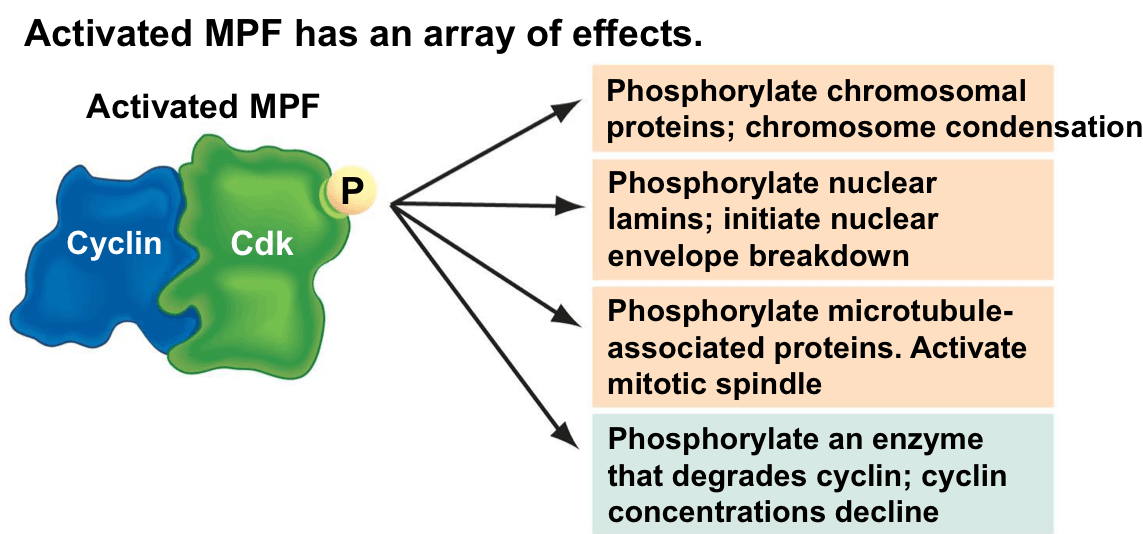
What is MPF and how does it drive mitosis?
Mitosis-promoting factor(MPF) is the cyclin-CDK complex that drives the cell through the G2/M checkpoint and drives the events of mitosis. MPF activity is controlled by cyclin accumulation.
MPF drives mitosis by triggering the events that occur during mitosis through protein phosphorylation.
400
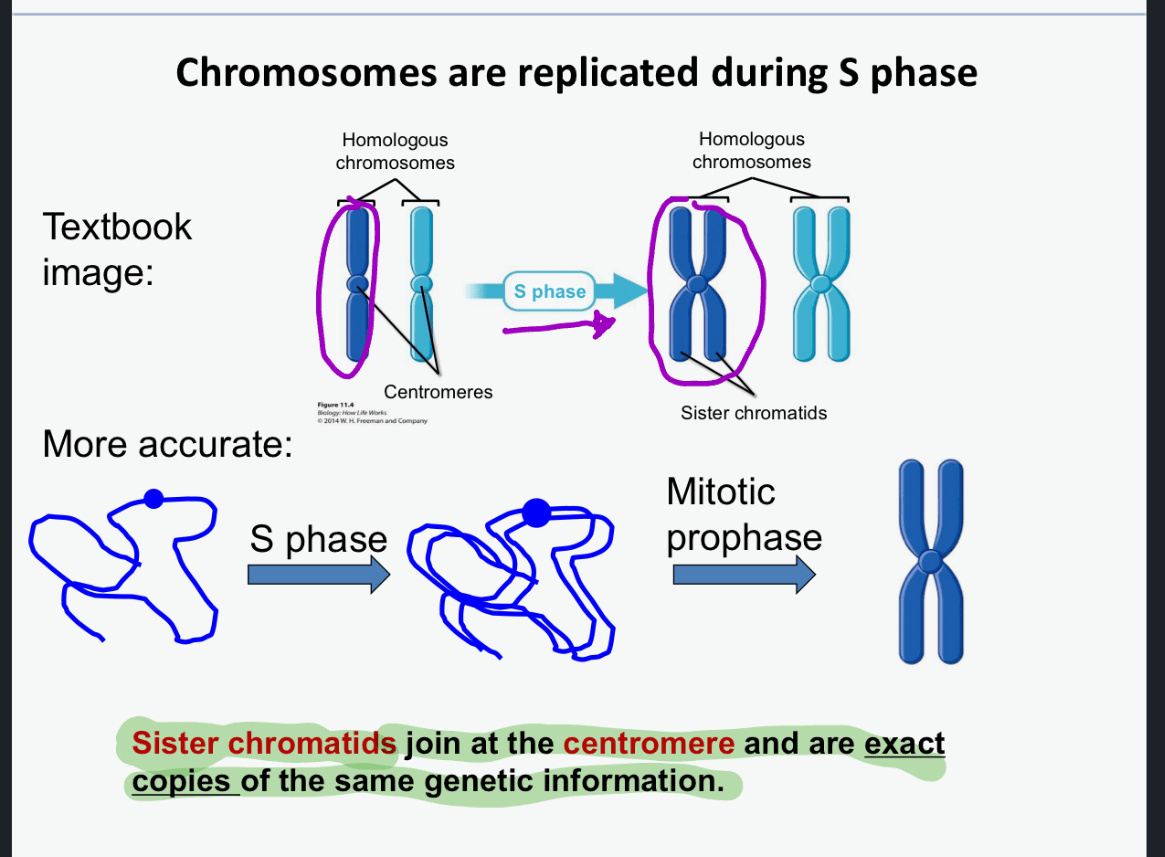
What are sister chromatids and where are they made?
Sister chromatids are composed of two homologous chromosomes that are joined together at the centromere. Sister chromatids are exact copies of the same genetic information.
Chromosomes are replicated during S phase and sister chromatids are formed during Mitotic prophase.
400
What happens during Prophase of Mitosis?
During prophase:
*Chromosomes condense: become thicker and shorter
*Transcription stops
*Spindle Apparatus begins to form
400
What happens during Telophase?
During Telophase, chromosomes de-condense and the nuclear envelope reforms.
400
Which checkpoints check for DNA damage?
The G1->S and G2->M checkpoints check for DNA damage, helping reduce the number of DNA damaging events that get converted to into mutations.
400
Why is cyclin degradation important?
Cyclin degradation is important so that the cell needs to fulfill the next checkpoint criteria before progressing.
500
Describe G0. What type of cells(an example) in the human body would be in the G0 phase? Why would cells be in G0?
G0 is a phase that most human cells are in. G0 is a quiescent stage were the cells are in a permanent state and never divide again. An example if a type of cells that will never divide again, hence be in G0 are neuronal cells.
Some cells might be in G0 rather than G1 because they don't meet the checkpoint criteria to pass on to G1.
500
What do microtubules do during interphase?
What do microtubules do during mitosis?
During interphase, microtubules form a meshwork throughout the cytoplasm, serving as tracks for motor proteins to transport vesicles and organelles.
During mitosis, microtubules form the spindle apparatus to separate chromosomes.(Spindle apparatus is composed of microtubules that extend from the centrosomes).
500
What has to proceed before chromosomal segregation during mitosis?
a). Chromosomal condensation
b.) Nuclear envelope breakdown
c). Centrosome migration to distinct parts of the cell
d). Spindle apparatus formation
e). All of the options are correct.
e). All of the options are correct
500
What needs to happen to pass each checkpoint?
Metaphase checkpoint: all chromosomes are properly attached to spindle apparatus and aligned.
G1: Cell size is adequate, nutrients are sufficient, organelles replicate, growth signals are present, and DNA is undamaged.
G2: chromosomes have replicated successfully and DNA is undamaged.
500
What does the proteasome do? Where is cyclin ubiquitinated in the cell cycle?
The proteasome degrades any ubiquitinated protein.
After the checkpoint criteria has been met for S phase, after the checkpoint criteria has been met for G2, and after the checkpoint criteria has been met for M phase.